The best engineering building sets for bridges turn structural concepts into hands-on challenges. Kids can explore balance, forces, and load distribution while building models they can test, adjust, and rebuild.
We selected 10 kits spanning simple classroom activities, creative construction projects, mechanical wooden models, and detailed architectural builds, so you can match the set to the builder’s age, goals, and experience.
Best 10 Engineering Building Sets for Bridges Picks for 2026
Best All-Round Engineering Set
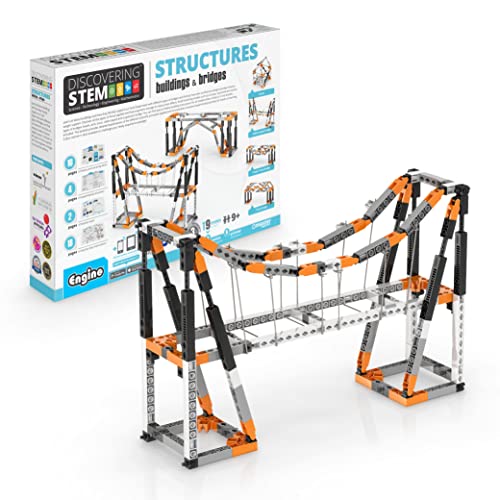
- Builds nine structures and bridge types
- Includes theory, experiments, and a quiz
- Snap-fit parts support 3D construction
Best For: Ages 9+ exploring multiple bridge designs
Best for Younger Builders
Bridge Builders STEM Challenges

- Includes nine bridge and tower challenges
- Suitable for ages 5 to 10
- Builds early problem-solving skills
Best For: Young children beginning hands-on engineering
Best for Structural Engineering Lessons

- Builds 20 structural models
- Covers force, load, tension, and compression
- Includes 285+ pieces and a 36-page manual
Best For: Intermediate learners ages 8 to 14
Best Large-Scale Replica

- Builds a bridge over 40 inches long
- Includes 1,536 rods and connectors
- Step-by-step instructions are included
Best For: Ages 9+ wanting a display-sized bridge model
Best Starter City Builder
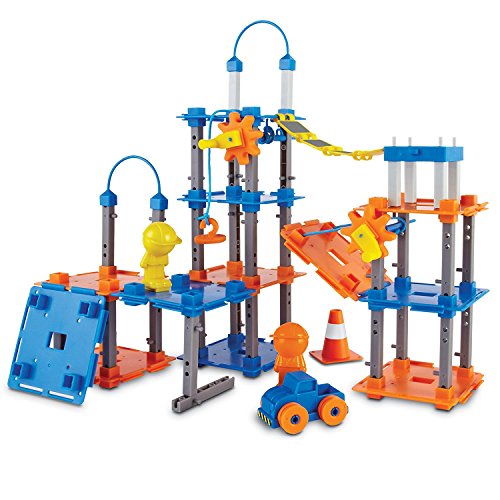
- 89-piece set for ages 5–8
- Activity cards teach the design process
- Build bridges, towers, and city structures
Best For: Young children beginning hands-on STEM exploration
Best Educational Bridge Variety

- 207 pieces for grades 3–5
- Build 13 functioning bridge replicas
- Includes teacher guide and storage tray
Best For: Structured classroom or small-group bridge lessons
Best Historical Model Project

- Build a self-supporting bridge model
- Explores engineering, physics, and history
- Designed for ages 14 and up
Best For: Teens, adults, makers, and history-minded STEM learners
Architectural Design Lab

- Builds 26 models of structures and structural elements
- Includes flexible pieces that mimic steel frames
- Guided by a 44-page full-color manual
Best For: Ages 8+ exploring bridges and architectural structures
Bridge Challenge Workshop

- Provides materials for 10 bridge structures
- Tests designs with a 100-penny challenge
- Encourages teamwork and experimentation
Best For: Classroom and group STEM bridge projects
Moving Mechanics Lab

- Builds a rotating wooden swing bridge
- Uses a hand-powered gear mechanism
- Approximate build time is one hour
Best For: Hands-on learning about movable bridge mechanics
Best All-Round Engineering Set – Discovering STEM Bridges
For families comparing engineering building sets for bridges, this Engino kit offers broad model variety with nine build options, including beam, arch, truss, cable-stayed, and suspension bridges. It combines guided construction with theory, experiments, and a quiz for a more structured STEM activity.
Best For: Curious children ages 9 and up who want to explore several bridge designs and foundational structural-engineering concepts.
Pros:
- Builds nine models, including five different bridge types.
- Includes instructions, theory pages, experiments, and a quiz.
- Snap-fit components support complex three-dimensional models.
- Designed for hands-on engineering and creative thinking.
Cons:
- The set focuses on manual construction and does not include electronic operation.
- The wide range of models may require more time and attention than a single-project kit.
This is a strong choice when variety and learning content matter as much as the finished bridge. Its 9+ age recommendation and educational materials make it especially suitable for home learning, science-fair preparation, or supervised STEM exploration.
Best for Younger Builders – Bridge Builders STEM Challenges
Among engineering building sets for bridges, the Learning Resources STEM Explorers Bridge Builders is tailored to younger children. Its nine challenges encourage kids to design, construct, test, and adjust bridges and towers while introducing basic structural-engineering ideas.
Best For: Children ages 5 to 10 developing early engineering, critical-thinking, problem-solving, and fine-motor skills.
Pros:
- Offers nine hands-on STEM building challenges.
- Introduces suspension bridges, beam bridges, and other structures.
- Designed for younger builders starting at age 5.
- Requires no batteries and supports repeated testing and redesign.
Cons:
- Its introductory level may be less demanding for older or advanced builders.
- The set centers on challenges rather than a large collection of detailed architectural replicas.
The emphasis on testing and tweaking makes this a practical first bridge-building kit. Choose it for younger children who benefit from clear challenges and open-ended experimentation rather than highly complex construction.
Best for Structural Engineering Lessons – Bridges & Skyscrapers
This Thames & Kosmos set is one of the more lesson-focused engineering building sets for bridges, linking model building with force, load, compression, tension, and building materials. It includes 20 models, more than 285 interchangeable pieces, and a 36-page illustrated manual.
Best For: Intermediate builders ages 8 to 14 who want a deeper introduction to structural engineering and mechanical physics.
Pros:
- Builds 20 different structural models.
- Explores compression, tension, force, and load.
- Includes over 285 plastic building pieces.
- Comes with an illustrated experiment and assembly manual.
Cons:
- The intermediate skill level may require adult guidance for some builders.
- The supplied notes do not identify a specific number of bridge designs among the 20 models.
This kit is a good fit when the educational explanation is central to the purchase. Its combination of interchangeable parts and experiment-based guidance supports repeated builds while giving older children a clearer framework for understanding why structures hold or fail.
Best Large-Scale Replica – K'NEX Golden Gate Bridge
For shoppers seeking engineering building sets for bridges with a dramatic finished display, this K’NEX Architecture kit recreates the Golden Gate Bridge at more than 40 inches long. Its 1,536 rods and connectors provide a substantial construction project for children and adults.
Best For: Builders ages 9 and up who want an iconic bridge replica, a long-form construction activity, and a display piece.
Pros:
- Creates an authentic-looking Golden Gate Bridge replica over 40 inches long.
- Includes 1,536 K’NEX rods and connectors.
- Step-by-step instructions support the large build.
- Encourages spatial reasoning, dexterity, and STEM learning.
Cons:
- It builds one primary bridge design rather than multiple bridge types.
- The large finished model needs substantial storage or display space.
- The flexible red cable parts may need to be curved during construction.
Choose this set when the goal is an impressive architectural replica rather than a series of engineering experiments. The large scale and high piece count make it a rewarding project, but buyers should plan for the required workspace and display area.
Best Starter City Builder – City Engineering & Design Set
For younger children exploring engineering building sets for bridges, the Learning Resources City Engineering & Design Building Set offers guided, hands-on construction play. Its 89 pieces, activity cards, and city theme introduce the engineering design process while leaving room for creative builds.
Best For: Preschool and early elementary children ages 5–8 who are developing problem-solving and basic STEM skills.
Pros:
- Introduces children to towers, bridges, and other city structures.
- Activity cards follow the ask, imagine, plan, create, and improve process.
- Supports both guided challenges and open-ended building.
- Works well at home, in classrooms, or in homeschool spaces.
Cons:
- Designed for younger builders, so it may be limited for advanced bridge modeling.
- The set has no manufacturer warranty listed.
This is a strong entry-level choice for families seeking an approachable introduction to engineering concepts rather than a detailed bridge-construction curriculum.
Best Educational Bridge Variety – Intro to Structures: Bridges
Among engineering building sets for bridges, the K’NEX Education Intro to Structures set stands out for its focus on recognizable bridge types. With 207 pieces, instructions, and a teacher’s guide, it supports structured learning through 13 functioning bridge replicas.
Best For: Grades 3–5, small-group classroom activities, and children interested in how real-world bridge designs work.
Pros:
- Builds 13 bridge replicas, including truss, arch, suspension, beam, and cable-stayed designs.
- Includes 207 rods, stems, and connectors for reusable construction.
- Comes with a portable storage tray and snap-on lid.
- Teacher materials are aligned with listed national educational standards.
Cons:
- The set is more classroom-oriented than a simple solo toy.
- Its target audience is older than preschool-level building sets.
This is the most focused option for comparing bridge structures and connecting hands-on construction with classroom STEM instruction.
Best Historical Model Project – Leonardo Da Vinci Bridge
For teens and adults seeking engineering building sets for bridges, this wooden kit recreates Leonardo da Vinci’s self-supporting bridge design. The project combines mechanical design, architecture, physics, and history in a compact model intended for display after assembly.
Best For: Builders ages 14 and up, makers, homeschool projects, classroom activities, and STEM or history enthusiasts.
Pros:
- Models a real Da Vinci-inspired self-supporting bridge.
- Connects engineering concepts with architecture, physics, and history.
- Uses precision-cut wooden components with illustrated instructions.
- Offers an approximately one-hour project and a displayable finished model.
Cons:
- It is intended for older builders rather than young children.
- The supplied details provide limited information about the component count.
This kit is a better fit for a focused model-building experience than repeated freeform construction, especially when historical context adds to the appeal.
Architectural Design Lab – Structural Model Engineering
For learners comparing engineering building sets for bridges, this Thames & Kosmos kit offers a broader introduction to structural design. It includes flexible pieces for building more than 20 models, including trusses, arches, domes, and scaled-down real-world buildings.
Best For: Young builders ages 8 and up who want to explore bridge structures alongside architectural engineering concepts.
Pros:
- Builds more than 20 structural and architectural models.
- Includes flexible pieces designed to mimic steel frames.
- Comes with a 44-page, full-color manual and requires no batteries.
Cons:
- Focuses on varied architectural structures rather than bridges alone.
- Plastic components may provide less natural construction feel than wood-based kits.
This is a versatile choice when bridge building is part of a wider STEM exploration. Its guided manual and reusable plastic pieces make it suitable for structured learning and imaginative follow-up designs.
Bridge Challenge Workshop – Classroom Bridge Building Kit
This kit is a practical pick among engineering building sets for bridges when the goal is hands-on testing and teamwork. Its assorted craft materials support up to 10 bridge structures, with challenges built around designing bridges strong enough to hold 100 pennies.
Best For: Classrooms, homeschool groups, STEM days, and small teams of children ages 8–12.
Pros:
- Includes materials for 10 complete bridge-building activities.
- Uses experimentation and a 100-penny strength challenge.
- Supports collaboration, design discussion, and problem solving.
Cons:
- Materials are primarily consumable craft supplies rather than reusable structural pieces.
- Best suited to group or project-based activities, not a single permanent model.
Choose this set when you want multiple learners to compare bridge designs and learn through iteration. The variety of sticks, tubes, cards, straws, stems, and tape encourages creative solutions, though finished models may not be intended for long-term display.
Moving Mechanics Lab – Working Swing Bridge Model
For buyers seeking engineering building sets for bridges with a moving feature, this wooden kit builds a functional swing bridge. A hand-powered gear mechanism rotates the bridge open and closed, giving builders a compact way to explore movable-bridge mechanics.
Best For: Children ages 8 and up, families, classrooms, and adults who enjoy a short mechanical model-building project.
Pros:
- Creates a working bridge that opens and closes by hand.
- Demonstrates gears, simple machines, and movable-bridge principles.
- Has an approximate one-hour build time and can be operated after assembly.
Cons:
- Builds one specific swing-bridge model rather than multiple designs.
- The finished model is relatively small at 6 x 3 x 7 inches.
This kit stands out for turning bridge engineering into an interactive demonstration. It is a focused option for learners who value mechanical operation and displayability over a larger set of structural experiments.
How We Picked the Best Engineering Building Sets for Bridges
We focused on kits that make structural engineering tangible through construction, experimentation, or both. The selection includes sets for elementary learners, classroom groups, independent projects, families, and experienced builders. We considered the clarity of the building process, the opportunity to test or modify designs, the educational value, piece count, finished-model appeal, and whether the recommended age range matches the kit’s complexity.
Because these products serve different purposes, a large display model is not automatically better than a compact classroom set. The right choice depends on whether the priority is open-ended design, guided lessons, mechanical movement, or a challenging long-term project.
Quick Comparison
| Best For | Look For |
|---|---|
| Young beginners | Large parts, simple instructions, and short projects |
| Classrooms | Repeatable activities, group work, and curriculum support |
| Open-ended STEM play | Multiple designs and parts that can be rebuilt |
| Advanced builders | Higher piece counts, realistic structures, and detailed plans |
| Mechanical learning | Moving components such as gears, lifting spans, or working mechanisms |
Key Buying Factors for Engineering Building Sets for Bridges
Age, Skill Level, and Supervision
Check both the stated age range and the type of help required. Younger builders generally benefit from guided steps and fewer, larger components. Older children and adults may prefer plans that introduce structural elements or leave room for independent design. Small parts and intricate assemblies can require adult supervision.
Design Freedom Versus Guided Construction
A structured kit is useful for teaching a specific concept or completing a lesson efficiently. Open-ended systems are better when the goal is experimentation. If the builder enjoys rebuilding, choose a set with versatile parts rather than one intended primarily as a single display model.
Scale, Materials, and Durability
Consider where the finished bridge will be used or stored. Large models create visual impact but need more space. Plastic construction systems are often reusable, while wooden kits can provide a more traditional model-building experience. Look for sturdy connections if the bridge will be tested repeatedly.
Testing and Educational Value
The strongest engineering kits encourage questions: How much weight can the bridge hold? Which shape reduces flexing? What changes improve stability? Sets that support testing, comparison, and redesign offer more lasting STEM value than projects that only follow instructions.
Who Should Buy Which Engineering Building Sets for Bridges?
Choose a beginner-friendly set for a child’s first introduction to bridges or for short family activities. For teachers, prioritize classroom-oriented kits with repeatable builds and clear learning objectives. Builders who enjoy creative problem-solving should choose a flexible system that supports several structures. Adults, collectors, and older students may prefer a detailed architectural model, while anyone interested in how bridges operate should consider a kit with a hand-powered or moving mechanism.
Before buying, confirm the piece count, workspace requirements, included tools or materials, and whether batteries or extra supplies are needed. Matching those details to the builder’s patience and experience will make the project more enjoyable and more likely to be completed.