Robotics sets for Raspberry Pi turn a compact computer into a hands-on platform for coding, electronics, computer vision, and mechanical design. The best kit depends on whether you want a guided starter project, a mobile robot, an articulated arm, or an AI-focused build.
We selected 10 kits spanning beginner-friendly component bundles and advanced robots with cameras, sensors, app control, and Python-based projects. Use the guide below to match the hardware, software support, and learning curve to your goals.
Best 10 Robotics Sets for Raspberry Pi Picks for 2026
Editor's Pick
Freenove Big Hexapod Robot Kit

- Six-legged walking and self-balancing design
- Camera and ultrasonic distance sensing
- Digital tutorial with complete Python code
Best For: Advanced STEM learners and hobbyists
Best AI Learning Lab

- Guided AI, vision, and voice projects
- Includes camera, pan-tilt hardware, and sensors
- Video lessons with Python and sample code
Best For: AI beginners and Raspberry Pi engineers
Best Smart Car
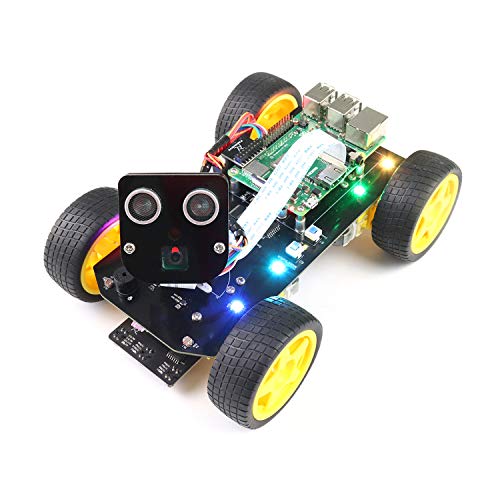
- Four-wheel-drive mobile platform
- Camera, line tracking, and obstacle avoidance
- Remote control plus Python tutorial
Best For: First-time Raspberry Pi robot builders
Best 2-in-1 Build
Raspberry Pi Robot Arm Tank Kit

- Combines tank car and robotic arm concepts
- Supports camera, tracking, and obstacle avoidance
- Web-based control from phones and computers
Best For: Teens and hobbyists who enjoy mechanical builds
Best All-Around Learning Kit

- 223 components for varied builds
- 128 guided electronics projects
- Python, C, Java, Scratch, and Processing
Best For: Beginners building a broad Raspberry Pi project foundation
Best Dedicated Robot Build

- Tank chassis with 4-DOF robotic arm
- OpenCV tracking and video transmission
- Includes illustrated assembly PDF and Python code
Best For: Hands-on builders creating a feature-rich mobile robot
Best Guided Starter Collection
SunFounder Raphael Starter Kit

- 337+ components and 161 projects
- 70+ expert-led video lessons
- Supports five programming languages
Best For: Beginners who prefer video-guided Raspberry Pi learning
Best All-Terrain Starter

- Crawler chassis with grabber, camera, and ultrasonic sensor
- Supports multiple Raspberry Pi models and Python projects
- Phone, tablet, and computer control
Best For: Beginners building interactive crawler robots
Best Ready-to-Explore AI Robot

- Includes Raspberry Pi Zero 2 W and 32G TF card
- 12 servos enable 32 expressive actions
- Voice, vision, touch, and app-based interaction
Best For: AI-focused learners wanting a feature-rich robot
Best AI Smart Car Platform

- Supports Python, Scratch, vision, and voice projects
- Works with several Raspberry Pi models
- Compatible with multiple LLM platforms
Best For: Older learners and hobbyists building AI smart cars
Editor's Pick – Freenove Big Hexapod Robot Kit
For hands-on robotics sets for raspberry pi, the Freenove Big Hexapod offers an ambitious build with six legs, a camera-equipped rotating head, and ultrasonic sensing. It requires assembly, a compatible Raspberry Pi, and a separately purchased battery.
Best For: Older beginners and hobbyists who want a feature-rich walking robot with Python guidance and several control options.
Pros:
- Six legs with three motors per leg support walking and self-balancing functions.
- Includes a camera and ultrasonic distance sensor for vision and ranging projects.
- Provides step-by-step digital instructions and complete Python code.
- Supports phone, tablet, and computer control.
Cons:
- Raspberry Pi and battery are not included.
- Assembly is required, and some older Pi models need extra parts.
- The tutorial is digital rather than printed.
This is a substantial choice for learners ready to combine mechanical assembly, programming, sensing, and wireless control in one Raspberry Pi project.
Best AI Learning Lab – SunFounder AI Fusion Lab Kit
The SunFounder AI Fusion Lab Kit broadens robotics sets for raspberry pi into guided AI and interactive hardware projects. It combines a camera, pan-tilt hardware, sensors, voice components, and project-based video lessons, while the Raspberry Pi itself is sold separately.
Best For: Beginners and engineers who want to learn Python, computer vision, voice interaction, sensors, and multi-LLM projects.
Pros:
- Supports projects using YOLO, OpenCV, MediaPipe, speech recognition, and text-to-speech.
- Includes a Fusion HAT+, camera, pan-tilt mount, 10-axis IMU, OLED screen, microphone, and speaker.
- Works with multiple Raspberry Pi models, including Pi 5, 4B, 3B+, and Zero 2W.
- Includes structured video lessons, documentation, sample code, and technical support.
Cons:
- The Raspberry Pi is not included.
- Its broad AI curriculum may be more involved than a simple robot-car project.
This kit is best viewed as a flexible AI laboratory rather than a single vehicle. It is a strong fit when learning software and multimodal interaction matters as much as physical movement.
Best Smart Car – Freenove 4WD Smart Car Kit
The Freenove 4WD Smart Car is a practical entry in robotics sets for raspberry pi, pairing four drive wheels with camera vision, line tracking, light tracing, and obstacle avoidance. Assembly is required, and you will need to supply the Raspberry Pi and battery.
Best For: Learners who want a mobile Raspberry Pi platform for experimenting with tracking, sensing, remote control, and Python programming.
Pros:
- Combines four-wheel drive with line tracking, light tracing, and obstacle avoidance.
- Rotating head includes a camera and ultrasonic distance sensor.
- Supports Android, iPhone, tablet, and computer control.
- Includes mechanical parts, motors, servos, tracking module, camera, and screwdriver.
Cons:
- Raspberry Pi and battery are not included.
- Some older compatible Pi models require extra parts.
- Instructions and Python code are accessed digitally rather than in a paper manual.
Compared with a walking robot, this car offers a more approachable wheeled platform while still providing several autonomous behaviors and a detailed route into Raspberry Pi robotics.
Best 2-in-1 Build – Raspberry Pi Robot Arm Tank Kit
This 2-in-1 robot car and arm kit gives robotics sets for raspberry pi a build-focused format, combining a tank-style vehicle with a programmable grabbing arm. It supports camera viewing, color tracking, line tracing, and obstacle avoidance, but the Raspberry Pi board is not included.
Best For: Teens and hobbyists who want a versatile construction project with both mobile driving and robotic-arm functions.
Pros:
- Combines a robot arm with a tank-style car platform.
- Offers grabbing, camera display, color tracking, line tracing, and obstacle avoidance.
- Includes tank and off-road tires with spring shock reduction.
- Supports phone, tablet, and computer control without requiring a separate app download.
Cons:
- The Raspberry Pi board is not included.
- The robotic arm must be purchased separately before assembling that function.
- Remote control requires two AA batteries, and the kit details indicate these need to be supplied separately.
Its combination of a mobile chassis and arm makes this a compelling project for learners who want more than a basic rover, provided they budget for the missing Raspberry Pi and arm requirements.
Best All-Around Learning Kit – Freenove Ultimate Starter Kit
If you want robotics sets for Raspberry Pi that also teach broad electronics and programming skills, the Freenove Ultimate Starter Kit is a versatile choice. It includes 223 items, 128 guided projects, and code examples in Python, C, Java, Scratch, and Processing. The Raspberry Pi board is not included.
Best For: Beginners and hobbyists who want a large component library and structured, multi-language project progression.
Pros:
- Supports Raspberry Pi 5, 400, 4B, 3B+, 3B, Zero 2 W, and several earlier models.
- Includes 128 projects with schematics, wiring diagrams, code, and explanations.
- Offers 223 components and five programming-language options.
- Provides a detailed 962-page downloadable or online tutorial.
Cons:
- Raspberry Pi board is not included.
- The extensive component count and tutorial may feel overwhelming for users seeking one focused robot build.
This is less of a dedicated rover kit and more of a comprehensive Raspberry Pi electronics foundation. Choose it if you value variety, documentation, and repeatable projects over a single finished robot.
Best Dedicated Robot Build – RaspTank Robot Car Kit
For shoppers specifically seeking robotics sets for Raspberry Pi, the RaspTank Robot Car Kit focuses on building and programming a tank-style robot. It combines a 4-DOF robotic arm with video transmission, tracking functions, LEDs, and remote control. The Raspberry Pi 3B, 3B+, or 4 board is required separately.
Best For: Makers aged 12 and up who want a hands-on mobile robot with computer-vision and remote-control features.
Pros:
- Combines a tank robot, 4-DOF robotic arm, and real-time video transmission.
- Supports object recognition, motion detection, and line tracking.
- Includes Python code and a GUI application compatible with Windows and Linux.
- Provides a 73-page illustrated PDF assembly manual.
Cons:
- Raspberry Pi board is not included.
- Compatibility is limited to Raspberry Pi 3B, 3B+, and 4 models.
- Assembly and computer-vision setup may require more technical effort than a basic starter kit.
This kit is the strongest fit when the goal is a recognizable, moving robot rather than a collection of general-purpose electronics. Its arm, camera-based functions, and GUI control offer several engaging ways to extend the build.
Best Guided Starter Collection – SunFounder Raphael Starter Kit
The SunFounder Raphael Ultimate Starter Kit is a strong option for beginners comparing robotics sets for Raspberry Pi with broader IoT learning materials. It includes more than 337 components, 161 projects, and over 70 expert-led video lessons, while supporting Raspberry Pi 5, 4B, 3B+, 3B, Zero 2 W, and 400 models. The Raspberry Pi is not included.
Best For: Beginners aged 10 and up who prefer video instruction, varied hardware, and projects that extend beyond one robot.
Pros:
- Includes 337+ components and 161 projects for a wide range of experiments.
- Offers 70+ video lessons led by educator Paul McWhorter.
- Supports Python, C, Java, Node.js, and Scratch.
- Includes cameras, speakers, sensors, actuators, LEDs, and LCDs.
Cons:
- Raspberry Pi board is not included.
- Its broad project focus may be less suitable if you want a dedicated, ready-to-assemble robot.
- The large number of components may require extra organization during projects.
Raphael stands out for guided learning and hardware variety. It is a practical pick for families, classrooms, or newcomers who want video support and enough parts to progress from simple experiments to more involved Raspberry Pi projects.
Best All-Terrain Starter – Freenove Tank Robot Kit
For hands-on robotics sets for raspberry pi projects, the Freenove Tank Robot Kit offers a practical crawler platform with a grabber, camera, and distance sensor. It supports several Raspberry Pi models and includes Python code and an online tutorial, though assembly, a Raspberry Pi, and batteries are required.
Best For: Beginners and younger learners who want to explore programming, remote control, obstacle avoidance, line tracking, and object grabbing.
Pros:
- Crawler chassis with liftable clamp for interactive projects.
- Includes camera and ultrasonic distance sensor.
- Supports phone, tablet, and computer control.
- Provides step-by-step assembly guidance and complete Python code.
Cons:
- Raspberry Pi and batteries are not included.
- Assembly is required, and the tutorial is downloaded rather than printed.
- Some older Raspberry Pi models need extra parts.
This is a versatile entry point for Raspberry Pi robotics, especially if you want a physical vehicle with several built-in activities rather than a simple moving chassis.
Best Ready-to-Explore AI Robot – SunFounder AI Robot Kit
Among robotics sets for raspberry pi, this SunFounder kit stands out as a more complete AI-focused package because it includes a Raspberry Pi Zero 2 W and 32G TF card. Its camera, microphone, speaker, sensors, and 12 servos support voice interaction, video recognition, app control, and Python programming.
Best For: Learners who want an assembled-platform-style introduction to AI interaction, expressive robot movement, computer vision, and voice commands.
Pros:
- Includes Raspberry Pi Zero 2 W and 32G TF card.
- Uses 12 servos for 32 movements and actions.
- Combines camera, microphone, speaker, gyroscope, ultrasonic, and touch sensors.
- Offers ChatGPT-4o integration, app control, and FPV viewing.
Cons:
- Its AI features depend on the supported software and services.
- The many sensors and servos may create a more involved setup than a basic robot car.
- Battery details and power accessories should be checked before purchase.
With its included Pi Zero 2 W and broad sensor package, this is a strong choice for buyers prioritizing conversational and expressive AI experiments over simple driving exercises.
Best AI Smart Car Platform – SunFounder PiCar-X AI Robot
For robotics sets for raspberry pi aimed at programming and AI experimentation, the SunFounder PiCar-X is a capable smart-car platform. It supports Raspberry Pi 5, 4, 3B+, 3B, and Zero 2W, while adding camera-based recognition, voice features, line following, obstacle avoidance, and compatibility with multiple LLM platforms. The Raspberry Pi is not included.
Best For: Older students, educators, and experienced hobbyists exploring Python, Scratch, computer vision, voice interfaces, and AI-enabled vehicle projects.
Pros:
- Supports multiple LLM options, including ChatGPT, Gemini, Grok, and local Ollama models.
- Combines camera vision, speech-to-text, text-to-speech, and sensor-based driving.
- Supports both Python and Scratch programming.
- Includes projects such as line following and obstacle avoidance.
Cons:
- Raspberry Pi is not included.
- Manufacturer recommends it for ages 15 and up.
- AI functions may require configuring compatible platforms and services.
PiCar-X is the most flexible option here for developing an AI-enabled smart car, particularly when you already own a compatible Raspberry Pi and want room to compare programming and LLM tools.
How We Picked These Robotics Sets for Raspberry Pi
We compared the kits by Raspberry Pi compatibility, included hardware, programming support, project variety, and the kinds of robotics skills they teach. We also considered whether a kit includes a camera, sensors, motors, a chassis, battery hardware, storage, or a Raspberry Pi board. Compatibility claims can vary by board revision, so check the manufacturer’s current parts list before ordering.
The selection covers general-purpose starter kits, wheeled cars, tracked robots, robotic arms, a hexapod, and AI-oriented platforms. This gives beginners a clear entry point while preserving options for computer vision, voice interaction, and more ambitious autonomous builds.
Quick Comparison
| Kit type | Best for | Typical strengths |
|---|---|---|
| Starter kit | Learning electronics and coding | Broad components, tutorials, multiple languages |
| Smart car | First mobile robot | Line tracking, obstacle avoidance, app control |
| Tank robot | Rugged movement and experiments | Tracked chassis, object interaction, sensors |
| Robotic arm car | Manipulation projects | Arm control, camera features, target tracking |
| AI robot | Computer vision and voice projects | LLM, camera, OpenCV, or MediaPipe integration |
| Hexapod | Advanced mechanical builds | Walking gait, balance, ranging, complex assembly |
Key Buying Factors for Robotics Sets for Raspberry Pi
Raspberry Pi Compatibility
Confirm support for your exact board, such as Raspberry Pi 5, 4 Model B, 3 B+, Zero 2 W, or Pi 400. Some kits exclude the computer, microSD card, power supply, batteries, or charger, which can materially increase the final cost.
Programming and Documentation
Python is the most practical common choice, but kits offering C, Java, Scratch, or Processing can suit classrooms and learners with different backgrounds. Look for wiring diagrams, downloadable code, video lessons, and clearly maintained tutorials.
Sensors, Camera, and AI Features
Choose basic sensors for line following and obstacle avoidance, or a camera-equipped kit for face tracking, OpenCV, YOLO, MediaPipe, and video recognition. AI features may require internet access, accounts, paid services, or more processing power than simple sensor projects.
Build Complexity and Power
Wheeled cars are usually easier to assemble and troubleshoot than tanks, arms, or walking robots. Check motor-driver details, battery requirements, chassis quality, spare parts, and whether the completed robot can run safely on your intended surface.
Who Should Buy Which Robotics Sets for Raspberry Pi?
Choose a starter kit if you are new to Raspberry Pi electronics or want a component library for many small projects. Pick a smart car for the quickest path to movement, sensors, and autonomous behavior. A tank is better for traction and object-focused experiments, while an arm-equipped car suits learners interested in manipulation and camera-guided tasks.
For voice commands, visual recognition, and LLM experimentation, select an AI-focused kit and verify its software requirements before buying. Choose the hexapod if you specifically want a challenging mechanical and gait-control project. Whichever option you choose, budget for missing accessories and allow time for assembly, calibration, and software setup.