Cleaner indoor air starts with knowing what you’re breathing. The best air quality monitors can help you spot rising CO2, fine particles, VOCs, and humidity issues before they become comfort or health problems.
Whether you want a simple home monitor or a more advanced multi-sensor display, this roundup focuses on accuracy, readability, and everyday usefulness.
Best 10 Air Quality Monitors Picks for 2026
Premium CO2 Focused Monitor
Aranet4 Indoor Air Quality Monitor
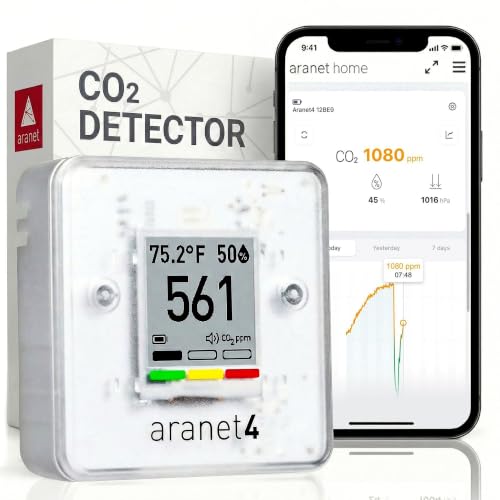
- Tracks CO2, temperature, humidity, and pressure
- NDIR sensor technology for precise CO2 readings
- Up to 4 years of battery life with e-ink display
Best For: Portable CO2 monitoring with long battery life and simple app history
Alexa Smart Home Monitor
Amazon Smart Air Quality Monitor

- Tracks PM2.5, VOCs, CO, humidity, and temperature
- Works with Alexa alerts and routines
- Plug-in setup with color-coded status
Best For: Alexa households that want automated responses to poor air quality
Pro Multi-Sensor Analyzer

- 8-in-1 monitoring with CO2, particles, VOCs, and formaldehyde
- App includes 90-day history and data export
- Rechargeable, with up to 6 hours portable use
Best For: Detailed air quality tracking across particles, gases, and comfort metrics
Compact Wi-Fi PM2.5 Monitor
GoveeLife Smart Air Quality Monitor H5106

- Tracks PM2.5, temperature, and humidity
- 2-second refresh with LED air-quality indicator
- Works with compatible GoveeLife smart devices
Best For: Plug-in PM2.5 monitoring with simple smart-home automation
Radon-First Smart Monitor

- Measures radon, PM2.5, CO2, VOCs, humidity, temperature, and pressure
- Battery-powered design with customizable eInk screen
- App-based live data, alerts, and cloud trend tracking
Best For: Homeowners who want always-on radon monitoring with broad indoor air tracking
Portable 16-Parameter Tester
16-in-1 Indoor Air Quality Monitor

- Tracks PM1.0, PM2.5, PM10, CO2, TVOC, HCHO, temp, and humidity
- One-button operation with optional audio prompt mute
- HD color screen with 1.5-second real-time sampling
Best For: People who want a compact handheld monitor for quick checks in multiple spaces
Data-Export Air Monitor

- Tracks PM2.5, PM10, HCHO, VOCs, humidity, temperature, and AQI
- Exports up to 3 months of data to Excel via USB
- Battery or Type-C powered for portable or continuous use
Best For: Users who want trend data and exportable reports for indoor air tracking
Large-Display Alert Monitor
16-in-1 Air Quality Monitor Indoor

- 7-inch LED display with three brightness levels
- Real-time buzzers for CO2, PM2.5, HCHO, TVOC, and more
- External sensors are designed for direct air sampling
Best For: Rooms that need a big screen and audible air alerts
Premium CO2 Focused Monitor – Aranet4 Indoor Air Quality Monitor
If you want a straightforward indoor air quality monitor that puts CO2 front and center, the Aranet4 is built for that job. It tracks CO2, temperature, humidity, and atmospheric pressure in real time, making it useful for ventilation checks in homes, offices, and classrooms where air freshness matters.
Best For: People who want accurate, portable CO2 monitoring with long battery life and simple historical tracking.
Pros:
- Uses NDIR sensor technology for precise and reliable CO2 measurement.
- Wireless, cable-free design with e-ink display and up to 4 years of battery life.
- Color coding, prominent CO2 reading, and optional buzzer make alerts easy to notice.
- App stores up to 90 days of historical data with graphs for review.
Cons:
- Focuses mainly on CO2 and basic comfort metrics rather than particles or VOCs.
- Depends on AA batteries instead of rechargeable power.
The Aranet4 is a strong pick if your main goal is to understand ventilation and keep tabs on CO2 without extra complexity. It is especially appealing for users who value portability, battery life, and dependable readings over a long feature list.
Alexa Smart Home Monitor – Amazon Smart Air Quality Monitor
The Amazon Smart Air Quality Monitor is designed for buyers who want air quality monitors that fit neatly into an Alexa-powered home. It tracks PM2.5, VOCs, carbon monoxide, humidity, and temperature, then turns that data into a color-coded reading, alerts, and automation options through the Alexa app.
Best For: Alexa users who want a plug-in monitor that can trigger smart home routines when air quality changes.
Pros:
- Measures five key factors: PM2.5, VOCs, carbon monoxide, humidity, and temperature.
- Provides notifications on your phone and announcements on Echo devices when air quality drops.
- Can automate compatible Alexa devices such as purifiers, dehumidifiers, and fans.
- Easy setup through the Alexa app with plug-in power.
Cons:
- Requires Alexa to get the full feature set and smart home integration.
- Needs to stay plugged in, so it is not a portable option.
This monitor makes the most sense if you already use Alexa and want a simple way to react to indoor air changes automatically. It is less about advanced analysis and more about convenient, connected monitoring.
Pro Multi-Sensor Analyzer – BREATHE Airmonitor Plus Gen 2
For shoppers comparing air quality monitors with broader sensing, the BREATHE Airmonitor Plus Gen 2 goes well beyond a basic CO2 meter. It tracks CO2, PM1, PM2.5, PM10, TVOC, formaldehyde, temperature, and humidity, giving you a detailed snapshot of indoor air conditions in real time.
Best For: Users who want a feature-rich monitor for comparing particles, gases, and comfort levels in one device.
Pros:
- 8-in-1 monitoring covers CO2, particulate matter, TVOC, formaldehyde, temperature, and humidity.
- NDIR CO2 measurement plus laser particle sensing and dedicated VOC/formaldehyde detection.
- App offers configurable alerts, 90-day history, and data export for deeper review.
- Rechargeable design supports up to 6 hours of portable use and USB-C continuous power.
Cons:
- Portable battery life is limited compared with always-on plug-in monitors.
- More sensors and features may be more than casual users need.
The Airmonitor Plus Gen 2 is built for people who want more context around indoor air instead of a single reading. It is a smart choice when you want to track how cooking, cleaning, occupancy, and ventilation affect multiple air quality factors.
Compact Wi-Fi PM2.5 Monitor – GoveeLife Smart Air Quality Monitor H5106
The GoveeLife Smart Air Quality Monitor is a practical choice if you mainly want PM2.5, temperature, and humidity monitoring with smart-home support. It uses a wired design with fast refreshes, a readable LED display, and data access through Bluetooth or Wi-Fi for home or office tracking.
Best For: Buyers who want a plug-in PM2.5 monitor that can coordinate with compatible Govee devices.
Pros:
- Measures PM2.5, temperature, and humidity with fast 2-second refreshes.
- LED display includes a 4-level ambient air quality indicator and switchable display modes.
- Can link with compatible GoveeLife purifiers, humidifiers, heaters, and fans for automation.
- Offers remote monitoring plus online graphs and long-term data export.
Cons:
- No built-in battery, so it must stay connected to power.
- Only measures three main factors, so it is less comprehensive than multi-gas monitors.
This model is a good fit if you want a steady, always-on monitor for a room where PM2.5 matters most. It keeps the interface simple while still offering useful app-based tracking and device automation.
Radon-First Smart Monitor – Airthings View Plus
If you want air quality monitors that go beyond basic particle counts, the Airthings View Plus is built for broader indoor tracking. It measures radon, PM2.5, CO2, VOCs, humidity, temperature, and air pressure, with live data in the Airthings app and cloud-based history for trend review.
Best For: Homeowners who want a battery-powered monitor with always-on radon and multi-parameter tracking.
Pros:
- Tracks radon plus PM2.5, CO2, VOCs, humidity, temperature, and pressure
- Battery powered for cable-free placement, with an eInk screen
- Live app alerts, trend tracking, and cloud-saved data
- Optional free extended warranty can increase coverage to five years
Cons:
- Requires the Airthings app and an account to function
- Both the monitor and app require internet access
- Battery average life is listed at about two years
For buyers prioritizing radon awareness and a wider indoor air snapshot, this model stands out as a connected, low-cable option. Its strongest value is combining a trusted radon sensor with everyday comfort metrics in one unit.
Portable 16-Parameter Tester – 16-in-1 Indoor Air Quality Monitor
This portable option is a practical choice if you want air quality monitors that can quickly check a lot of variables in one pass. It tracks PM1.0, PM2.5, PM10, CO2, TVOC, HCHO, temperature, and humidity, and uses a color screen with real-time updates every 1.5 seconds.
Best For: Users who want a compact, easy-to-use multi-parameter monitor for rooms, cars, and quick spot checks.
Pros:
- Measures 16 parameters, including PM, CO2, TVOC, HCHO, temperature, and humidity
- Simple one-button operation with switchable audio prompt
- HD color display with frequent 1.5-second sampling updates
- Portable design works for home, office, bedroom, car, and more
Cons:
- Run time is only about 4-5 hours on a full charge
- Designed more for portable testing than fixed, always-on monitoring
- No app or cloud-based logging is mentioned
If you need a straightforward handheld monitor for checking indoor air conditions in different places, this model covers a lot of ground. It is best viewed as a flexible tester rather than a long-term smart-home system.
Data-Export Air Monitor – Temtop LKC-1000S+
For shoppers comparing air quality monitors on analysis features, the Temtop LKC-1000S+ is built around measurement depth and record keeping. It tracks PM2.5, PM10, HCHO, VOCs, humidity, temperature, and AQI, and can export up to three months of data to Excel without needing an app or subscription.
Best For: Users who want a semi-professional monitor for trend tracking, reporting, and renovation or ventilation checks.
Pros:
- 7-in-1 monitoring with PM2.5, PM10, HCHO, VOCs, humidity, temperature, and AQI
- Built-in trend histogram helps reveal pollution spikes over time
- USB logging with Excel export for up to 3 months of data
- Can run on battery for spot checks or on Type-C power for continuous use
Cons:
- Does not detect gas or CO leaks
- Requires warm-up time after major temperature changes
- Accuracy guidance warns against nearby alcohol, perfume, or cleaning sprays during testing
This model makes the most sense if you care about data you can save, review, and share. It is less about simple everyday convenience and more about getting organized, usable readings over time.
Portable Smart 10-in-1 Monitor – 10-in-1 Air Quality Monitor Indoor
If you want a compact air quality monitor for quick checks around the home, car, or workspace, this 10-in-1 unit covers the basics without feeling overcomplicated. It tracks CO2, HCHO, TVOC, benzene, PM2.5, PM10, and more, while the color screen makes it easy to spot changing conditions at a glance.
Best For: Everyday indoor checks in homes, cars, pet areas, and small workspaces.
Pros:
- Tracks multiple key pollutants, including CO2, HCHO, TVOC, benzene, PM2.5, and PM10
- Color display changes when air quality crosses safety thresholds
- Portable build with a 2000mAh rechargeable battery rated for up to 20 hours
- Simple one-button operation with no complex menu setup
Cons:
- Smaller display than the larger 7-inch and 7.2-inch models in this roundup
- Fewer alert and display customization details than the bigger units
- Best suited to practical monitoring rather than advanced room-wide display needs
Overall, this is a straightforward choice if you want broad pollutant coverage in a portable format. It leans toward convenience and quick visibility, making it a solid fit for routine air checks where ease of use matters most.
Large-Display Alert Monitor – 16-in-1 Air Quality Monitor Indoor
This 7-inch air quality monitor is built for users who want a larger, easier-to-read display and active alerts. It monitors CO2, PM1.0, PM2.5, PM10, HCHO, TVOC, temperature, humidity, and AQI, with on-device buzzers and a clear LED layout for fast reference.
Best For: Households that want a big screen and audible alerts for constant indoor monitoring.
Pros:
- Large 7-inch LED display with three brightness settings
- Monitors nine key readings, including CO2, PM2.5, PM1.0, PM10, HCHO, TVOC, temp, humidity, and AQI
- Includes real-time alert buzzers plus a mute option
- External high-precision sensors sample directly from the air for fast response
Cons:
- More of a stationary room monitor than a compact portable tester
- Alarm-heavy design may be more than some users need for simple spot checks
- Requires a bit more space than smaller handheld-style units
If readability and alerts are your priorities, this model stands out among air quality monitors. The larger screen and multi-alert setup make it especially useful in shared living spaces where everyone can see the readings quickly.
High-Precision Family Monitor – 16-in-1 VOC Meter Air Monitor
For buyers comparing air quality monitors for family spaces, this Sainlogic model emphasizes precision, fast updates, and easy visibility. It tracks the core indoor readings most people care about, and its 7.2-inch display, tri-color alerts, and flashing ventilation prompt make it easy to notice when conditions change.
Best For: Families, nurseries, and bedrooms where fast, readable air monitoring matters.
Pros:
- Tracks CO2, PM2.5, PM1.0, PM10, AQI, HCHO, TVOC, temperature, and humidity
- 0.001-level sensor sensitivity with 1.5-second sampling and 1-2 second refreshes
- 7.2-inch screen with three brightness levels for easy viewing across a room
- Can run without app or WiFi setup, and includes a one-touch sensor reset
Cons:
- Wireless battery life is listed at up to 8 hours, which is shorter than some competing monitors
- Best used as a room monitor rather than a highly portable day-long tracker
- Some users may not need the full alert and display feature set for basic monitoring
This is a strong pick if you want a visible, responsive monitor for regular household use. It focuses on fast readings and practical alerts, which makes it a good fit when air quality is a daily concern instead of an occasional check.
How We Picked These Air Quality Monitors
We focused on the features buyers actually use: the pollutants measured, sensor credibility, display clarity, app support, alerts, portability, and whether the unit fits a bedroom, office, or whole-home setup. We also favored models that make trends easy to understand instead of burying data in complicated menus.
Quick Comparison: What Different Monitors Track
Not every monitor measures the same things. Some units emphasize CO2 and ventilation, while others add PM2.5, VOCs, temperature, humidity, formaldehyde, or even radon. If you’re comparing Air Quality Monitors, decide first whether you need one key reading or a broader picture of indoor air conditions.
Best for Ventilation Checks
Choose a CO2-focused monitor if your main goal is to improve airflow in bedrooms, offices, or classrooms.
Best for Pollution and Allergies
Look for PM2.5 and particle monitoring if wildfire smoke, dust, cooking, or seasonal irritation are your biggest concerns.
Best for Complete Indoor Insight
Multi-parameter monitors are best when you want one device to track several air factors at once.
Key Buying Factors for Air Quality Monitors
Sensor coverage: Make sure the device measures the pollutants that matter most in your space. CO2 helps with ventilation, PM2.5 reflects fine particles, VOCs can point to off-gassing, and radon is important in lower levels or older homes.
Accuracy and calibration: Better sensors tend to hold readings more consistently over time. If you need reliable long-term use, look for models with clear calibration guidance or a strong reputation for stable measurements.
Display and alerts: A large screen and readable color indicators are helpful if you want at-a-glance checks. App notifications are useful when you’re away from home or want trend history.
Power and placement: Battery-powered units offer flexibility, while wired models can be easier for continuous use. Consider where the monitor will sit and whether it needs to move between rooms.
Who Should Buy Which Air Quality Monitors?
If you want simple, practical feedback for everyday living, a straightforward monitor with CO2, temperature, and humidity may be enough. If you’re dealing with smoke, dust, cooking particles, or allergies, prioritize PM2.5 monitoring. If you want the broadest view possible, choose a multi-sensor unit that tracks VOCs, particles, and climate readings together. And if your home has radon risk, select a monitor that includes that specific capability.
In short, the best Air Quality Monitors are the ones that match your actual indoor air concerns, not just the longest spec sheet.