Powered KVM switches make it easier to control multiple computers from one keyboard, mouse, and display setup. The right model can also simplify dual-monitor workstations, share USB peripherals, and reduce cable clutter.
This roundup compares 10 options across single- and multi-monitor configurations, HDMI and DisplayPort connectivity, high-refresh video support, USB port counts, and switching convenience.
Best 10 Powered Kvm Switches Picks for 2026
Best Dual-Display Choice
Unitek DP/HDMI Dual-Monitor KVM

- Dual-monitor switching for two desktop computers
- 4K at 60Hz with HDMI and DisplayPort support
- Four USB ports and included 5V/2A adapter
Best For: Desktop workstations sharing two monitors
Best HDMI Office Setup

- Shares two HDMI monitors between two computers
- 4K at 60Hz with extend and mirror modes
- Four USB 3.0 ports and included cables
Best For: HDMI-based home and office workstations
Best High-Resolution DP Pick

- DisplayPort 1.4 support up to 8K at 60Hz
- Shares one monitor and four USB devices
- Supports high refresh rates up to 4K at 240Hz
Best For: Single-monitor DisplayPort workstations
Best for Four Computers

- Connects four computers to one HDMI monitor
- 4K at 60Hz with adaptive EDID
- Remote keypad and LED source indicators
Best For: Multi-computer desks and control stations
Triple-Display Powerhouse

- Controls two computers across three monitors
- Supports up to 8K@60Hz and high refresh rates
- Includes four USB 3.0 ports and wired switching
Best For: Compatible triple-monitor workstations
Simple Single-Screen Switcher
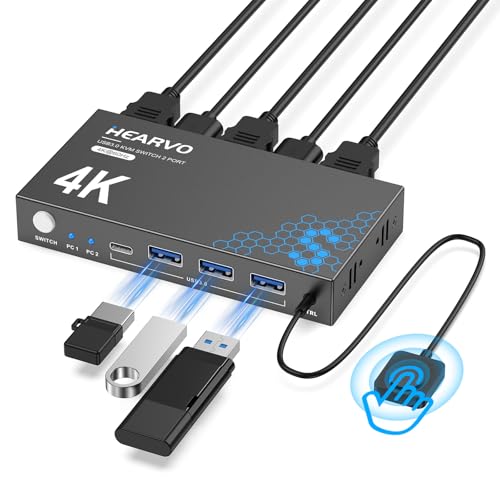
- Shares one monitor between two computers
- Supports 4K@60Hz HDMI output
- Adds four USB 3.0 peripheral ports
Best For: Single-monitor home and office desks
Dual-Screen High-Resolution Hub

- Switches two computers across dual monitors
- Supports 8K@60Hz and 4K@120Hz
- Includes four USB 3.0 ports and smart charging
Best For: High-resolution dual-monitor workstations
Best for Four-Computer Workspaces
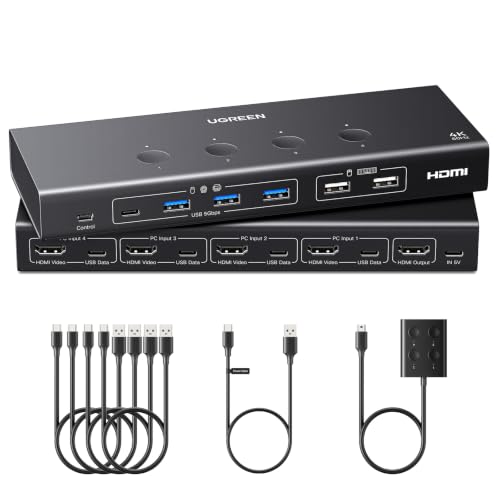
- Controls four computers through one monitor
- 4K@60Hz and six shared USB ports
- EDID emulation plus wired-controller switching
Best For: Multi-computer offices and testing stations
Best for Dual-Monitor Power Users

- Shares two monitors between two computers
- Supports 8K@60Hz and 4K@120Hz
- Includes 12V power adapter and four USB 3.0 ports
Best For: Extended-display workstation setups
Best Compact Budget Pick

- Switches two PCs on one 4K monitor
- Includes two USB 2.0 peripheral ports
- Uses button or wired-controller switching
Best For: Simple two-PC home and office desks
Best Dual-Display Choice – Unitek DP/HDMI Dual-Monitor KVM
For desktop users comparing powered kvm switches, the Unitek is designed to share two monitors and USB peripherals between two computers. It combines HDMI and DisplayPort connectivity, 4K output, and an included 5V/2A adapter for more stable operation with multiple USB devices.
Best For: Desktop workstations that need dual-monitor support across two computers.
Pros:
- Supports dual monitors through HDMI and DisplayPort, with resolutions up to 4K at 60Hz.
- Includes four USB-A ports, including USB 3.0 connectivity up to 5Gbps.
- Offers front-button and wired desktop-controller switching.
- Includes a 5V/2A power adapter for high-power USB equipment.
Cons:
- Designed for desktop hosts and explicitly not compatible with laptops.
- Simultaneous HDMI and DisplayPort video requires the necessary USB, HDMI, and DP cables connected to each host.
This is a capable powered KVM switch for a fixed desktop setup, especially when dual-display productivity matters. Confirm your computers have the required ports before buying.
Best HDMI Office Setup – UGREEN Dual-Monitor HDMI KVM
The UGREEN HDMI model is one of the powered kvm switches suited to two-computer, two-monitor workspaces. It supports extend and mirror modes, 4K at 60Hz, four USB 3.0 ports, and button or desktop-controller switching, with power supplied through the included adapters.
Best For: Home or office users sharing two HDMI monitors and USB accessories between two computers.
Pros:
- Supports two monitors with extend and mirror modes.
- Provides 4K at 60Hz output along with HDR-related format support listed by the manufacturer.
- Includes three USB-A and one USB-C port with transfer speeds up to 5Gbps.
- Package includes four HDMI cables, two USB cables, power adapters, and a desktop controller.
Cons:
- HDMI-only; it is not a DisplayPort KVM.
- Does not support EDID emulation or keyboard hotkey switching.
- Each computer needs two HDMI cables and one USB-A cable, and the monitors display one computer at a time.
Choose this powered KVM switch when your setup is HDMI-based and you want a well-equipped dual-monitor package. Check cable lengths and confirm your computers support dual-screen output.
Best High-Resolution DP Pick – UGREEN 8K DisplayPort KVM
For DisplayPort users seeking powered kvm switches, this UGREEN unit connects two computers to one monitor and shares four USB devices. Its DP 1.4 support reaches up to 8K at 60Hz, while USB-C power input helps support connected peripherals.
Best For: Single-monitor DisplayPort setups that prioritize high refresh rates and high resolution.
Pros:
- Supports up to 8K at 60Hz and lower modes including 4K at up to 240Hz.
- Shares four USB 3.0 devices, including USB-A and USB-C accessories.
- Provides button and wired desktop-controller switching.
- Works with Windows, macOS, and Linux without driver installation.
Cons:
- Supports one monitor only and has no HDMI interface.
- DP cables, USB-C power cable, and power adapter are not included.
- Does not support EDID emulation or hotkey switching, and switching is unavailable while a computer is asleep.
This is a strong powered KVM switch for a high-resolution DP workstation, but its required accessories are sold separately. Budget for suitable DP 1.4 cables and a USB-C power source.
Best for Four Computers – 4-Port HDMI USB 3.0 KVM
This four-port model is a practical option among powered kvm switches for users managing several HDMI computers from one desk. It shares one monitor, keyboard, mouse, and other USB devices across four computers, with front buttons, a numbered wired controller, and LED status indicators.
Best For: Offices, labs, or workstations that need access to four HDMI computers from one monitor.
Pros:
- Connects four computers to one monitor and one keyboard-and-mouse set.
- Supports HDMI resolution up to 4K at 60Hz and adaptive EDID identification.
- Includes three USB 3.0 ports plus USB-C connectivity for shared devices.
- Offers numbered remote selection, front-panel buttons, and active-source LEDs.
Cons:
- Limited to one shared monitor.
- Does not support hotkey switching.
- The package includes only one HDMI cable, so additional video cables may be needed for a four-computer installation.
If you need to switch among four HDMI computers rather than run a dual-monitor setup, this powered KVM switch offers straightforward physical controls and useful source indicators. Plan for the additional cables required.
Triple-Display Powerhouse – 8K Triple-Monitor KVM
This powered KVM switch is designed for users who need to control two computers across three monitors. The UGREEN model combines two DisplayPort 1.4 outputs, one HDMI 2.1 output, four USB 3.0 peripheral ports, and support for resolutions up to 8K@60Hz, making it a strong fit for demanding workstations.
Best For: Home offices, content creators, and IT professionals running compatible triple-monitor systems.
Pros:
- Supports two computers sharing three monitors and four USB 3.0 peripherals.
- Handles up to 8K@60Hz, with support for HDR10+, VRR, FreeSync, and G-Sync.
- Offers button and wired desktop-controller switching, plus mirror and extend display modes.
- Includes the required display, USB, power, and controller cables.
Cons:
- Both computers must support triple-monitor output, with two DisplayPort and one HDMI connection required per computer.
- Requires the included power adapter and does not support keyboard hotkey switching.
- Does not support EDID emulation, and converters or docking stations may cause compatibility issues.
This is a feature-rich choice when three-screen output and high refresh rates matter, but its connection requirements make it best suited to carefully matched computers, monitors, and cables.
Simple Single-Screen Switcher – 4K USB 3.0 KVM
This powered KVM switch lets two computers share one monitor, keyboard, mouse, and other USB accessories. Its 4K@60Hz HDMI support, four USB 3.0 ports, and wired remote make it a practical option for a straightforward desk setup.
Best For: Users switching between two computers on a single 4K monitor.
Pros:
- Combines HDMI and USB switching for two computers and one monitor.
- Supports 4K@60Hz, HDCP 2.2, 4K@30Hz, 2K, 3D, and 1080p sources.
- Provides three USB-A ports and one USB-C port with transfer speeds up to 5Gbps.
- Includes a wired remote and adaptive EDID for easier switching and stable display settings.
Cons:
- Supports only one monitor.
- The product notes state that no power supply is required, which may limit suitability for setups needing separately powered operation.
- Its USB peripheral sharing is limited to the four available ports.
For a conventional two-computer, one-screen arrangement, this KVM keeps the feature set focused and installation simple while still offering useful 4K video and USB 3.0 connectivity.
Dual-Screen High-Resolution Hub – 8K Dual-Monitor KVM
This powered KVM switch is built for two-computer setups that use dual monitors. It supports 8K@60Hz and 4K@120Hz video, provides four USB 3.0 ports, and includes both front-button and wired-remote switching for a flexible Windows, Mac, or Linux workstation.
Best For: Work, design, and gaming setups requiring two monitors and high-resolution output.
Pros:
- Controls two computers with one keyboard, mouse, and dual-monitor setup.
- Supports mirror and extend modes on Windows, Mac, and Linux.
- Offers 8K@60Hz and 4K@120Hz output for sharp, fluid visuals.
- Includes four 5Gbps USB 3.0 ports, smart charging support, a 5V/2A adapter, and an 8K braided HDMI cable.
Cons:
- The supplied notes do not specify the exact HDMI input and output arrangement.
- Requires the included power adapter for stable operation.
- Dual-monitor use depends on compatible computers, displays, and cabling.
With its powered design, metal housing, dual-monitor support, and high-refresh-rate capabilities, this model is a compelling middle ground for users who need more screen space without moving to a triple-monitor KVM.
Best for Four-Computer Workspaces – UGREEN 4-Port HDMI KVM
For users comparing powered KVM switches for a multi-computer desk, this UGREEN model connects four computers to one monitor while sharing a keyboard, mouse, and other USB peripherals. It supports up to 4K at 60Hz and includes a power connection for more stable operation.
Best For: Offices, testing stations, and home workspaces that need to manage four computers from one display.
Pros:
- Supports four computers sharing one monitor.
- Offers 4K@60Hz video with HDMI 2.0, HDR, HDCP, and 3D support.
- Provides four USB 3.0 ports and two USB 2.0 ports for shared peripherals.
- Includes EDID emulation and both device-button and wired-controller switching.
Cons:
- HDMI cables and the power adapter are not included.
- Each computer needs both an HDMI cable and a USB-A-to-USB-C data cable for normal KVM use.
- It is not designed for use with docking stations.
This is the most flexible option here for a four-system setup, especially if you need fast USB 3.0 transfers and display settings that remain consistent when switching. Plan for the required cables and external power connection.
Best for Dual-Monitor Power Users – 8K Dual-Display HDMI KVM
This dual-monitor model is a strong candidate among powered KVM switches for users who want two computers to share two displays and four USB peripherals. Its included 12V adapter is intended to provide stable power for the switch and higher-power USB devices.
Best For: Dual-screen workstation users who need extended or mirrored displays between two computers.
Pros:
- Supports two monitors with copy and extended-display modes.
- Handles resolutions up to 8K@60Hz and 4K@120Hz.
- Includes four USB 3.0 ports with transfer speeds up to 5Gbps.
- Comes with a 12V power adapter and desktop controller.
Cons:
- Each computer needs two HDMI outputs and support for dual-display modes.
- Keyboard-shortcut switching is not supported.
- The supplied notes specify limited host-port power for high-power USB devices without the external adapter.
Choose this switch when dual-display productivity matters more than a compact setup. Its external power design and high-resolution support suit demanding workstations, but confirm that both computers can provide the required two HDMI outputs.
Best Compact Budget Pick – 2-Port 4K HDMI KVM
For a simple two-computer desk, this compact option provides the core features expected from powered KVM switches without requiring an external power supply. It switches one HDMI monitor, keyboard, and mouse between two PCs and supports up to 4K at 60Hz.
Best For: Basic home or office setups with two HDMI-equipped computers and one monitor.
Pros:
- Shares one monitor, keyboard, and mouse between two computers.
- Supports 4K@60Hz and lower resolutions.
- Offers front-button and wired desktop-controller switching.
- Compact, plug-and-play design requires no external power supply.
Cons:
- Uses USB 2.0 ports with speeds up to 480Mbps.
- Does not support hotkey switching.
- The notes do not recommend it for Mac devices, and HDMI cables are not included.
This is the straightforward choice for switching between two HDMI PCs on a single display. It keeps the setup inexpensive and uncluttered, but users needing USB 3.0 speeds, dual monitors, or broader Mac compatibility should consider a different model.
How We Picked These Powered Kvm Switches
We focused on the features that most affect real-world compatibility and usability: supported monitor count, computer inputs, HDMI or DisplayPort connectivity, advertised resolution and refresh rate, USB 3.0 bandwidth, switching methods, and operating-system support. We also included both compact two-computer models and higher-capacity switches for users managing three or four systems.
Resolution claims are only useful when every part of the chain supports them. Your computers, graphics outputs, cables, monitors, and the KVM switch must all match the required standard. Some models may also require separate power, particularly when sharing several USB peripherals or maintaining stable high-bandwidth video.
Quick Comparison
- Dual-monitor users: Look at the Unitek, dual-monitor UGREEN, and 8K dual-monitor models.
- Single-monitor users: Several HDMI switches support two computers, while four-computer models suit larger setups.
- High-resolution gaming or creative work: Prioritize models advertising 8K at 60Hz or 4K at 120Hz, then verify your devices support those modes.
- Many USB accessories: Choose a switch with three, four, or six USB ports, depending on your keyboard, mouse, storage, webcam, and other peripherals.
- Mixed video requirements: DisplayPort and HDMI combinations can be more flexible than HDMI-only designs when your computers use different outputs.
Key Buying Factors for Powered Kvm Switches
Monitor Layout and Video Ports
First decide whether you need one, two, or three monitors and whether each computer must drive them independently. A single-monitor KVM cannot replace a dual-monitor model, even if it supports a high resolution. Match the switch’s input and output ports to your graphics hardware; adapters can introduce compatibility limits or reduce refresh rates.
Resolution, Refresh Rate, and Signal Standards
Choose based on the mode you actually use. Office work may need only 4K at 60Hz, while gaming and motion-heavy applications benefit from 4K at 120Hz or higher. “8K” support does not guarantee every combination of resolution, refresh rate, color depth, HDR, or adaptive-sync features, so check the detailed specifications before buying.
USB Sharing and Power
Count the accessories you want to share. Basic models are sufficient for a keyboard and mouse, while USB 3.0 hubs are better for webcams, storage, and other higher-bandwidth devices. Powered designs can provide more reliable operation than bus-powered units, but confirm the included power adapter and the switch’s USB power limits.
Switching and Compatibility
Buttons are simple and dependable; wired remotes are useful when the switch is out of reach. Hotkeys can be faster, but they may conflict with software or behave differently across Windows, macOS, and Linux. Confirm keyboard, mouse, audio, webcam, and sleep-wake compatibility if those features are important to your workflow.
Who Should Buy Which Powered Kvm Switches?
Choose a dual-monitor model if you regularly work across two screens and want both computers available without repeatedly moving cables. A single-monitor, two-computer switch is a better fit for compact desks or a straightforward home-office setup. Users with three or four computers should prioritize the larger-capacity HDMI models, while mixed-output workstations may benefit from a DisplayPort/HDMI option.
For gaming, video editing, and other high-refresh workloads, prioritize bandwidth and verify the complete cable and monitor chain. For general productivity, prioritize stable USB sharing, convenient switching, and the exact number of displays you use. When uncertain, buy for your current monitor arrangement rather than relying on an impressive maximum resolution alone.