Powered USB hubs make it easier to connect multiple peripherals without relying entirely on a computer’s limited USB ports. The right model can add dependable data connections, dedicated charging, or both.
Our 2026 roundup covers compact four- and five-port hubs, high-capacity desktop models, and USB-C options with faster transfer speeds and higher-wattage power delivery. Use the guide below to match port count, performance, and power features to your setup.
Best 10 Powered USB Hubs Picks for 2026
Compact Control
SABRENT 4-Port Powered USB 3.0 Hub

- Four USB 3.0 ports with up to 5Gbps transfers
- Individual LED-lit power switches
- Compact design with included 2.5A adapter
Best For: Compact desktop or travel setups needing controlled USB expansion
High-Capacity Workstation
ACASIS 16-Port USB 3.2 Powered Hub

- Sixteen USB 3.2 ports rated up to 10Gbps
- 96W adapter with surge protection
- Aluminum housing and individual port switches
Best For: Large workstations with many connected USB peripherals
Everyday Expansion
SABRENT 10-Port 60W USB 3.0 Hub

- Ten USB 3.0 ports with up to 5Gbps speeds
- Individual switches and blue LED indicators
- Includes a 60W power adapter and USB cable
Best For: Home offices and desktops needing flexible multi-device expansion
USB-C Charging Station
GITFOS C1 15-in-1 Powered USB-C Hub

- Fifteen ports with USB-C, USB-A, and charging options
- 10Gbps data ports plus 100W USB-C PD
- Includes a 65W adapter and aluminum desktop design
Best For: USB-C users combining peripheral expansion with device charging
Most Versatile
Wenter 11-Port Powered USB Hub

- 10 USB 3.0 data ports plus a dedicated charging port
- Individual power switches with LED status indicators
- Includes 12V/3A adapter and long connection cables
Best For: Busy desktop workstations needing extensive USB expansion
Best for Simple Expansion
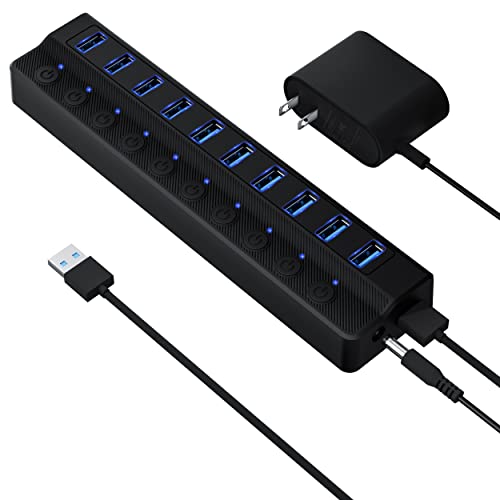
- Adds ten USB 3.0 ports with 5Gbps transfers
- Individual switches and LED power indicators
- 12V/2A adapter with broad operating-system compatibility
Best For: Straightforward peripheral expansion for laptops and desktops
Fastest Data Options

- USB 3.2 ports support transfers up to 10Gbps
- Two dedicated 45W USB-C PD charging ports
- Includes a 65W adapter and angled aluminum desktop design
Best For: USB-C users prioritizing fast transfers and mixed-port flexibility
Compact Aluminum Control

- Four USB 3.0 data ports reach up to 5Gbps
- Dedicated 2.4A smart-charging port
- Individual switches in an aluminum enclosure
Best For: Organized home and office workspaces
High-Capacity Workstation Hub

- Ten USB 3.0 data ports for large setups
- Separate 2.4A smart-charging port
- 36W adapter and individual LED switches
Best For: Multi-peripheral desks and workstations
USB-C Charging Choice

- Four 5Gbps USB 3.0 data ports
- Dedicated USB-C charging port
- Individual switches with soft LED indicators
Best For: Mac and PC users needing USB-C charging
Compact Control – SABRENT 4-Port Powered USB 3.0 Hub
If you need a few extra connections without taking over your desk, this powered USB hub adds four USB 3.0 ports with transfer speeds up to 5Gbps. Its included 2.5A adapter helps supply power to connected peripherals, while individual switches let you turn ports on or off without unplugging them.
Best For: Users who want compact port expansion with independent control for a desktop or laptop.
Pros:
- Four USB 3.0 ports support up to 5Gbps data transfer.
- Individual LED-lit power switches simplify device management.
- Includes a 5V/2.5A power adapter and supports USB 2.0 and USB 1.1 devices.
- Thin, lightweight design is convenient for travel or limited desk space.
Cons:
- Only four total ports are available.
- Its plastic enclosure may feel less substantial than aluminum alternatives.
This is a practical choice when you value simple plug-and-play setup and per-port control more than maximum capacity. It is especially well suited to keyboards, mice, storage devices, and other everyday USB accessories.
High-Capacity Workstation – ACASIS 16-Port USB 3.2 Powered Hub
For a busy workstation with many peripherals, this powered USB hub provides 16 USB 3.2 ports rated for up to 10Gbps data transfer. A 96W adapter, surge protection, aluminum housing, and independent port switches make it designed for sustained multi-device use.
Best For: Power users, offices, and creators connecting numerous USB devices at once.
Pros:
- Sixteen ports provide extensive connectivity for peripherals and storage devices.
- USB 3.2 supports up to 10Gbps data transfer.
- Included 12V/8A, 96W adapter helps support multiple connected devices.
- Aluminum housing aids heat dissipation, and every port has an independent switch.
Cons:
- The large port count and desktop-oriented design are less portable.
- At 781g, it is considerably heavier than compact hubs.
This ACASIS model stands out when capacity and power handling are the priorities. Its broad operating-system compatibility and individual switches make it a strong fit for a permanent, heavily populated desk setup.
Everyday Expansion – SABRENT 10-Port 60W USB 3.0 Hub
This powered USB hub expands one USB connection into 10 USB 3.0 ports, giving a desktop setup room for storage drives, phones, card readers, and other peripherals. Its 60W adapter provides external power, while individual switches and blue LEDs make it easy to manage connected devices.
Best For: Home offices and desktops that need several USB 3.0 ports with straightforward power control.
Pros:
- Ten USB 3.0 ports support data transfer speeds up to 5Gbps.
- Each port has its own power switch and LED indicator.
- Includes a 60W 12V/5A adapter, USB 3.0 cable, and user manual.
- Works with Windows, Mac OS, and Linux and is backward compatible with USB 2.0 and 1.1.
Cons:
- It uses the older USB 3.0 speed tier rather than 10Gbps USB 3.2.
- The ABS plastic enclosure may be less durable-feeling than metal designs.
With a useful middle ground between four-port and 16-port models, this SABRENT hub is a sensible all-purpose option. The per-port switches are particularly helpful if you frequently connect and disconnect powered accessories.
USB-C Charging Station – GITFOS C1 15-in-1 Powered USB-C Hub
This USB-C powered USB hub combines 15 ports with 10Gbps data connections, USB-C charging, and a 100W PD port. It includes a 65W DC adapter for stable operation, but note that the hub’s ports do not support video output and require the adapter to function.
Best For: USB-C laptops, tablets, and modern workspaces needing data expansion plus device charging.
Pros:
- Fifteen-port layout includes USB-C and USB-A data and charging connections.
- Selected USB 3.2 ports support up to 10Gbps transfers.
- 100W USB-C PD port and additional USB-C charging ports support flexible power delivery.
- Aluminum housing, angled design, and non-slip feet suit organized desktop use.
Cons:
- The hub requires the included 65W adapter to operate.
- Its ports do not support video output.
- The USB-C charging ports have stated output limits and are not recommended for high-power computers.
This model is best viewed as a connectivity and charging station rather than a display dock. Check your computer’s USB-C or Thunderbolt compatibility and charging requirements before buying, especially if you need monitor support.
Most Versatile – Wenter 11-Port Powered USB Hub
If you need powered USB hubs with plenty of room for peripherals, the Wenter 11-port model combines ten USB 3.0 data ports with a dedicated charging port. It supports up to 5Gbps data transfer, making it practical for a desktop setup with several drives, printers, input devices, or other USB accessories.
Best For: Desktop users who need many individually controlled USB connections plus a separate charging port.
Pros:
- Ten USB 3.0 data ports support transfers up to 5Gbps.
- Dedicated charging port can deliver up to 2.4 amps per port.
- Individual switches and LED indicators make power management convenient.
- Includes a 12V/3A adapter and relatively long cables.
Cons:
- The hub uses a plastic enclosure.
- The charging and data functions are split between separate ports.
The Wenter stands out when port count and per-port control matter most. Its broad compatibility and included power adapter make it a flexible choice for a busy workstation.
Best for Simple Expansion – ONFINIO 10-Port USB 3.0 Hub
Among powered USB hubs, the ONFINIO 10-port model is a straightforward expansion option for laptops and desktops. It adds ten USB 3.0 data ports with up to 5Gbps transfer speeds, while the included 12V/2A adapter helps support multiple connected peripherals.
Best For: Users who want a simple, high-port-count USB 3.0 hub for keyboards, drives, printers, cameras, and similar accessories.
Pros:
- Adds ten USB 3.0 ports from one USB connection.
- Supports data transfer speeds up to 5Gbps.
- Individual on/off switches and LED indicators simplify control.
- Compatible with Windows, Mac, Linux, and ChromeOS according to the supplied specifications.
Cons:
- It does not list a dedicated charging port.
- The included power adapter is rated at 12V/2A, below the Wenter model’s adapter rating.
This ONFINIO hub keeps the design focused on adding USB 3.0 data connections. It is a sensible fit if you need many switched ports without requiring a separate high-power charging feature.
Fastest Data Options – Intpw 9-Port USB 3.2 Hub
For users comparing powered USB hubs by speed and connector variety, this Intpw model offers USB 3.2 ports rated up to 10Gbps alongside USB 3.0 connections. It also includes two dedicated USB-C PD charging ports and a 65W power adapter, though those charging ports do not transfer data and the hub does not provide video output.
Best For: USB-C laptop users who need faster file transfers, mixed USB-A/USB-C connectivity, and dedicated device charging.
Pros:
- Includes USB 3.2 ports with up to 10Gbps transfer speeds.
- Provides two dedicated USB-C PD charging ports rated at 45W.
- 65W adapter supports stable operation with multiple connected devices.
- Angled aluminum design helps with desktop plugging and unplugging.
Cons:
- The PD charging ports do not support data transfer.
- It does not support video output.
- The notes advise against using multiple SSDs or removable drives simultaneously.
The Intpw is the most speed-focused option here, particularly for USB-C setups and large file workflows. Its limitations around video, computer charging, and simultaneous drives should be considered before buying.
Compact Aluminum Control – 5-Port Powered USB Hub
This atolla model is a practical choice among powered USB hubs when you need four fast data connections plus a dedicated charging port. Its aluminum enclosure, individual switches, and included 5V/3A adapter suit organized home or office workspaces.
Best For: Users who want a compact, durable hub with port-level power control and a separate charging connection.
Pros:
- Four USB 3.0 data ports support transfer speeds up to 5Gbps and work with older USB devices.
- Dedicated smart-charging port provides up to 2.4A for compatible USB-charged devices.
- Individual switches and LED indicators make it easy to disable unused ports.
- Includes a 5V/3A power adapter, 100cm USB cable, and 18-month warranty.
Cons:
- The hub has only four data ports; the fifth port is for charging.
- The charging port does not add another data connection.
Choose this hub if build quality and simple port management matter more than maximum port count. Its straightforward plug-and-play design is well suited to everyday peripherals and mobile-device charging.
High-Capacity Workstation Hub – 11-Port Powered USB Hub
For setups that regularly connect many peripherals, this JESWO is one of the more expansive powered USB hubs in the group. It combines ten USB 3.0 data ports with a separate charging port and a 36W adapter for a busy desk.
Best For: Multitasking users who need numerous connected peripherals such as keyboards, drives, cameras, and card readers.
Pros:
- Ten USB 3.0 data ports support transfer speeds up to 5Gbps.
- Separate charging port provides up to 2.4A for compatible devices.
- Independent switches and LED indicators allow convenient port-by-port control.
- Includes a 12V/3A, 36W power adapter and carries a three-year warranty.
Cons:
- Full functionality requires the included power adapter to be connected.
- The plastic enclosure may feel less premium than an aluminum alternative.
This is the strongest fit when port count is the priority. Make sure you have room for the hub and its power connection, then use the individual switches to keep only active peripherals powered.
USB-C Charging Choice – 5-Port USB 3.0 Powered Hub
This Wenter hub gives a computer four USB 3.0 data ports while reserving the fifth connection for USB-C charging. It is a useful option among powered USB hubs for users who want individual controls, long cables, and a dedicated Type-C charging port.
Best For: Mac and PC users who need standard USB expansion alongside convenient USB-C charging.
Pros:
- Four USB 3.0 data ports support speeds up to 5Gbps and backward compatibility.
- Dedicated Type-C charging port can deliver up to 2.4A with the included 5V/3A adapter.
- Individual on/off switches and soft LED indicators simplify power management.
- Includes 100cm USB and 120cm power cables, plus a 24-month warranty.
Cons:
- The Type-C port supports charging only, not data transfer.
- Some high-power external hard drives may require careful use with the power supply.
Consider this model when USB-C charging is more useful than having a fifth data port. Its long cables and plug-and-play compatibility also make it convenient for flexible desktop arrangements.
How We Picked the Best Powered USB Hubs
We evaluated these Powered USB Hubs by looking at port count, USB generation, stated transfer speeds, power-adapter capacity, charging support, physical design, and day-to-day convenience features. Individual power switches and status LEDs can simplify desktop use, while USB-C connectivity and Power Delivery are more useful for newer laptops and mixed-device setups.
Because hub specifications vary, treat advertised speeds as maximum theoretical performance. Actual results depend on the host computer, connected devices, cables, and whether several ports are being used simultaneously.
Quick Comparison
| Best For | What to Prioritize | Recommended Configuration |
|---|---|---|
| Basic desktop expansion | Simple setup and reliable power | 4–5 powered USB 3.0 ports |
| Many connected peripherals | High port count and strong adapter | 10–16 ports with dedicated power |
| Fast external storage | USB 3.2 and 10Gbps support | USB 3.2 hub with compatible host port |
| Modern laptops | USB-C and charging flexibility | USB-C hub with PD support |
| Selective device control | Independent switching | Per-port switches and LEDs |
Key Buying Factors for Powered USB Hubs
Port Count and Layout
Choose enough ports for your current devices plus a little room to grow. Four or five ports suit a keyboard, mouse, storage drive, and occasional accessory. A 10- or 16-port model is better for desks with several drives, cameras, controllers, and other peripherals. Check spacing as well; bulky plugs can block neighboring ports.
Speed and Compatibility
USB 3.0 is sufficient for many keyboards, mice, printers, and standard storage devices. For frequent large-file transfers, look for USB 3.2 or 10Gbps support. The computer’s host port must also support the advertised speed, and a slower connected device will still operate at its own limit.
Power and Charging
A dedicated adapter helps maintain stable performance when multiple bus-powered drives or other demanding devices are connected. Do not assume that a powered hub can charge a laptop or fast-charge every phone. Confirm whether the product includes a smart-charging port or USB Power Delivery, and check its stated wattage.
Controls, LEDs, and Build
Individual switches are useful for disconnecting accessories without repeatedly unplugging them. LEDs provide quick status checks but may be distracting in a bedroom or studio. Aluminum housings can improve durability and heat handling, while a compact footprint matters when desk space is limited.
Who Should Buy Which Powered USB Hubs?
Choose a compact powered hub if you need a few extra ports for everyday accessories. Pick a high-port-count desktop hub if several peripherals remain connected at once. For external SSDs and other demanding storage, prioritize USB 3.2 or 10Gbps support and a robust power adapter. If your computer is USB-C based, select a model with the required USB-C host connection and verify whether its charging features meet your expectations.