The best mineral collection kits for kids turn geology into a hands-on activity, combining real rocks, minerals, crystals, fossils, and simple identification tools. Whether your child is starting a first collection or ready for a more structured STEM project, the right kit makes exploring Earth science engaging and accessible.
We compared these 10 options by specimen variety, educational value, included tools, storage, and suitability for different ages and interests.
Best 10 Mineral Collection Kits for Kids Picks for 2026
Mega Collection Pick
Dan&Darci 250+ Rock Collection
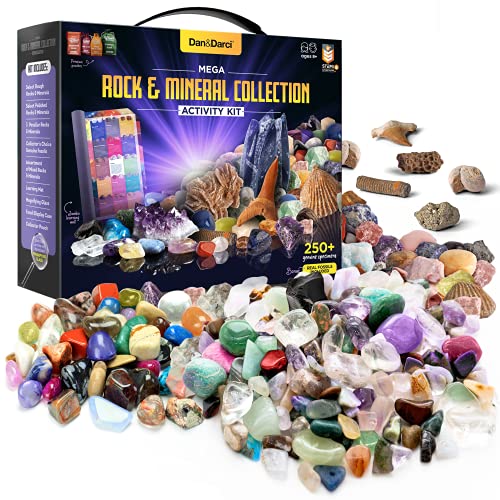
- 250+ rocks, minerals, gems, and fossils
- Includes learning mat and collection accessories
- Two-pound assortment for group or solo play
Best For: Large-scale geology exploration and family activities
Sharing Pick
National Geographic 50-Specimen Rock Collection

- Includes 50 specimens and over one pound of rocks
- Ten carrying bags support sharing and trading
- Learning guide suits classrooms and homeschool use
Best For: Group activities, classrooms, and specimen sharing
Organized Starter Pick

- Nine polished gems plus 45 raw specimens
- Includes cards, guidebook, magnifier, and case
- Compact storage supports sorting and display
Best For: Beginner collectors and organized geology study
Mineral Testing Pick
Toysmith 15-Specimen Science Kit

- Includes 15 mineral specimens
- Features streak plate, nail, viewer, and guide
- Designed for hands-on identification practice
Best For: Mineral tests, classroom demos, and guided STEM learning
Best Collection Size
National Geographic 300+ Rock Collection

- Includes 300+ genuine rocks, minerals, and crystals
- Comes with two break-open geodes and a magnifying glass
- Includes a learning guide and storage bag
Best For: Kids who want a large, varied specimen collection
Best Identification Tools
Toysmith STEM Rock & Mineral Science Kit

- Includes 30 real rock and mineral specimens
- Comes with a viewer, streak plate, nail, and testing tools
- Trays support sorting and organized storage
Best For: Kids learning to test and classify specimens
Best Activity Variety
National Geographic Geology Kit Bundle

- Combines a rock collection, gem dig, and crystal-growing lab
- Includes hundreds of real specimens and two geodes
- Light-up base displays the crystals kids grow
Best For: Kids who want multiple hands-on geology activities
Global Explorer Pick
36-Piece Rock & Mineral STEM Kit

- 36 natural minerals and crystals
- Specimens from 30+ countries
- Guide and portable storage case included
Best For: Young collectors exploring world geology
Hands-On Discovery Pick

- 30 named rocks, gems, and crystals
- Magnifying glass and brushes included
- Full-color learning guide
Best For: Beginners who want interactive specimen study
Compact Display Pick
18-Piece Educational Rock Collection

- 18 rocks and minerals
- Plastic collection box included
- Description sheet and educational information
Best For: Younger children and compact displays
Mega Collection Pick – Dan&Darci 250+ Rock Collection
For shoppers seeking mineral collection kits for kids with plenty to explore, this Dan&Darci set combines more than 250 rocks, gemstones, crystals, fossils, and minerals with tools for sorting and learning. Its large learning mat and two-pound collection make it a substantial choice for individual or group activities.
Best For: Kids and families wanting a large, hands-on geology and paleontology activity.
Pros:
- Includes 250+ specimens across rocks, minerals, gems, and genuine fossils.
- Comes with a jumbo learning mat, magnifying glass, fossil display case, and collector’s pouch.
- Supports STEM learning and group play for children and adults.
Cons:
- The collection is recommended for ages 8 and up by the manufacturer.
- The large assortment may require time to sort and identify.
This is the strongest option here for sheer variety and display potential. Choose it when you want a generous collection that can support repeated sorting, comparison, and geology-themed play.
Sharing Pick – National Geographic 50-Specimen Rock Collection
Among mineral collection kits for kids, this National Geographic set stands out for sharing. It includes 50 specimens, more than one pound of polished rocks and gems, ten carrying bags, an identification card, and a learning guide, making it practical for classrooms, homeschool groups, or trading with friends.
Best For: Classrooms, homeschool activities, and children who want specimens to share or trade.
Pros:
- Provides 50 sharing specimens with ten individual carrying bags.
- Includes pyrite, quartz, desert rose, pumice, and tiger’s eye specimens.
- Works for geology lessons, games, collecting, and classroom activities.
Cons:
- The manufacturer recommends the set for ages 8 and up.
- It offers less overall variety than the larger 250-plus-piece collection.
This kit is a convenient fit when the fun depends on distributing specimens among several children. Its organized sharing format makes it especially useful for group learning rather than a single collector’s display.
Organized Starter Pick – 54-Piece Rock Collection Kit
This compact option among mineral collection kits for kids is designed for beginners who want labeled specimens and a structured way to learn. The 54-piece set includes nine polished gems, 45 raw stones, identification cards, a learning book, a magnifier, and a compartmented storage box.
Best For: Beginning collectors who value labeled specimens, storage, and guided identification.
Pros:
- Combines nine polished gems with 45 raw crystals, rocks, and minerals.
- Includes 54 illustrated cards, a learning book, magnifier, and storage case.
- Supports matching, observation, STEM learning, and classroom displays.
Cons:
- The manufacturer’s recommended age is 6 years and up, while the listing highlights it as a gift for ages 8+.
- The compact case holds fewer specimens than the larger collection kits.
Pick this set when organization matters as much as variety. The labeled cards and divided case make it easier for a new collector to compare samples, keep pieces sorted, and build foundational geology vocabulary.
Mineral Testing Pick – Toysmith 15-Specimen Science Kit
For children more interested in testing minerals than assembling a large collection, this Toysmith kit offers 15 specimens and basic identification tools. The included magnifying viewer, streak plate, nail, and guide introduce practical observations such as hardness, streak, luster, and crystal shape.
Best For: Young scientists, classroom demonstrations, and guided mineral-identification activities.
Pros:
- Focuses on hands-on comparison of real mineral specimens.
- Includes a magnifying viewer, streak plate, nail, and identification guide.
- Supports STEM lessons, homeschool units, science fairs, and observation skills.
Cons:
- With 15 specimens, it provides less collection variety than the larger kits.
- The listing identifies the included components generally as a toy, so the set may be better for guided exploration than detailed display.
This is the most test-oriented choice in the group. It makes sense for buyers who want children to practice the methods geologists use, rather than simply sort and admire a broad assortment of rocks.
Best Collection Size – National Geographic 300+ Rock Collection
For shoppers comparing mineral collection kits for kids, this National Geographic set stands out for its sheer variety. It includes more than 300 genuine rocks, minerals, and crystals, plus two break-open geodes, a magnifying glass, storage bag, and learning guide.
Best For: Kids ages 8 and up who want a large collection for identifying, examining, storing, and displaying specimens.
Pros:
- Includes over 300 genuine specimens from around the world.
- Two geodes provide a hands-on crystal-discovery activity.
- Learning guide and magnifying glass support identification and close observation.
- Storage bag helps keep the collection organized.
Cons:
- The kit is focused on collection and exploration rather than multiple experiments.
- Its large number of pieces may require extra sorting time.
This is a strong choice when quantity and specimen variety matter most. It works well as a standalone collection or as an expansion for a child already interested in rocks and minerals.
Best Identification Tools – Toysmith STEM Rock & Mineral Science Kit
This Toysmith kit is a practical option among mineral collection kits for kids who want to do more than gather samples. It includes 30 real specimens—15 rocks and 15 minerals—along with tools for viewing, testing, classifying, and organizing them.
Best For: Young geologists ages 8 to 12 who need a compact, structured kit for hands-on geology at home or in a classroom.
Pros:
- Provides a balanced set of 15 rock and 15 mineral specimens.
- Includes a magnifying viewer, streak plate, nail, and hardness-testing tools.
- Durable trays help sort and store specimens for repeated exploration.
- Compact size makes it suitable for organized learning spaces.
Cons:
- Contains fewer specimens than larger collection-focused kits.
- The supplied notes do not list a learning guide or geode activity.
Choose this set if identification and testing are more important than having the biggest collection. Its tool-oriented format supports a more methodical introduction to basic geology.
Best Activity Variety – National Geographic Geology Kit Bundle
Among mineral collection kits for kids, this National Geographic bundle offers the broadest mix of activities. It combines hundreds of real gems, minerals, and rocks with a two-geode collection, a 15-gemstone dig brick, and a crystal-growing lab with a light-up display.
Best For: Kids ages 8 and up who enjoy alternating between collecting specimens, digging for gems, and growing crystals.
Pros:
- Combines a rock collection, gemstone dig, and crystal-growing activity.
- Includes hundreds of real specimens and two geodes to crack open.
- Gem dig brick contains 15 gemstones to discover.
- Light-up display provides a way to show off grown crystals.
Cons:
- The large bundle takes up more space than compact kits.
- Some activities involve consumable materials and are not simply reusable collection pieces.
- The bundle weighs 6.6 pounds, making it less convenient to move around.
This bundle is the best fit for children who want an activity-rich geology experience rather than a collection alone. Its combination of digging, growing, and examining offers varied ways to explore earth science.
Global Explorer Pick – 36-Piece Rock & Mineral STEM Kit
For shoppers comparing mineral collection kits for kids, this 36-piece set stands out for its broad selection of natural rocks and gemstones. Specimens sourced from more than 30 countries, a learning guide, and a portable storage case combine hands-on collecting with an introduction to world geology.
Best For: Young collectors who want a larger, globally sourced collection with organized storage and STEM-focused learning.
Pros:
- Includes 36 unique natural minerals and crystals.
- Specimens are sourced from more than 30 countries.
- Comes with a detailed learning guide and compact storage box.
- Supports hands-on earth science exploration.
Cons:
- The set weighs about 3 pounds, so it may be less convenient for very young children to carry.
- The listing does not identify the individual specimens included.
With its large specimen count and international sourcing, this kit offers plenty to examine and organize. The included guide makes it more useful as a learning activity than a display-only collection.
Hands-On Discovery Pick – 30-Piece Rock & Gemstone Kit
This option is a practical choice among mineral collection kits for kids because it pairs 30 named rocks, gemstones, and crystals with tools for closer inspection. A full-color guide, magnifying glass, and brushes give children several ways to examine specimens while learning about geology.
Best For: Beginners who want an interactive kit with identification help and simple observation tools.
Pros:
- Includes 30 natural rocks, gemstones, and crystals.
- Provides a magnifying glass and brushes for detailed examination.
- Full-color learning guide supports mineral identification and exploration.
- Recommended for ages 6 to 18 according to the supplied details.
Cons:
- The collection has fewer pieces than the 36-piece alternative.
- The supplied notes do not mention a dedicated storage case or display box.
The named specimen list gives buyers a clear sense of the collection’s variety, while the included tools make it especially activity-oriented. It is a well-rounded introductory set for children ready to investigate rocks beyond simply viewing them.
Compact Display Pick – 18-Piece Educational Rock Collection
For families seeking a smaller mineral collection kit for kids, this 18-piece Dancing Bear set offers a straightforward introduction to rocks and minerals. The collection comes in a plastic box with a description sheet and educational information, making it suitable for basic study or display.
Best For: Younger children, classrooms, or collectors who prefer a compact and simple starter assortment.
Pros:
- Includes 18 rocks and minerals in a compact collection box.
- Comes with a description sheet and educational information.
- Its smaller format is suited to basic display and storage.
- Recommended age range is 4 to 12 years in the supplied details.
Cons:
- Contains fewer specimens than the 30- and 36-piece kits.
- The supplied notes do not mention tools such as a magnifying glass or brush.
- The age-range fields are inconsistent, listing both adult and child-oriented information.
This is the simplest and most compact choice of the three. It trades specimen quantity and accessories for an easy-to-manage collection box and basic educational reference material.
How We Picked the Best Mineral Collection Kits for Kids
We focused on what makes a collection kit useful beyond its piece count. Each option was considered for the variety and authenticity of its specimens, the clarity of its labels or identification guide, and the quality of hands-on learning materials. Kits with magnifiers, testing tools, excavation activities, or organized storage received extra consideration because they encourage children to observe, compare, and classify specimens.
Age range also matters. A simple labeled collection may suit younger children, while older kids may get more value from a geology kit with streak, hardness, or magnification activities. We also considered whether the contents are practical for repeated use and easy to keep organized.
Quick Comparison
| Best For | What to Look For |
|---|---|
| First-time collectors | A modest specimen count, clear labels, and a simple guide |
| Large displays | Bulk collections with varied rocks, crystals, minerals, and fossils |
| STEM activities | Magnifiers, viewers, testing tools, or observation exercises |
| Gifts and group play | Shareable specimens, durable packaging, and accessible instructions |
| Dig-and-discover play | Excavation blocks or geology activities alongside specimens |
Key Buying Factors for Mineral Collection Kits for Kids
Specimen Variety and Labeling
A larger assortment is not automatically better. Check whether the kit includes distinct specimen types and useful identification information. Labels or an included guide help children connect what they see with geology concepts.
Age and Activity Level
For younger children, prioritize larger, easy-to-handle pieces and straightforward instructions. Older children may prefer smaller specimens, testing tools, and activities that explain hardness, texture, color, or crystal formation. Always review the manufacturer’s age guidance and supervise play when pieces are small.
Educational Support
Look for guides that explain how rocks and minerals differ, how specimens form, and how to observe them safely. A magnifying viewer or basic testing equipment can make the collection more interactive, but only if the instructions are clear and appropriate for the child’s age.
Storage and Durability
Boxes, compartments, and collection bags reduce lost pieces and make sorting easier. Consider the kit’s total size and weight, especially when it includes dozens or hundreds of specimens. Well-organized storage can be more useful than a higher piece count.
Who Should Buy Which Mineral Collection Kits for Kids?
Choose a smaller labeled set for a child’s first introduction to geology or for a compact classroom activity. Families looking to build a broad display should consider a larger collection with several categories of specimens. For children who enjoy experiments and structured learning, a STEM-focused kit with viewing and testing tools is the better choice.
If the main goal is an exciting gift, a kit that combines collecting with excavation or discovery activities can provide more immediate play value. For siblings, classrooms, or parties, prioritize collections with enough specimens to share. Across all Mineral Collection Kits for Kids, the best match is the one that fits the child’s age, available storage, and preferred learning style—not simply the kit with the biggest number on the box.