Long coding sessions demand more than a comfortable cushion. The best ergonomic office chair for programmers supports your lower back, keeps your arms aligned with your keyboard, and adjusts easily as your workday changes.
We selected 10 chairs with different strengths, including adjustable seat depth, advanced lumbar support, footrests, reclining mechanisms, wide seats, and higher weight capacities. Use the guide below to narrow the list to the chair that best matches your desk setup and daily routine.
Best 10 Ergonomic Office Chair for Programmers Picks for 2026
Best Overall Fit

- Five-position sliding seat depth
- Adjustable lumbar and 3D headrest
- Four recline locks with tension control
Best For: Programmers who prioritize precise ergonomic fit
Best for Larger Users
400lb Big and Tall Office Chair

- Supports up to 400 pounds
- Five-inch cushioned seat with mesh back
- Flip-up arms and adjustable lumbar support
Best For: Larger users needing a stable, roomy work chair
Best with Footrest

- 135-degree recline with retractable footrest
- Four-inch molded foam seat
- Adjustable depth, headrest, and 3D arms
Best For: Workspaces that double as relaxation areas
Best Adjustable Mesh Option

- Highly adjustable lumbar system
- 3D flip-up armrests and 2D headrest
- Breathable mesh back with 330-pound capacity
Best For: Programmers who change positions throughout the day
Best All-Day Adjustability

- Moving 4D lumbar support
- Adjustable seat and backrest
- 6D armrests and 135° recline
Best For: Programmers who want extensive ergonomic customization
Best for Custom Fit

- Six-level lumbar adjustment
- Sliding 20–21.6-inch seat
- 6D armrests and breathable mesh
Best For: Users who change positions throughout the workday
Best for Comfort
GABRYLLY Reclining Office Chair

- Retractable steel footrest
- 135° recline with three positions
- 300-pound support rating
Best For: Programmers who want work-and-relax functionality
Thick-Seat Lumbar Support
Adjustable Dual-Lumbar Office Chair

- Independent dual lumbar adjustment
- 4.3-inch thick foam seat
- 350-pound capacity and 125° recline
Best For: Programmers seeking cushioning and customizable lower-back support
Work-to-Rest Mesh Design
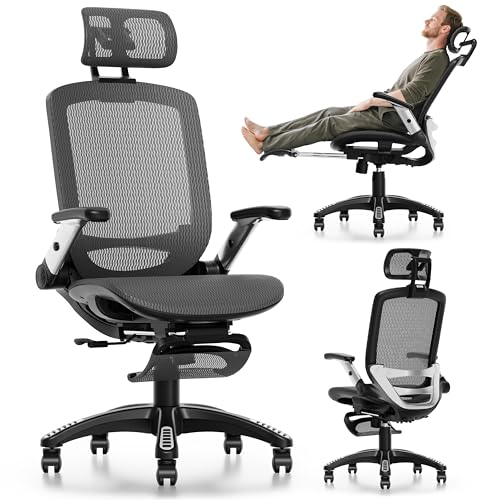
- All-mesh seat and back for airflow
- Retractable steel footrest
- 135° recline with 3D headrest
Best For: Programmers wanting breathable support and built-in relaxation features
Best Overall Fit – ProtoArc EC200
The ProtoArc EC200 is a strong ergonomic office chair for programmers who want precise seat positioning during long coding sessions. Its sliding seat depth, adjustable lumbar support, mesh back, and four-stage recline make it especially useful for users within its stated 5’4″–6’0″ and under-220-pound range.
Best For: Programmers seeking detailed fit adjustments and all-day support in a compact home-office chair.
Pros:
- Five-position seat-depth adjustment helps support the thighs without putting pressure behind the knees.
- Lumbar support adjusts vertically and in depth, while the 3D headrest adds upper-body support.
- Four recline lock positions and tilt-tension control accommodate work, reading, calls, and breaks.
- 55D foam, a mesh back, and a three-year warranty support daily use.
Cons:
- Its recommended user range excludes people over 220 pounds or outside the stated height range.
- Assembly is required, and the chair has a relatively narrow 17-inch backrest.
The EC200 stands out when ergonomic fit is the priority. Its independent seat-depth adjustment is particularly valuable for programmers who spend eight or more hours at a desk, provided the size limits match your body.
Best for Larger Users – 400lb Big and Tall Office Chair
This big-and-tall model is a practical ergonomic office chair for programmers who need a higher weight capacity and a roomier, cushioned seat. Its breathable mesh back, thick seat, flip-up arms, and adjustable height suit extended computer work while also accommodating desks and standing tables.
Best For: Users who need up to 400 pounds of support and a thick, spacious seat for home or office work.
Pros:
- 400-pound maximum weight recommendation and a large 28-inch five-star base emphasize stability.
- Five-inch cushion and breathable nylon mesh help balance padding and airflow.
- Adjustable seat height, backrest, lumbar support, and flip-up arms allow a flexible setup.
- Casters are designed for movement across tile, wood, carpet, and other flooring.
Cons:
- The stated suitable height range is approximately 5’5″–6’2″, so it may not fit everyone.
- It offers two reclining positions rather than the broader range found on some alternatives.
- Assembly takes about 30 minutes and is required.
This chair favors capacity and straightforward adjustability over highly granular ergonomic customization. It is a sensible choice for programmers who want a supportive, cooler-feeling seat and need a 400-pound rating.
Best with Footrest – OdinLake L2 Ergo PRO 633
The OdinLake L2 is an ergonomic office chair for programmers who want full-back support plus a way to stretch out between coding tasks. Its integrated contoured back, 4-inch molded foam seat, adjustable seat depth, 135-degree recline, and retractable footrest combine focused desk support with comfortable breaks.
Best For: Programmers who want a cushioned seat and integrated footrest for alternating work and relaxation.
Pros:
- One-piece contoured backrest supports the lower, mid, and upper back.
- Four-inch molded foam seat with a waterfall edge helps distribute pressure across the hips and thighs.
- Adjustable seat depth, 3D armrests, headrest, and seat height support personalized positioning.
- 135-degree recline, retractable footrest, breathable mesh, and a five-year warranty add versatility.
Cons:
- The 300-pound maximum weight recommendation is lower than the 400-pound model in this roundup.
- Assembly is required.
- The footrest and reclining design may be more than needed for a strictly task-focused workstation.
The L2 is appealing for programmers who alternate between concentrated work and recovery breaks. Its combination of a thick foam seat and footrest is less minimalist than a standard task chair, but it offers more relaxation flexibility.
Best Adjustable Mesh Option – Marsail RM-MSOC10B
The Marsail RM-MSOC10B is a versatile ergonomic office chair for programmers who want breathable mesh and a broad set of upper-body adjustments. Its adjustable lumbar system, 3D armrests, 2D headrest, and 90- to 120-degree recline help support changing postures throughout a workday.
Best For: Programmers who prefer a cool mesh back and flexible arm, headrest, lumbar, and recline adjustments.
Pros:
- Lumbar support adjusts 1.18 inches forward and backward and 2.16 inches up and down.
- 3D armrests move forward, backward, and side to side, and can flip up.
- Responsive mesh back promotes airflow, while the 3.14-inch foam seat provides cushioning.
- 330-pound maximum weight recommendation offers more capacity than many standard task chairs.
Cons:
- Its listed dimensions and seat measurements are unusually large, so verify available desk space carefully.
- The recline range is 90 to 120 degrees, with two listed reclining positions.
- Assembly is required.
The Marsail is a good middle ground for programmers who want extensive adjustability without adding a footrest. Its mesh back and movable armrests are especially useful for users who change keyboard, mouse, reading, and meeting positions.
Best All-Day Adjustability – SIHOO B300 Pro
The SIHOO B300 Pro is a strong ergonomic office chair for programmers who want fine control over lumbar position, seat depth, arm support, and recline resistance. Its spring-assisted 4D lumbar system and independently adjustable backrest are designed to stay aligned as you shift between coding, meetings, and breaks.
Best For: Programmers who prioritize highly adjustable back and arm support during long desk sessions.
Pros:
- Spring-assisted 4D lumbar support moves with your body and adjusts in height and depth.
- Adjustable backrest and seat depth help accommodate different heights and leg lengths.
- 6D armrests, a 3D headrest, breathable mesh, and recline up to 135° support varied work positions.
- Includes a 3-year warranty and 30-day returns.
Cons:
- Does not include a footrest.
- The many adjustment options may take time to dial in.
Choose this model if personalized fit matters more than simplicity. The automatic weight-sensing recline and moving lumbar support make it especially practical for programmers who alternate between focused typing and relaxed thinking.
Best for Custom Fit – Marsail Mesh Office Chair
The Marsail mesh chair is a practical ergonomic office chair for programmers who need adjustable support without a fixed sitting position. Its six-level lumbar adjustment, sliding seat, 6D armrests, and four-position recline help you configure the chair for coding, calls, reading, or study.
Best For: Remote workers, students, and programmers who want flexible positioning and breathable seating.
Pros:
- Six-level lumbar support helps accommodate different waist positions and sitting habits.
- Sliding seat depth adjusts from 20 to 21.6 inches for more tailored thigh support.
- 6D armrests and a 3D headrest offer extensive upper-body positioning options.
- Breathable mesh and a curved front edge help limit heat and thigh pressure.
Cons:
- Recline locks at 90°, 99°, 109°, or 121°, with fewer positions than some competing models.
- The extensive armrest adjustments may feel unnecessary for users who prefer a simpler chair.
This is a balanced choice for users who regularly change tasks and posture. The sliding seat is particularly useful when standard chair dimensions do not provide the right leg support.
Best for Comfort – GABRYLLY Reclining Office Chair
The GABRYLLY is an ergonomic office chair for programmers who want a workstation seat that can also support breaks and relaxation. It combines two-way lumbar adjustment with a 135° recline, retractable footrest, adjustable headrest, and a large steel base rated to support up to 300 pounds.
Best For: Programmers who want to recline, stretch their legs, or take short rest breaks without leaving the desk.
Pros:
- Two-way lumbar support adjusts vertically and horizontally to follow the lower back.
- Retractable two-level footrest extends up to 18.1 inches.
- Three recline positions—90°, 110°, and 135°—support work and relaxation.
- 3D armrests, adjustable mesh headrest, steel base, and silent wheels add flexibility and stability.
Cons:
- The stated recommended height range is 5’3″ to 6′, so it may not suit everyone.
- The footrest and reclining design may be more than users need for strictly upright coding.
This model stands out when relaxation features are part of your buying criteria. It is a compelling hybrid for programmers who work long sessions, game after hours, or use the chair for occasional naps.
Thick-Seat Lumbar Support – Adjustable Dual-Lumbar Office Chair
If you want an ergonomic office chair for programmers that prioritizes lower-back adjustability and cushioning, this high-back mesh model is a practical option. Its independent dual lumbar zones, thick foam seat, adjustable height, and recline function are suited to long coding sessions and varied desk work.
Best For: Programmers who want substantial seat cushioning, customizable lumbar support, and a roomy fit for extended home-office use.
Pros:
- Independent dual lumbar zones with forward/backward adjustment provide more targeted lower-back support.
- Extra-thick 4.3-inch high-density foam seat and 20.1-by-20.5-inch dimensions offer generous cushioning.
- Supports up to 350 pounds and includes breathable high-back mesh, flip-up padded arms, a 3D headrest, and 125-degree recline.
- Lifetime warranty, smooth casters, 360-degree swivel, and guided assembly add practical convenience.
Cons:
- The substantial cushioned seat may feel warmer or less flexible than an all-mesh seat.
- Its stated height range is broad, but individual fit will still depend on desk and leg proportions.
Choose this chair if seat depth, cushioning, and independently adjustable lumbar support matter more to you than a minimalist design. It also makes sense for users who want a higher weight capacity and a recline option without sacrificing desk-friendly flip-up arms.
Work-to-Rest Mesh Design – Office Chair with Footrest
This ergonomic office chair for programmers combines an all-mesh seat and back with a retractable footrest, making it useful for switching between focused work and breaks. Adjustable height, recline, headrest, lumbar support, and flip-up arms allow you to tailor the chair for coding, meetings, reading, or relaxing.
Best For: Remote workers and programmers who want breathable mesh, a footrest, and a chair that can recline for breaks.
Pros:
- Full-body mesh promotes airflow and is designed to resist wear during regular use.
- Retractable steel footrest extends up to 18.1 inches and pairs with recline settings up to 135 degrees.
- Includes a 3D headrest, lumbar support, flip-up armrests, and a wide 20.5-by-20-inch seat.
- Supports up to 300 pounds, includes silent PU wheels, and comes with a three-year warranty.
Cons:
- The recommended user height range is 5’2″ to 6’1″, which may not suit especially short or tall users.
- An integrated footrest adds functionality but also introduces another component to adjust and maintain.
This is a strong fit if you prefer a cooler all-mesh feel and want a built-in way to elevate your legs during breaks. Its 135-degree recline and footrest are especially useful for long workdays that include webinars, reading, or short rest periods.
Adaptive Lumbar Engineering – NEWTRAL Ergonomic Office Chair
For programmers who move frequently between typing, reviewing code, and leaning back, this ergonomic office chair for programmers emphasizes adaptive support. Its auto-following lumbar mechanism tracks the lower-back curve, while adjustable seat depth, back height, 4D armrests, and a 136-degree tilt help fine-tune the sitting position.
Best For: Users who want highly adjustable lumbar, arm, seat-depth, and back-support settings for varied desk postures.
Pros:
- Auto-tracking lumbar support is designed to follow the natural curve of the lower back as you move.
- 4D armrests move vertically, horizontally, and sideways for detailed positioning.
- Adjustable seat depth and back height can help accommodate different body proportions.
- Includes a 2D headrest, 136-degree tilt lock, and a gas lift tested through more than 100,000 lift-and-lower cycles.
Cons:
- The chair requires assembly, and its extensive adjustments may take time to dial in.
- The supplied specifications contain varying weight references; the stated recommended maximum is 330 pounds, with another listing showing 350 pounds.
- The listed dimensions and 17-inch seat depth may feel compact for some users.
This model is best considered when adjustment range is your priority. The adaptive lumbar system and adjustable seat depth offer more personalization than a basic fixed-support chair, while the robust base and tested gas lift support regular office use.
How We Picked the Best Ergonomic Office Chair for Programmers
We focused on features that matter during long periods of coding, debugging, reading, and video meetings. Each selected chair offers some combination of adjustable lumbar support, seat-height or seat-depth adjustment, armrest positioning, recline control, breathable materials, and a stable base. We also included options for different body sizes, budgets, and preferences, such as chairs with footrests, molded foam seats, wide cushions, and heavy-duty frames.
Because comfort is personal, no single design suits every programmer. A chair that feels supportive at a compact desk may be too wide for another workspace, while a deeply reclining model may be useful for breaks but unnecessary for users who prefer an upright posture.
Quick Comparison
| Best For | Look For | Most Relevant Features |
|---|---|---|
| Long coding sessions | Adjustable lumbar and seat depth | Back support, pressure distribution, posture control |
| Relaxing between tasks | Recline and footrest | Leg support, tilt lock, headrest |
| Larger users | Wide seat and high weight capacity | Stable base, reinforced frame, generous cushioning |
| Warm rooms | Mesh back and seat | Airflow, flexible support, easier heat management |
| Precise positioning | 4D armrests and adjustable seat | Keyboard and mouse alignment, shoulder relief |
Key Buying Factors for an Ergonomic Office Chair for Programmers
Lumbar and Upper-Back Support
Look for lumbar support that can be adjusted in height, depth, or tension rather than a fixed pad. A high back and headrest can also help during extended reading or meetings, but they should not force your head forward.
Seat Depth and Cushioning
Your lower back should contact the backrest while leaving a small gap behind your knees. Adjustable seat depth is especially useful if multiple people share the chair. Foam seats can feel supportive and stable, while mesh seats typically provide better airflow.
Armrests and Desk Compatibility
Adjustable armrests should let your elbows rest close to your sides without lifting your shoulders. Check the chair’s minimum and maximum height against your desk, and make sure the armrests can fit beneath the desktop if you want to sit close to the keyboard.
Recline, Footrests, and Base Stability
A reclining backrest is useful for changing posture throughout the day. Footrests add comfort during breaks, but they are not a substitute for correct desk height. Prefer a wide, stable base and smooth casters suitable for your floor type.
Who Should Buy Which Ergonomic Office Chair for Programmers?
- Choose an adjustable seat-depth model if posture and leg support are your top priorities or more than one person will use the chair.
- Choose a footrest and reclining model if you alternate between focused work, reading, gaming, and relaxation.
- Choose a heavy-duty wide-seat chair if you need extra room, a higher weight rating, or a more substantial frame.
- Choose a breathable mesh design if you work in a warm room or dislike thick upholstery.
- Choose advanced lumbar and armrest adjustments if you spend most of the day at the keyboard and want precise positioning.
Before buying, verify the published weight capacity, seat dimensions, return policy, and warranty. The best Ergonomic Office Chair for Programmers is the one that fits your body, desk, and working habits well enough to support consistent posture without restricting natural movement.