Moisture-sensitive filament can cause stringing, popping, weak layers, and inconsistent extrusion—even when your Bambu Lab printer is calibrated correctly. The right dryer helps restore damp filament and keeps it ready for reliable printing.
We compared 10 filament dryers for Bambu Lab, including AMS-compatible heaters, independent multi-spool systems, and enclosed dryers with active storage. The best choice depends on your filament types, spool count, available space, and whether you want to dry while printing.
Best 10 Filament Dryer for Bambu Lab Picks for 2026
Multi-Spool Control
Chitu Systems E1 Filament Dryer
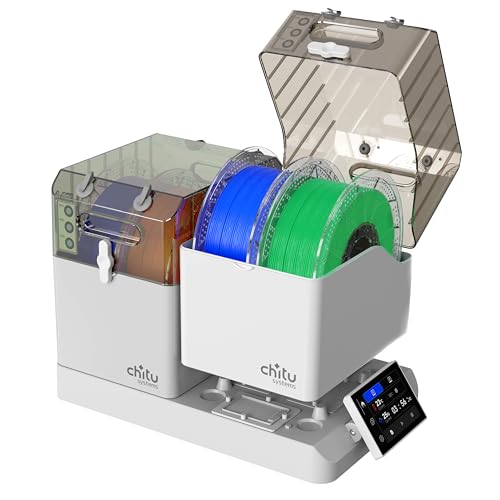
- Dries and stores four spools
- Independent chamber controls
- Automatic humidity monitoring
Best For: Multi-material and multi-printer setups
High-Capacity Standalone

- Holds four 1 kg or two 2 kg spools
- Dual 200W heating chambers
- Up to 85°C with sealed storage
Best For: High-volume and advanced-material printing
Best Multi-Spool Upgrade
EIBOS Tetras for Bambu Lab AMS
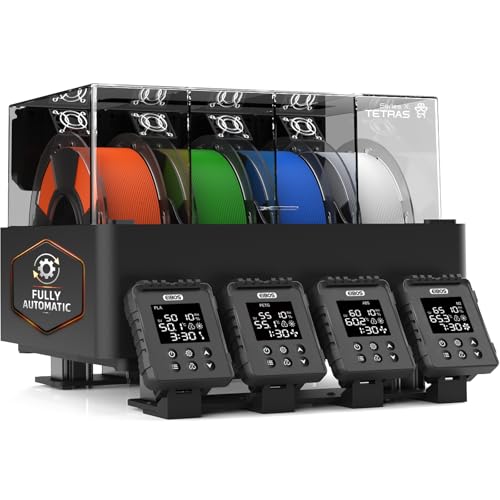
- Four independent drying chambers
- Dries while printing
- Automatic venting and sealing
Best For: AMS Gen 1 owners printing multiple materials
Best Standalone Dryer
Creality Space Pi SE Filament Dryer

- Heats to 65°C in 15 minutes
- Fits most 1 kg spools
- Simple humidity and timer display
Best For: Users wanting a standalone dryer for everyday filament
Best Balanced AMS Add-On

- Two independent drying chambers
- Four-spool capacity
- Active drying while printing
Best For: AMS Gen 1 users needing controlled four-spool drying
Best Value Pick
Creality Space Pi Filament Dryer

- 360° PTC hot-air heating
- Presets for up to 12 materials
- 0–48-hour timer with power-off memory
Best For: Everyday drying of 1.75 mm and 2.85 mm filament
Best for Multi-Printer Setups
Creality Space Pi X4 Filament Dryer
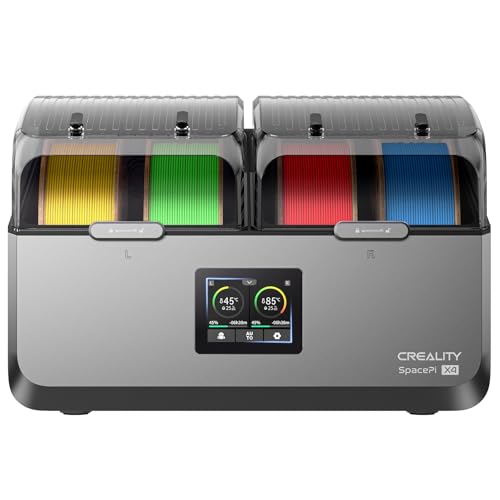
- Four-spool drying and printing
- Independent dual-chamber temperatures
- Reaches up to 85°C
Best For: Workshops and multi-printer workflows
Best Two-Spool Option
Creality Space Pi Filament Dryer Plus
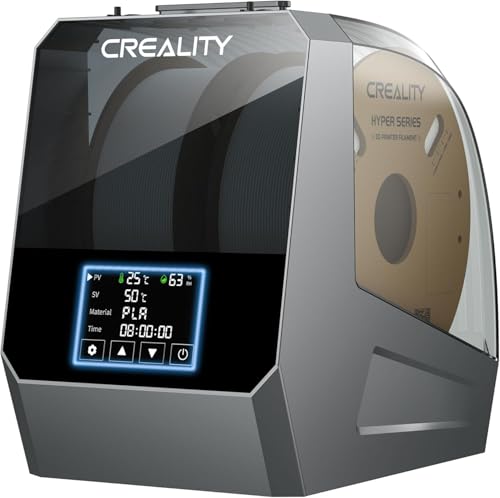
- Holds two 1 kg filament rolls
- Dual 360° PTC hot-air heating
- Four-inch touchscreen with 12 presets
Best For: Home users running two spools or printers
AMS Drying Upgrade – SUNLU AMS Heater for Bambu Lab
If you want a filament dryer for Bambu Lab that works inside your existing AMS Gen 1, this SUNLU heater is a practical upgrade. It replaces the original AMS top cover, heats to 70°C in about 20 minutes, and is designed to dry up to four spools while printing.
Best For: Bambu Lab AMS Gen 1 owners who want simultaneous drying and printing without buying a separate dryer.
Pros:
- Supports drying while printing with an AMS Gen 1.
- Four-spool capacity with dual airflow for more even heating.
- Automatic humidity-based operation and multiple safety features.
- Tool-free installation takes about two minutes.
Cons:
- AMS unit is not included.
- Designed for AMS Gen 1 rather than newer AMS generations.
This is a convenient choice when keeping filament in the AMS is more important than having a standalone appliance. Confirm your AMS generation before ordering.
Multi-Spool Control – Chitu Systems E1 Filament Dryer
The Chitu Systems E1 is a standalone filament dryer for Bambu Lab users who need multi-spool capacity and more control than a basic drying box. It holds four spools, provides real-time humidity monitoring, and uses independently controlled heating chambers for different materials.
Best For: Multi-material setups that need simultaneous drying, storage, and separate temperature or time settings.
Pros:
- Holds four spools and includes eight filament holes with PTFE tubes.
- Automatic activation when internal humidity reaches or exceeds 50%.
- Dual 120W PTC heaters and fans circulate warm air for even drying.
- Touchscreen offers presets and independent chamber control.
Cons:
- Its 3.5 kg weight and multi-chamber design may require more workspace.
- Separate controls may be more functionality than simple single-spool users need.
The E1 stands out for users printing with varied materials such as PLA, PETG, ABS, PA, PC, or TPU. Its humidity monitoring also lets it function as a storage box between prints.
Simple AMS Upgrade – SUNLU AMS Heater Gen 1
This SUNLU unit is a focused filament dryer for Bambu Lab AMS Gen 1 systems. It replaces the stock lid without modifying the AMS, enabling simultaneous printing and drying while reaching 70°C in approximately 20 minutes.
Best For: Users who want a straightforward, non-destructive way to add drying to a Bambu Lab AMS Gen 1.
Pros:
- Enables simultaneous printing and drying.
- Supports the AMS Gen 1’s existing functions.
- Airflow is directed toward the filament area to help protect the feeding motor.
- Includes installation hardware and a power cord.
Cons:
- Not compatible with Bambu Lab AMS 2nd generation.
- AMS itself is not included.
Choose this model when compatibility and simple installation are the priorities. It offers the same four-spool, 70°C drying concept as a practical AMS lid replacement, but generation compatibility is essential.
High-Capacity Standalone – Creality Space Pi X4 Dryer
The Creality Space Pi X4 is a high-capacity filament dryer for Bambu Lab users who prefer a standalone box rather than an AMS modification. Its dual heating chambers hold four standard 1 kg spools or two 2 kg spools, with temperatures reaching up to 85°C.
Best For: High-volume printing setups that need four-spool drying, sealed storage, and support for a broad range of filament materials.
Pros:
- Fits four standard 1 kg spools or two large 2 kg spools.
- Dual independent 200W heating chambers support separate drying zones.
- Reaches up to 85°C for materials including ABS, PET, PC, ASA, PA, and PAHT.
- Sealed storage helps limit moisture re-absorption during pauses.
Cons:
- Standalone design requires additional desk or printer-area space.
- Its feature set may be excessive for users who only dry one spool at a time.
The Space Pi X4 is a strong capacity-oriented alternative to an AMS-mounted dryer. Its large spool support and higher maximum temperature make it especially useful for demanding materials, while the illuminated window allows monitoring without opening the enclosure.
Best Multi-Spool Upgrade – EIBOS Tetras for Bambu Lab AMS
If you need a filament dryer for Bambu Lab that can handle several materials at once, the EIBOS Tetras is designed as a drop-in upgrade for Bambu Lab AMS Gen 1. It provides four independently controlled drying chambers, allowing different spools to use separate temperature and humidity settings while printing.
Best For: Bambu Lab AMS Gen 1 owners who print with multiple materials and want active drying during prints.
Pros:
- Four independent chambers support separate drying settings for up to four spools.
- Dries filament while printing, with temperature control from 20°C to 65°C.
- Automatic venting, sealing, and humidity monitoring help maintain storage conditions.
- Supports materials including PLA, ABS, PETG, TPU, and Nylon.
Cons:
- It is an add-on for Bambu Lab AMS Gen 1; the AMS is not included.
- Its 110V setup and 8.8-pound weight may require dedicated placement.
Tetras is the most capable option here for users who need independent control across four spools. Its separate power supply and independent operation also mean dryer performance is not tied to Bambu Lab firmware updates.
Best Standalone Dryer – Creality Space Pi SE Filament Dryer
The Creality Space Pi SE is a practical filament dryer for Bambu Lab users who want a standalone box rather than an AMS upgrade. It fits most 1 kg spools, heats from 45°C to 65°C, and uses circulating hot air to address moisture-related stringing, clogging, and adhesion problems.
Best For: Bambu Lab owners seeking an easy-to-use standalone dryer for common 1 kg spools.
Pros:
- Reaches 65°C within 15 minutes using an upgraded PTC heating system.
- Supports PLA, PETG, TPU, ABS, ASA, PP, PC, and Nylon.
- Simple display and knob provide real-time humidity and countdown information.
- Adjustable drying time runs from 0 to 24 hours.
Cons:
- Its 45°C minimum temperature offers less low-temperature flexibility than the EIBOS AMS upgrades.
- It holds one 1 kg spool rather than multiple independently controlled spools.
- The supplied warranty is six months.
Choose the Space Pi SE if you prefer a no-assembly dryer that works separately from your Bambu Lab printer. After drying, the manufacturer recommends moving filament to a vacuum bag for longer-term storage.
Best Balanced AMS Add-On – EIBOS Dyas for Bambu Lab AMS
The EIBOS Dyas is a filament dryer for Bambu Lab AMS Gen 1 that combines active drying with AMS-compatible storage. Its two independent chambers can handle four spools, letting you set separate drying conditions while filament feeds to the printer.
Best For: AMS Gen 1 users who want four-spool capacity with two independently controlled drying zones.
Pros:
- Two independent chambers provide separate heater, fan, temperature, and humidity controls.
- Each chamber supports 20°C to 65°C operation and drying times up to 24 hours or unlimited operation.
- Automatic exhaust, sealing, and humidity mode support drying and storage.
- Second-stage thermal processing helps maintain consistent feeding, including with TPU.
Cons:
- It requires Bambu Lab AMS Gen 1 and does not include the AMS.
- Two chambers provide less individual control than a four-chamber design.
- Installation adds hardware to the existing AMS setup.
Dyas offers a middle ground between a basic standalone box and a fully independent chamber system. It is a strong fit when four-spool capacity matters but two controlled zones are sufficient for your typical material combinations.
Best Value Pick – Creality Space Pi Filament Dryer
If you need a practical filament dryer for Bambu Lab or another FDM printer, the Creality Space Pi offers uniform 360° hot-air circulation, broad material support, and straightforward touchscreen controls. Its 45°C–70°C range suits common filaments such as PLA, PETG, TPU, and ABS, along with several composite materials.
Best For: Everyday users who want one dryer for common and composite 1.75 mm or 2.85 mm filament.
Pros:
- 360° hot-air circulation and a 110W PTC heater are designed for more even drying.
- Presets support up to 12 filament types, including PLA-CF, PA-CF, and ASA.
- Adjustable 0–48-hour timer and power-off memory add convenience.
- 3.7-inch LCD touchscreen supports Celsius and Fahrenheit.
Cons:
- Temperature tops out at 70°C, which may be limiting for some higher-temperature drying needs.
- Its capacity is not specified in the supplied details.
This is a versatile single-box option for routine filament maintenance. The wide material compatibility and memory function make it particularly convenient for regular printing setups.
Best for Multi-Printer Setups – Creality Space Pi X4 Filament Dryer
For a multi-printer workflow, the Space Pi X4 is a strong filament dryer for Bambu Lab users who need to dry and feed several spools at once. It holds four spools, uses eight filament holes with PTFE tubing, and provides separate temperature control for its two chambers.
Best For: Workshops or print farms that need simultaneous drying and printing across multiple printers.
Pros:
- Dries and prints with four spools at the same time.
- Dual chambers can run different filament types at independent temperatures.
- Dual 200W PTC heaters reach up to 85°C for engineering materials such as PA, PAHT, and PC.
- Single-chamber mode can save up to 40% energy, according to the supplied product notes.
Cons:
- Other brands’ plastic trays should be checked for heat resistance before use.
- The larger four-spool design may be more than a single-printer user needs.
The X4 stands out when throughput matters more than compactness. Independent chambers and higher maximum heat make it the most capable choice here for users managing multiple materials and printers.
Best Two-Spool Option – Creality Space Pi Filament Dryer Plus
The Creality Space Pi Filament Dryer Plus is a useful middle ground for a filament dryer for Bambu Lab: it accommodates two 1 kg rolls while offering dual 360° hot-air heating and four filament outlets. It is suited to users who want to dry filament while feeding two printers or changing materials less often.
Best For: Home users who need two-spool capacity, broad material support, and simple preset operation.
Pros:
- Two-roll capacity supports drying and printing from two spools simultaneously.
- Dual 160W PTC heating with 360° airflow is designed for uniform drying.
- One-key settings cover up to 12 filament types, including PA, PC, ASA, and carbon-fiber blends.
- Four-inch touchscreen and adjustable 45°C–70°C range simplify operation.
Cons:
- Maximum temperature is 70°C, below the Space Pi X4’s 85°C rating.
- It is larger and heavier than a basic single-spool dryer.
This model balances capacity and usability well. Choose it over the single-spool Space Pi when you regularly work with two materials, but do not need the X4’s four-spool, dual-temperature setup.
How We Picked the Best Filament Dryer for Bambu Lab
We focused on practical features that matter in a Bambu Lab setup: AMS compatibility, drying temperature, chamber design, spool capacity, humidity control, heating consistency, and the ability to feed filament while drying. We also considered whether each unit is better suited to occasional filament recovery, everyday storage, or managing several spools at once.
Because filament requirements vary, no single dryer is ideal for every material. PLA and PETG generally need less heat than moisture-sensitive nylon, TPU, or polycarbonate, so temperature control and manufacturer guidance are important.
Quick Comparison
| Type | Best For | Main Advantage |
|---|---|---|
| AMS heater | Bambu Lab AMS owners | Dries or warms filament inside the AMS while printing |
| Four-spool dryer | Multi-material workflows | Handles several spools with separate or controlled chambers |
| Dual-spool dryer | Routine home printing | Good balance of capacity, size, and drying speed |
| High-temperature dryer | Nylon and other demanding materials | Higher heat range for more thorough moisture removal |
Key Buying Factors for a Filament Dryer for Bambu Lab
AMS Compatibility and Feeding
If you want to dry filament without removing it from your Bambu Lab AMS, choose a purpose-built AMS heater or upgrade designed for the correct AMS generation. Confirm the product supports your AMS version and that the filament path remains unobstructed.
Temperature Range
Look for adjustable temperature rather than a single preset. Lower settings are useful for PLA and materials that can deform, while higher settings may be needed for nylon and other hygroscopic filaments. Always follow the filament manufacturer’s drying recommendations.
Capacity and Chamber Layout
A two-spool dryer is often easier to fit beside a printer, while four-spool models suit users who print frequently or switch materials often. Independent chambers can prevent one spool from affecting another and may allow different settings at the same time.
Humidity Control and Storage
A dryer that can hold a target humidity after heating is more useful than one that only warms the spool. Sealed storage, humidity monitoring, and automatic humidity hold help keep filament ready between prints.
Heating Performance and Controls
Consider heating uniformity, wattage, circulation, sensor accuracy, timer controls, and display readability. Even heating is preferable to a unit that creates hot spots, especially with flexible or temperature-sensitive filament.
Who Should Buy Which Filament Dryer for Bambu Lab?
- Bambu Lab AMS owners: Choose an AMS-compatible heater if you want a compact solution that supports drying while printing.
- High-volume or multi-material users: A four-spool dryer with independent chambers offers greater flexibility and capacity.
- Most home printers: A dual-spool dryer is a practical compromise between footprint, cost, and throughput.
- Nylon and moisture-sensitive filament users: Prioritize a well-controlled higher-temperature model with reliable circulation and humidity management.
- Occasional users: A simpler dryer may be sufficient if you mainly need to revive one or two damp spools before printing.
Before buying, check spool dimensions, maximum temperature, power requirements, and compatibility with your exact Bambu Lab AMS generation. The best Filament Dryer for Bambu Lab is the one that matches your materials and workflow without adding unnecessary complexity.