Choosing the right particle counters depends on where you’ll use them, what particle sizes matter, and how much accuracy you need. From portable indoor air monitors to cleanroom-grade handheld units, the best option is the one that matches your workflow.
Below, we’ve narrowed the field to 10 strong picks for 2026, focusing on measurement range, usability, monitoring features, and value for buyers who need reliable air data.
Best 10 Particle Counters Picks for 2026
Portable Multi-Size Monitoring
Temtop Handheld Airborne Particle Counter

- Measures 0.3 µm, 0.5 µm, 1.0 µm counts
- Tracks PM2.5, PM10, TSP plus temp/humidity
- 32GB logging and USB export for field use
Best For: portable inspections and general indoor air quality checks
Budget Dust Counter
PerfectPrime AQ9600 Particle Detector

- Measures 0.3 µm, 2.5 µm, and 10.0 µm
- Custom sampling from 1 second to 59:59
- Compact handheld unit with adapter included
Best For: basic indoor air quality checks with flexible sampling
Professional Compliance Pick

- Measures PM1.0, PM2.5, PM10, and TSP
- Constant-flow sampling with RS-485 Modbus
- 32GB logger with calibration support
Best For: industrial hygiene, compliance, and facility monitoring
Indoor Air Quality Logger
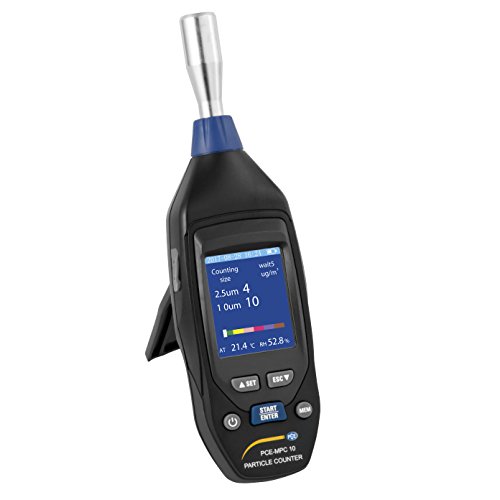
- Measures PM2.5 and PM10
- Tracks temperature and humidity
- 5000-record logger with USB and color display
Best For: routine indoor air quality monitoring with easy-to-read logs
Cleanroom-Grade Precision
Temtop Professional Particle Counter & Environmental Monitor
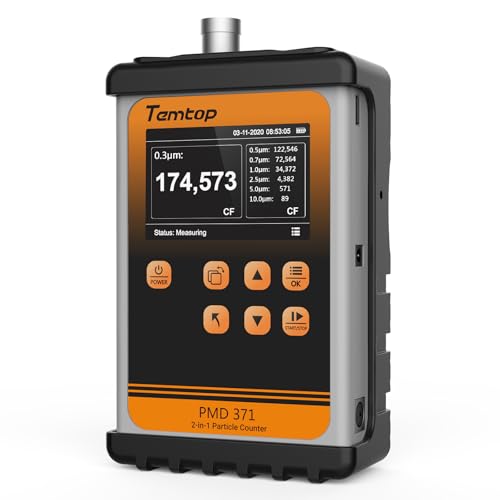
- Measures PM and particle counts from 0.3μm to 10μm
- 2.83L/min pump with ISO 21501 and NIST-aligned design
- 8GB storage, USB/RS-232 export, 4-inch display
Best For: Cleanrooms, labs, hospitals, and industrial particulate monitoring
All-in-One Indoor Monitor
Temtop PM2.5 PM10 Air Quality Monitor with Export

- Measures PM2.5, PM10, HCHO, VOCs, temp, humidity, and AQI
- 12-hour trend histogram and Excel export for reporting
- Portable battery mode or plug-in continuous monitoring
Best For: Homes, offices, schools, and renovation air checks
Portable Audit Tool
Portable Laser Particle Counter with PDF Export

- Measures 0.3μm, 2.5μm, and 10μm particles
- 3.2-inch display with real-time data and trends
- Exports PDF reports and transfers data via USB
Best For: Cleanroom audits, inspections, and portable industrial testing
Portable PM2.5 Monitor

- PM2.5 and PM10 monitoring with visual indicators
- Stores 12 hours of air-quality data
- Handheld design for indoor and outdoor use
Best For: portable everyday air-quality checks
Handheld Pump Meter
Temtop Airing-2000 Particle Counter
- Measures 0.3µm, 0.5µm, 1.0µm, PM2.5, PM10, and TSP
- Adds temperature and humidity sensing
- 32GB storage with USB data transfer
Best For: lab, facility, and workshop monitoring
ISO Cleanroom Counter
Temtop PMD331 Laser Dust Monitor

- ISO 21501-4 compliant with calibration
- Monitors 7 particle sizes from 0.3µm to 10µm
- Stores over 2,000,000 records with export support
Best For: cleanrooms and compliance-focused monitoring
Portable Multi-Size Monitoring – Temtop Handheld Airborne Particle Counter
If you need particle counters for spot-checking indoor air quality, this Temtop handheld model gives you a broad reading set in one device. It measures 0.3 µm, 0.5 µm, and 1.0 µm particle counts along with PM2.5, PM10, and TSP, so it’s useful for tracking fine dust, allergens, and general airborne pollution across homes, offices, schools, and job sites.
Best For: Users who want a portable all-in-one particle counter with temperature, humidity, and onboard logging.
Pros:
- Measures multiple particle sizes plus PM2.5, PM10, and TSP
- Includes temperature and humidity sensors for fuller indoor air monitoring
- 32GB memory with automatic data logging and USB flash drive export
- 3500mAh battery supports over 4 hours of continuous use
Cons:
- Built for handheld use, so it may not suit fixed-install monitoring needs
- No software is needed, but that also means analysis is limited to exported records
This is a practical choice if you want portable particle counters that can handle quick inspections and longer walkthroughs without much setup. The clear display and simple controls make it easy to use in the field, while the built-in logging adds value for repeat testing.
Budget Dust Counter – PerfectPrime AQ9600 Particle Detector
PerfectPrime AQ9600, PM 0.3/2.5/10 Μm Air Quality Particle/Dust Detector/Counter
Check Price On AmazonThe PerfectPrime AQ9600 is a straightforward option among particle counters if you mainly need PM readings in a compact, handheld format. It measures 0.3 µm, 2.5 µm, and 10.0 µm particles, with sampling settings you can customize from 1 second to nearly an hour, making it suitable for basic indoor air quality checks and quick dust monitoring.
Best For: Buyers who want a simpler PM-focused particle counter with adjustable sampling and compact dimensions.
Pros:
- Measures 0.3 µm, 2.5 µm, and 10.0 µm particle sizes
- Custom sampling from 1 second to 59 minutes 59 seconds
- Supports continuous or frequency-based sampling
- Includes an adapter and uses a semiconductor laser light source
Cons:
- 9V DC battery is not included
- Does not list temperature or humidity monitoring
For shoppers comparing particle counters on functionality alone, this model keeps the feature set focused on particle measurement and sampling flexibility. It is a practical pick if you want a basic counter without extra environmental sensors or advanced connectivity.
Professional Compliance Pick – Temtop Aerosol Mass Monitor
If you need particle counters for industrial hygiene or environmental compliance, the Temtop PMD351 is built for more rigorous work. It reports PM1.0, PM2.5, PM10, and TSP in real time, uses a constant-flow sampling system with a German Furgut vacuum pump, and adds RS-485 Modbus support for remote monitoring and facility integration.
Best For: Professionals who need a high-accuracy aerosol mass monitor with logging, calibration support, and integration options.
Pros:
- Real-time PM1.0, PM2.5, PM10, and TSP monitoring
- Constant 2.83 L/min flow for stable sampling conditions
- 32GB storage with over 2 million data sets and USB export
- RS-485 Modbus output for remote monitoring systems
Cons:
- Heavier and less casual than typical handheld meters
- Designed for professional use, so it may be more than basic home users need
This model stands out among particle counters when data quality and service support matter more than price or simplicity. The included calibration service, warranty, and technical support make it especially appealing for ongoing professional deployment.
Indoor Air Quality Logger – PCE Instruments PCE-MPC 10
The PCE-MPC 10 is a practical choice if you want particle counters that focus on indoor air quality with simple, readable output. It measures PM2.5 and PM10 while also tracking temperature and humidity, and the 2-inch full-color display makes the readings easy to review during routine checks.
Best For: Home or workplace users who want a straightforward air quality particle counter with logging and a color display.
Pros:
- Measures PM2.5 and PM10 for basic particulate monitoring
- Includes temperature and humidity measurement
- 2-inch full-color LCD with user-friendly graphics
- 5000-data logger plus USB transfer for recordkeeping
Cons:
- Does not list fine particle size channels like 0.3 µm
- More limited than professional mass-monitoring models
For buyers comparing particle counters for everyday indoor use, this model keeps the experience simple while still offering useful environmental context. It is a solid fit if you want logged readings and clear visuals without moving into more advanced industrial equipment.
Cleanroom-Grade Precision – Temtop Professional Particle Counter & Environmental Monitor
If you need particle counters for cleanrooms, labs, or other sensitive environments, this Temtop unit is built for more serious monitoring than a basic air tester. It measures both particle concentration and particle count across multiple particle sizes, and it adds industrial features like a metal body, high-flow pump, and broad data export options for more structured reporting.
Best For: Cleanrooms, laboratories, hospitals, and industrial users who need detailed particulate analysis.
Pros:
- Measures PM1, PM2.5, PM4, PM10, TSP plus particle counts from 0.3μm to 10μm
- Uses Mie-scattering sensing with a 2.83L/min pump for professional-grade monitoring
- Stores 2,000,000+ data sets and supports USB plus RS-232 Modbus transfer
- Metal construction, 8-hour battery life, and a 4-inch display for field use
Cons:
- ISO certificates for individual units are optional and may cost extra
- More capability than casual home users are likely to need
This is a strong fit when you need a particle counter focused on detailed particulate analysis and data handling, not just quick spot checks. The accessory package and 5-year warranty also make it easier to deploy in professional settings.
All-in-One Indoor Monitor – Temtop PM2.5 PM10 Air Quality Monitor with Export
For buyers who want particle counters plus broader indoor air tracking, this Temtop monitor combines PM2.5 and PM10 measurement with formaldehyde, TVOC, temperature, humidity, and AQI. It is aimed at practical home and office use, with data export and a trend view that helps you see whether ventilation, cooking, or renovation work is affecting air quality.
Best For: Homes, offices, schools, and renovation monitoring where broad air-quality tracking matters.
Pros:
- Tracks PM2.5, PM10, HCHO, VOCs, humidity, temperature, and AQI
- Built-in 12-hour trend histogram helps identify pollution peaks
- USB data export to Excel supports longer-term reporting
- Portable battery use plus plug-in continuous monitoring
Cons:
- Does not detect gas or CO leaks
- Needs warm-up time after major temperature changes for best accuracy
This is a practical pick if you want one device to cover both particle readings and other common indoor air concerns. Its biggest advantage is convenience: it is simple to read, easy to export, and flexible enough for spot checks or continuous monitoring.
Portable Audit Tool – Portable Laser Particle Counter with PDF Export
This compact option is geared toward on-site particle counting where quick setup and readable results matter. It measures 0.3μm, 2.5μm, and 10μm particles, shows real-time data on a color screen, and can export PDF reports for cleanroom checks, quality inspections, and general particulate troubleshooting.
Best For: Cleanroom audits, quality inspection, and portable particulate testing in industrial settings.
Pros:
- Measures 0.3μm, 2.5μm, and 10μm particles with PM2.5 range up to 1000μg/m³
- 3.2-inch color display shows real-time counts, temperature, humidity, and trends
- One-click PDF report generation and USB data transfer to PC
- Tripod mounting holes support hands-free continuous measurement
Cons:
- Stores up to 999 records, which is less than higher-capacity professional units
- Measures fewer particle sizes than more advanced counters
For teams that need a straightforward particle counter with report-ready output, this model covers the essentials well. It is especially appealing when portability, fast deployment, and audit documentation are more important than deep multi-size analysis.
Portable PM2.5 Monitor – Temtop P600 Particle Counter
The Temtop P600 is a practical pick among particle counters if you want a handheld monitor for PM2.5 and PM10 with simple, real-time visual feedback. Its second-generation laser sensor, color health indicators, and 12-hour data history make it easy to check indoor or outdoor air quality at a glance.
Best For: Homeowners, travelers, and anyone who wants a portable PM2.5 and PM10 checker with trend tracking.
Pros:
- Second-generation PM2.5 laser sensor turns readings into clear visual data.
- Stores and displays up to 12 hours of data with a histogram trend view.
- Lightweight handheld design with a back stand for indoor or outdoor use.
- Industrial-grade sensor is rated for more than 20,000 hours of lifespan.
Cons:
- Focuses on PM2.5 and PM10 rather than multi-size particle channel counts.
- No advanced connectivity or export features listed in the supplied details.
Overall, the P600 is a straightforward option if you need a portable air-quality monitor that emphasizes ease of use and readable trend data over lab-grade reporting.
Handheld Pump Meter – Temtop Airing-2000 Particle Counter
This Temtop handheld particle counter is built for users who need more than a basic dust readout. It measures 0.3µm, 0.5µm, and 1.0µm particles while also showing PM2.5, PM10, and TSP, plus temperature and humidity for a fuller picture of the environment.
Best For: Lab, facility, and workshop users who want multi-size particle readings with onboard logging.
Pros:
- Measures 0.3µm, 0.5µm, and 1.0µm particles plus PM2.5, PM10, and TSP.
- Includes temperature and humidity sensing for broader environmental monitoring.
- Large display and simple buttons make it easy to operate.
- 32GB internal storage and USB transfer support data logging and review.
Cons:
- Battery life is listed as just over 4 hours, so long sessions may need charging.
- It is handheld only, which may limit hands-free monitoring setups.
For users who need practical field measurements and local data storage, this model offers a flexible middle ground between basic air monitors and heavier-duty professional counters.
ISO Cleanroom Counter – Temtop PMD331 Laser Dust Monitor
The Temtop PMD331 is a professional particle counter aimed at higher-stakes environments where certified measurements matter. It monitors seven particle sizes at once from 0.3µm through 10µm, includes a 4-inch display for live graphing, and supports large-scale record keeping for audits and reporting.
Best For: Cleanrooms, laboratories, and HVAC teams that need ISO-aligned particle monitoring and detailed logs.
Pros:
- ISO 21501-4 compliant and individually calibrated for repeatable results.
- Tracks seven particle sizes simultaneously, from 0.3µm to 10µm.
- Over 2,000,000 records of onboard storage with USB export support.
- Includes RS-485 Modbus output for facility integration and reporting.
Cons:
- At 9 pounds, it is much heavier than typical handheld monitors.
- Built for specialized environments, so it may be more than casual users need.
If you need serious documentation, stable sampling hardware, and support for compliance-focused environments, the PMD331 is the most specialized option in this group.
How We Picked These Particle Counters
We focused on models that cover the most common buyer needs: indoor air quality checks, dust monitoring, portable spot measurements, and more specialized cleanroom use. The list favors devices with useful particle-size reporting, clear displays, practical portability, and monitoring features that make day-to-day use easier.
We also looked for a range of form factors and capabilities so buyers can compare simple handheld options against more advanced Particle Counters with environmental readouts or cleanroom-oriented specifications.
Quick Comparison
If you want a fast starting point, think in terms of use case. Basic air-quality users usually need PM-focused monitors, while facilities teams and technicians may need multi-channel particle counts, stronger sampling methods, and better documentation. Cleanroom applications call for tighter specs and certifications, while general dust or indoor air checks can prioritize convenience and price.
Key Buying Factors for Particle Counters
Particle Size Range
Check which sizes are measured, such as 0.3 μm, 2.5 μm, and 10 μm. Broader size coverage helps if you need to track fine dust, aerosols, or contamination trends across different environments.
Sampling Method and Accuracy
Some Particle Counters use a built-in pump or suction system, which can improve consistency in fixed workflows. If accuracy matters, look for clear calibration info, channel counts, and standards such as ISO-related certifications where relevant.
Environmental Readings
Many buyers benefit from extras like temperature, humidity, TVOC, or formaldehyde measurement. These features are useful for diagnosing indoor air problems, but they should not replace a dedicated particle measurement focus when precision is the goal.
Portability and Display
Handheld units are easier for field work, inspections, and quick checks across multiple rooms or sites. A readable display, simple menus, and data storage can save time if you collect readings often.
Who Should Buy Which Particle Counters?
For homeowners or office managers, a straightforward portable monitor is usually enough. For HVAC technicians, environmental health teams, and facility managers, multi-function Particle Counters can provide more context and better documentation. Cleanroom operators, labs, and manufacturing teams should prioritize certified instruments, multi-channel detection, and measurement consistency over extra consumer-style features.
In short, match the instrument to the job. The best Particle Counters are the ones that give you the right particle sizes, dependable readings, and a workflow that fits how you actually test air.