If you need clearer insight into indoor air quality, the right particle counter can show what basic comfort meters miss. From fine dust to PM2.5 and PM10, these tools help you track airborne particles with much more precision.
Below, we’ve rounded up 10 of the best options for homes, offices, classrooms, workshops, and professional testing needs.
Best 10 Particle Counters for Indoor Air Picks for 2026
Indoor Air Monitor
PCE-MPC 10 Particle Counter with PM2.5/PM10
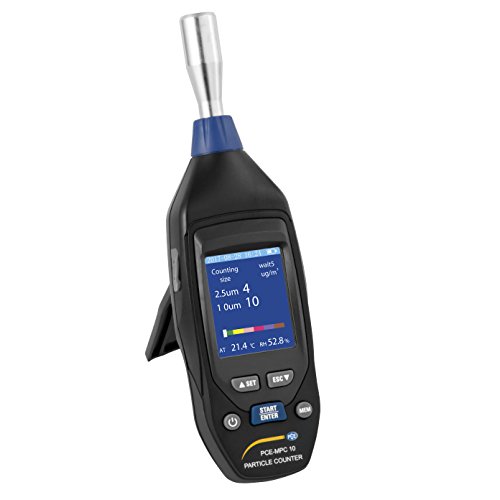
- Measures PM2.5 and PM10
- Logs up to 5,000 readings
- Shows temp and humidity too
Best For: Indoor users needing basic particulate tracking with logging
Plug-In Air Quality Monitor

- Indoor air quality monitor
- Requires 120V power
- Compact plug-in setup
Best For: Stationary indoor monitoring where 120V power is available
Multi-Channel Dust Meter
T7-TC8100 Laser Particle Counter
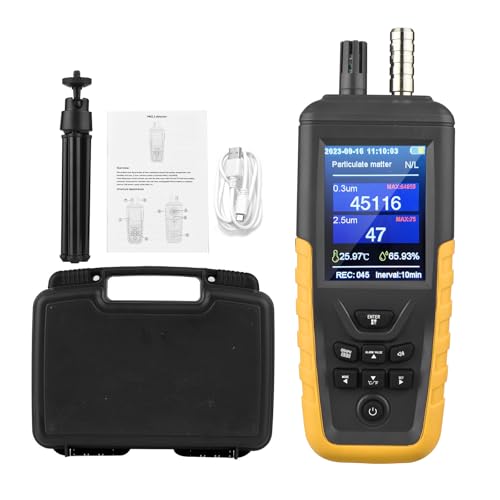
- Counts 0.3, 2.5, and 10 µm particles
- Logs 999 records and exports PDF
- Includes temp, humidity, and alarms
Best For: Advanced indoor air monitoring with logging and export features
Portable Particle Tester

- Measures six particle sizes simultaneously
- Laser-scattering detection method
- Lightweight handheld design
Best For: Fast portable checks across multiple particle sizes
Professional Particle Counter

- 0.3μm, 0.5μm, and 1.0μm particle detection
- Tracks PM2.5, PM10, TSP, temp, and humidity
- 32GB storage and 4+ hour battery life
Best For: Portable indoor air spot checks with detailed particulate logging
CO2 + Particle Monitor

- Measures CO2, PM2.5, PM10, temp, and humidity
- Audio alarm and color TFT display
- CSV data export for analysis
Best For: Indoor spaces that need CO2 and particulate monitoring with exportable data
Cleanroom Dust Counter

- Laser scattering for 0.3μm, 2.5μm, and PM10 detection
- Stores up to 999 data groups with curve view
- Adds temperature, humidity, and AQI readings
Best For: Industrial and cleanroom-style particulate monitoring
Desktop Particle Counter with PC Interface
DC1100-PRO-PC Air Quality Monitor

- PC interface for captured data
- Graphing and analysis support
- Serial cable or USB adapter needed
Best For: Indoor particle tracking with computer-based analysis
Tripod-Mount Particle Counter with Data Logging
PM0.3/2.5/10 Air Quality Monitor

- Detects PM0.3, PM2.5, and PM10
- Stores up to 999 readings
- Includes tripod and PC transfer
Best For: Portable monitoring with logging and hands-free setup
9-in-1 Indoor Air Monitor with Particle Counter
VEVOR DM197 Air Quality Monitor

- Tracks PM1.0, PM2.5, and PM10
- Also measures CO2, TVOC, and HCHO
- Large display with CO2 alarm
Best For: Broad indoor air checks with particle and gas monitoring
Indoor Air Monitor – PCE-MPC 10 Particle Counter with PM2.5/PM10
If you want a straightforward option for particle counters for indoor air, the PCE Instruments PCE-MPC 10 focuses on the basics that matter most: PM2.5, PM10, temperature, and humidity. Its 2-inch color display and 5,000-data logger make it useful for checking conditions over time in homes, offices, and other indoor spaces.
Best For: Users who want a compact indoor air monitor with PM2.5/PM10 readings and built-in logging.
Pros:
- Measures PM2.5 and PM10 particle matter
- Tracks temperature from 0 to 50°C and humidity from 0 to 100% RH
- Includes a 2-inch full-color LCD for easy viewing
- Stores up to 5,000 data points and supports USB transfer
Cons:
- Does not list finer particle-size channels beyond PM2.5 and PM10
- Tabletop design may be less convenient for portable spot checks
Overall, this is a practical indoor air quality tool if you need simple particulate monitoring with environmental readouts and a decent logging capacity.
Plug-In Air Quality Monitor – DC1100 Pro Indoor Monitor
The DC1100 Pro Air Quality Monitor is a simple option if you are comparing particle counters for indoor air and want a device designed for continuous use. The supplied details are limited, but its 120V requirement suggests a plug-in setup that can suit fixed indoor monitoring locations.
Best For: Buyers who want a basic, stationary indoor monitor with a plug-in power setup.
Pros:
- Designed for indoor air quality monitoring
- 120V power requirement supports continuous plugged-in use
- Compact size may fit well on a shelf or desk
Cons:
- Supplied notes provide very limited feature detail
- No particle size channels or logging specs are listed
- 120V-only operation limits flexibility in some setups
This is the most minimal listing in the group, so it makes sense mainly when you need a straightforward indoor monitor and already know the power and installation fit your space.
Multi-Channel Dust Meter – T7-TC8100 Laser Particle Counter
If you need particle counters for indoor air that do more than basic PM readings, the T7-TC8100 adds particle count data for 0.3 µm, 2.5 µm, and 10 µm sizes. It also measures PM2.5/PM10 mass concentration, temperature, and humidity, making it a stronger fit for long-term indoor tracking and trend review.
Best For: Users who want a feature-rich handheld particle counter with logging and export support.
Pros:
- Counts particles at 0.3 µm, 2.5 µm, and 10 µm
- Measures PM2.5/PM10, temperature, and humidity
- Stores up to 999 records with customizable logging intervals
- Exports historical records to PC as PDF via USB
Cons:
- More advanced than a simple spot-check meter
- Battery-focused design may require regular charging for continuous use
For indoor air monitoring, this model stands out because it combines particle counting, environmental measurements, alarms, and exportable records in one handheld unit.
Portable Particle Tester – Gugxiom 6-Size Dust Monitor
The Gugxiom Outdoor air Quality Monitor is a handheld choice for buyers comparing particle counters for indoor air and needing simultaneous readings across six particle sizes. Its laser-scattering design, portable body, and back stand make it practical for quick checks in indoor or outdoor environments.
Best For: Users who want a lightweight multi-size particle counter for fast environmental checks.
Pros:
- Measures six particle sizes at the same time
- Uses laser scattering for particle detection
- Lightweight handheld design with a back stand
- Ready to use with no complicated setup
Cons:
- Supplied details do not list logging or export functions
- Positioned as an outdoor monitor, so indoor-specific features are limited
- Fewer smart or analytical features than some competing models
This model is best when you want quick, multi-size particle readings without extra setup, especially for portable inspection work.
Professional Particle Counter – Temtop Handheld Air Meter
If you need particle counters for indoor air that go beyond a basic PM readout, this handheld Temtop meter is built for detailed spot checks. It measures 0.3μm, 0.5μm, and 1.0μm particles while also tracking PM2.5, PM10, TSP, temperature, and humidity, which makes it useful for labs, facilities, and workshops.
Best For: Users who want a portable, more advanced indoor air particle counter with logging and environmental readings.
Pros:
- Measures 0.3μm, 0.5μm, and 1.0μm particles plus PM2.5, PM10, and TSP
- Includes temperature and humidity sensing for broader indoor air monitoring
- Large display and simple controls make it easier to use in the field
- 3500mAh battery and 32GB internal storage support longer sessions and data logging
Cons:
- Handheld design is better for spot testing than continuous wall-mounted monitoring
- Focused on particulate and environment readings rather than CO2 tracking
This is a strong pick if your priority is detailed particulate measurement with practical portability. The included storage, battery life, and USB transfer make it especially useful when you need to collect and review readings over time.
CO2 + Particle Monitor – Temtop M2000C 2ND
For particle counters for indoor air that also help you watch ventilation quality, this Temtop monitor combines CO2, PM2.5, PM10, temperature, and humidity in one portable device. It is a practical choice for homes, schools, and small businesses that want a clearer picture of indoor conditions and a simple way to export readings for review.
Best For: Homes, classrooms, and small businesses that want CO2 plus particle monitoring with easy data export.
Pros:
- Tracks CO2 alongside PM2.5, PM10, temperature, and humidity
- Audio alarm helps flag air quality issues quickly
- CSV export via USB supports longer-term analysis
- Color TFT display and rechargeable battery improve everyday usability
Cons:
- Does not measure the finer particle sizes offered by dedicated particle counters
- Best suited to general indoor monitoring rather than specialized cleanroom-style use
This model stands out when you want more than particle counts alone. Its mix of CO2 monitoring, alarms, and exportable data makes it a smart all-around indoor air tool for people who want actionable readings instead of a single snapshot.
Cleanroom Dust Counter – TC-8100 Particle Detector
If you are shopping for particle counters for indoor air in industrial or controlled environments, the TC-8100 is designed for detailed dust detection and data collection. It uses laser scattering to detect 0.3μm, 2.5μm, and PM10-related particles, while also providing temperature, humidity, and AQI grade information on a full-color display.
Best For: Industrial, cleanroom, and technical users who need handheld particulate monitoring with recorded data.
Pros:
- Detects 0.3μm, 2.5μm, and PM10 particle levels using laser scattering
- Stores up to 999 groups of records and shows data curves
- Includes temperature, humidity, and AQI grade readings
- Full-color TFT display, audible alarm, and external USB power support
Cons:
- Heavier, more industrial style may be less convenient for casual home use
- Packaged with a battery compartment insulating sheet that must be removed before use
This is the most specialized option in the group, especially for environments where particulate tracking and logged readings matter. The combination of storage, display detail, and industrial application focus makes it well suited to more technical air-quality workflows.
Desktop Particle Counter with PC Interface – DC1100-PRO-PC Air Quality Monitor
If you want particle counters for indoor air that can log results for later review, the DC1100-PRO-PC is built around PC connectivity. It captures air quality data to a computer for graphing and analysis while sampling, making it a practical pick for users who want a simple desktop monitor with exportable data rather than a handheld meter.
Best For: Users who want to track indoor particle levels on a PC for graphing and comparison.
Pros:
- Includes a COM port interface for capturing data to a PC
- Supports graphing and analysis during sampling
- Uses the standard DC1100 air quality monitoring features
- Can be paired with a 9-pin serial cable or USB-to-COM adapter
Cons:
- Serial cable or USB-to-COM adapter is not included
- Requires a computer connection to use the data-capture workflow
This model makes sense if your buying priority is not just measuring indoor particles, but also reviewing the results in a more analytical way. It is especially useful when you want a monitor that can compare readings over time against other particle counter data.
Tripod-Mount Particle Counter with Data Logging – PM0.3/2.5/10 Air Quality Monitor
Among particle counters for indoor air, this monitor stands out for measuring PM0.3, PM2.5, and PM10 while also tracking temperature and humidity. It is designed for real-time viewing on a 3.2-inch color display, and its built-in data storage plus PC transfer capability make it useful for users who need both quick checks and recorded results.
Best For: Users who want a portable air quality tester with logging, tripod support, and multiple particle sizes.
Pros:
- Detects PM0.3, PM2.5, and PM10
- Measures temperature and humidity as well
- Saves up to 999 data sets and transfers them to a PC
- Includes a tripod for hands-free monitoring
Cons:
- Best suited to users who need more than basic particle-only readings
- Battery life is about 9 hours per full charge
This is a flexible choice if you need a monitor that can handle indoor or outdoor checks, show live readings clearly, and keep historical records for later review. Its included tripod and rechargeable battery make it especially convenient for longer inspections or lab-style use.
9-in-1 Indoor Air Monitor with Particle Counter – VEVOR DM197 Air Quality Monitor
If you need particle counters for indoor air that also track broader air quality, this VEVOR unit combines PM1.0, PM2.5, and PM10 monitoring with CO2, TVOC, HCHO, humidity, and temperature. Its 1.5-second resampling, audible CO2 alarm, and large display make it geared toward quick reading checks in homes, offices, or other indoor spaces.
Best For: Buyers who want a broad indoor air quality monitor with particle counting and CO2 alerts.
Pros:
- Measures PM1.0, PM2.5, PM10, CO2, TVOC, HCHO, humidity, and temperature
- Resamples every 1.5 seconds for updated readings
- Includes an audible alarm when CO2 exceeds 1000 PPM
- Large 5.7-inch HD display shows all values at once
Cons:
- More feature-rich than a dedicated particle-only counter
- Designed for real-time monitoring rather than data logging detail
This model is a strong fit when your priority is seeing the bigger indoor air picture, not just particle counts. It combines particle monitoring with gas and comfort metrics, so it is useful for checking overall room conditions in one device.
How We Picked the Best Particle Counters for Indoor Air
We focused on Particle Counters for Indoor Air that offer practical measurement ranges, useful particle size channels, and reliable display or logging features. We also prioritized models that fit different use cases, from portable handheld units to more feature-rich monitors for ongoing indoor tracking.
Important factors included reported particle size coverage, ease of reading results, temperature and humidity sensing, data export, alarm functions, and overall suitability for indoor environments.
Quick Comparison
For basic room-by-room checks, simpler handheld counters are often the easiest choice. For continuous monitoring, smart air quality monitors with particle detection, CO2 tracking, and alerts tend to be more useful. If you need more detailed particle data, look for multi-channel sensors or pump-suction designs that support tighter inspection workflows.
Key Buying Factors for Particle Counters for Indoor Air
Particle Size Coverage
Check which particle sizes the device measures. Common targets include PM0.3, PM2.5, and PM10, which help you understand both fine and larger airborne debris. More channels can offer a fuller picture, especially in dusty or high-traffic spaces.
Measurement Method and Sensitivity
Some particle counters use laser-based sensing, while others are built for more professional inspection tasks. Higher sensitivity can be useful, but only if the device is also easy to interpret and matches your monitoring goals.
Portability Vs. Continuous Monitoring
Handheld counters are better for spot checks, duct inspections, or moving between rooms. Desktop and wall-style monitors are a stronger fit if you want ongoing indoor readings and alerts.
Extra Air Quality Metrics
Many buyers want more than particle counts. Temperature, humidity, CO2, formaldehyde, and TVOC readings can add important context, especially in offices, schools, and renovated spaces.
Data, Alarms, and Export
If you plan to track trends over time, choose a model with logging, app support, or export features. Audible alarms and visual indicators are also helpful for fast response when air quality changes.
Who Should Buy Which Particle Counters for Indoor Air?
Homeowners and renters usually benefit from a simple, easy-to-read monitor that tracks PM levels and ambient conditions. Office managers and facility teams may prefer smarter monitors with alarms, broader gas detection, and data history. Contractors, inspectors, and air quality professionals should lean toward handheld or pump-based Particle Counters for Indoor Air when detailed spot measurement matters most.
If you want the best balance of usability and insight, start with the feature set that matches how often you’ll check the air and how much detail you actually need.