Choosing the right particle counter for air testing can make a big difference in cleanroom checks, HVAC troubleshooting, and indoor air quality monitoring.
Below, we’ve narrowed the field to 10 standout options that balance measurement range, usability, and value for different testing needs.
Best 10 Particle Counters for Air Testing Picks for 2026
Cleanroom-Grade Choice
Temtop PMD331 7-Channel Handheld Counter

- ISO 21501-4 certified for professional verification
- Tracks 7 particle sizes from 0.3μm to 10μm
- Stores 2M+ records with USB and RS-485 output
Best For: Cleanrooms, labs, and HVAC compliance testing
Video Documentation Pick
Extech VPC300 with Built-In Camera

- Built-in camera records JPEG and AVI files
- SD card memory plus USB connectivity
- Tripod-mountable for steadier inspections
Best For: Indoor inspections that need visual documentation
Portable Field Monitor
Temtop Handheld Pump Suction Meter

- Measures particles plus PM2.5, PM10, and TSP
- Adds temperature and humidity sensing
- 3500mAh battery with 32GB internal storage
Best For: Portable environmental testing and air quality checks
Hands-Free Audit Tool
Professional 3-Channel Laser Particle Counter

- Measures 0.3μm, 2.5μm, and 10μm particles
- Generates PDF reports and supports USB transfer
- Tripod-mountable for hands-free monitoring
Best For: Cleanroom checks and filter inspections
Portable 3-Channel Monitor
PM0.3/PM2.5/PM10 Air Quality Monitor

- Tracks PM0.3, PM2.5, and PM10
- Logs up to 999 readings for PC transfer
- Includes tripod, display, and climate readings
Best For: Portable air checks with logging and tripod-mounted monitoring
All-in-One Air Analyzer
Temtop M2000 CO2 and Particle Monitor

- Measures CO2, PM2.5/PM10, HCHO, temp, and humidity
- Exports data and supports sensor calibration
- Features alarm, color display, and rechargeable battery
Best For: Comprehensive air quality testing beyond particles alone
Detailed High-Count Meter
Laser Particle Counter with 999-Record Logging
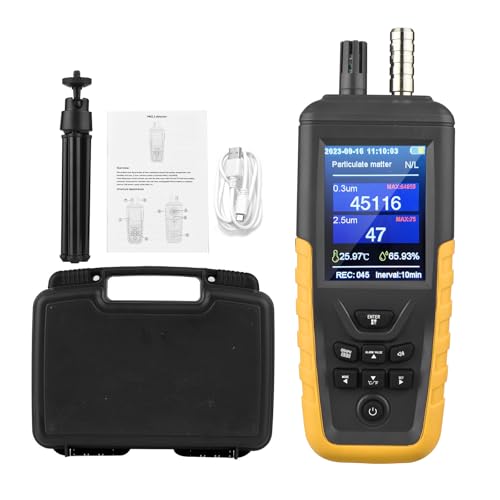
- Counts 0.3 μm, 2.5 μm, and 10 μm particles
- Stores 999 records and exports PDF data
- Includes alarm, indicator bar, and tripod
Best For: Detailed particle monitoring with logging and fixed-point use
Compact All-Purpose Counter

- Detects six particle sizes from 0.3μm to 10μm
- Measures PM2.5 and PM10 plus particle count
- Stores thousands of data sets with USB backup
Best For: People who need a simple multi-function air tester for home or office use
Precision Spot Counter

- Tests particle sizes at 0.3μm, 2.5μm, and 10μm
- Custom sampling can run from 1 second to 59:59
- Uses a semiconductor laser light source
Best For: Users who want adjustable sampling and size-specific particle readings
Multi-Sensor Air Monitor
Temtop 7-in-1 Particle Counter

- Tracks PM2.5, PM10, HCHO, VOCs, humidity, temperature, and AQI
- Exports logged data to Excel via USB
- Portable spot-check and plug-in continuous modes
Best For: Users who want particle counting plus formaldehyde, VOC, and trend tracking
Cleanroom-Grade Choice – Temtop PMD331 7-Channel Handheld Counter
If you need particle counters for air testing in controlled environments, the Temtop PMD331 is built for serious verification work. It monitors seven particle sizes at once, meets ISO 21501-4 standards, and adds industrial components plus high-capacity logging for audit-friendly use.
Best For: Cleanrooms, labs, HVAC checks, and pharmaceutical environments that need ISO-aligned particle testing.
Pros:
- ISO 21501-4 certified and calibrated for repeatable, high-accuracy results.
- Simultaneously tracks 7 particle channels from 0.3μm to 10μm.
- Massive onboard storage for over 2,000,000 records with USB and RS-485 Modbus output.
- Includes a protective case, calibration certificate, filter tube, USB drive, and AC adapter.
Cons:
- Heavier and more industrial than a basic handheld tester.
- Optional individual ISO calibration certificates may require a custom quote.
The PMD331 stands out when compliance and documentation matter more than portability alone. It is a strong pick for facilities that want dependable counts, detailed logs, and a setup designed for professional verification workflows.
Video Documentation Pick – Extech VPC300 with Built-In Camera
The Extech VPC300 is a practical option for particle counters for air testing when you want visual documentation along with measurements. Its built-in camera, SD card memory, and tripod mounting make it useful for recording conditions during indoor inspections.
Best For: Users who want to capture video or still images while logging particle counts during indoor testing.
Pros:
- Built-in camera supports JPEG and AVI recording for visual records.
- Includes SD card memory and USB connectivity for data handling.
- Tripod-mountable design helps with steadier long-form testing.
- NIST specification met for added confidence in documented use.
Cons:
- Older-style feature set compared with newer high-storage models.
- Designed for indoor use only.
For buyers who care about proof as much as counts, the VPC300 makes it easier to document what was happening at the test location. It is a straightforward pick for inspections where image capture and portable logging are both useful.
Portable Field Monitor – Temtop Handheld Pump Suction Meter
This Temtop handheld model is a versatile choice if you need particle counters for air testing in workshops, labs, or general environmental monitoring. It combines particle measurement with temperature and humidity readings, plus onboard storage for longer field sessions.
Best For: Field users who want a portable particle counter with temp and humidity data in one unit.
Pros:
- Measures 0.3μm, 0.5μm, and 1.0μm particles, plus PM2.5, PM10, and TSP.
- Includes temperature and humidity sensors for broader environmental context.
- 3500mAh battery supports over 4 hours of operation.
- 32GB internal storage and USB transfer simplify data logging.
Cons:
- Only lists measuring range for 0.3 to 1.0μm in the supplied details.
- Less specialized than ISO-focused cleanroom counters.
This model fits users who want a capable all-around air meter rather than a niche certification tool. Its mix of particle sizing, environmental sensors, and long battery life makes it a solid field companion.
Hands-Free Audit Tool – Professional 3-Channel Laser Particle Counter
For buyers comparing particle counters for air testing, this handheld laser model focuses on practical audit features. It measures 0.3μm, 2.5μm, and 10μm particles, shows real-time data on a color screen, and can generate PDF reports for easier documentation.
Best For: Cleanroom checks, filter inspections, and on-site particle testing that benefits from report export.
Pros:
- Measures three key particle sizes and includes PM2.5 concentration data.
- 3.2-inch TFT color screen shows real-time counts, temperature, humidity, and trends.
- One-click PDF report generation and USB transfer support audit workflows.
- Tripod mounting holes allow hands-free continuous testing.
Cons:
- Stores up to 999 records, which is far less than higher-capacity competitors.
- Not as broad in channel coverage as seven-size particle counters.
This is a good fit when you want fast field measurements with easy reporting rather than maximum channel count. Its tripod support and PDF export make it especially useful for repeated inspections and basic documentation.
Portable 3-Channel Monitor – PM0.3/PM2.5/PM10 Air Quality Monitor
If you need particle counters for air testing that are easy to move between rooms or job sites, this monitor gives you a practical snapshot of airborne dust levels. It tracks PM0.3, PM2.5, and PM10, while also reporting temperature and humidity, so you can check multiple conditions with one handheld unit.
Best For: Indoor/outdoor users who want a portable particle counter with data logging and tripod-mounted monitoring.
Pros:
- Detects PM0.3, PM2.5, and PM10 with a claimed accuracy of ±12 μg/m³.
- Measures temperature from -10 to 60 ℃ and humidity from 0 to 100% RH.
- Stores up to 999 data sets and supports transfer to a PC via the included cable.
- 3.2-inch TFT color display includes a tri-color air quality bar and historical records.
Cons:
- Does not list CO2 or formaldehyde sensing, so it is focused on particles and basic climate readings.
- Battery life is rated at about 9 hours, which may not suit very long unattended sessions.
- Best used as a monitoring tool rather than a specialized lab instrument with advanced gas analytics.
This is a solid pick if you want straightforward particle testing with useful logging and hands-free tripod support. It leans practical rather than overcomplicated, making it a good fit for routine air checks in production areas, labs, or around the home.
All-in-One Air Analyzer – Temtop M2000 CO2 and Particle Monitor
For buyers comparing particle counters for air testing, this Temtop model stands out by combining particle monitoring with CO2 and formaldehyde sensing. It is built for broader indoor air analysis, with a colorful display, audio alarm, and data export tools that make it useful for tracking conditions over time.
Best For: Users who want a more comprehensive air quality analyzer with CO2, particles, and formaldehyde monitoring.
Pros:
- Monitors CO2, PM2.5, PM10, particles, HCHO, temperature, and humidity in one device.
- Uses NDIR CO2, HCHO, and professional-grade particle sensors for broader coverage.
- Supports USB data export and built-in calibration for CO2 and HCHO.
- Includes an audio alarm, color air-quality indicator, and rechargeable battery for portable use.
Cons:
- More feature-rich than a basic particle counter, so it may be more than some users need.
- Its broader sensor set can make it less focused if you only want particle counts.
- No tripod is mentioned in the supplied notes, so fixed-position use may require a separate stand.
This is the strongest option here if you want a true all-in-one air testing tool rather than a particle-only meter. It makes sense for home, office, lab, or travel use when you want more context around overall air quality.
Detailed High-Count Meter – Laser Particle Counter with 999-Record Logging
If your priority is detailed particle counters for air testing, this laser meter is built to show both particle counts and mass concentration in a way that suits home or professional use. It measures 0.3 μm, 2.5 μm, and 10 μm particles, adds temperature and humidity readings, and supports extended data logging for trend tracking.
Best For: Users who want a feature-packed particle counter with high-count tracking, logging, and hands-free monitoring.
Pros:
- Detects 0.3 μm, 2.5 μm, and 10 μm particles, with count range up to 2,000,000 pieces per liter.
- Stores up to 999 records and can export historical data to a PC as PDF via USB.
- Includes customizable alarm thresholds and a green-to-red pollution indicator bar.
- Comes with a tripod, storage case, USB cable, and power adapter for more complete setup.
Cons:
- Focuses on particle and basic environmental readings, not gases like CO2 or formaldehyde.
- Its many features may be more than a casual user needs for occasional checks.
- Best suited to fixed-point monitoring when used with the tripod, rather than quick spot checks alone.
This model is a strong choice if you want deeper particle-count visibility and better support for recordkeeping. It offers a good balance of portability, logging, and alarm features for routine air quality monitoring.
Compact All-Purpose Counter – Precise 0.3–10μm Dust Tester
If you want particle counters for air testing that do more than basic spot checks, this Omquot unit is built for quick readings across six dust sizes from 0.3μm to 10μm. It also measures PM2.5 and PM10, so it can serve as a practical option for both home and office air quality checks when you need one device for multiple readings.
Best For: Users who want a simple, multi-function particle counter with storage and PC-friendly data handling.
Pros:
- Detects six particle sizes from 0.3μm to 10μm.
- Measures PM2.5 and PM10 concentrations in addition to particle count.
- Two measurement modes make it easier to switch between count and concentration testing.
- Stores thousands of data sets and supports USB backup/printing.
Cons:
- More of a general-use tester than a highly specialized lab instrument.
- Requires basic familiarity with particle count and concentration readings.
Overall, this is a practical choice if you need a portable air testing device with broad coverage and built-in data storage. The folding stand and 2.8-inch LCD add convenience, while the micro vacuum pump helps keep measurements fast and responsive.
Precision Spot Counter – AQ9600 PM Dust Detector
PerfectPrime AQ9600, PM 0.3/2.5/10 Μm Air Quality Particle/Dust Detector/Counter
Check Price On AmazonThis PerfectPrime model is a focused option for particle counters for air testing when you need straightforward measurements of 0.3μm, 2.5μm, and 10μm particles. It uses a semiconductor laser light source and supports custom sampling timing, which makes it useful for users who want more control over how readings are taken.
Best For: Buyers who want a compact particle counter with adjustable sampling and simple size-based reporting.
Pros:
- Tests three key particle sizes: 0.3μm, 2.5μm, and 10.0μm.
- Allows custom sampling from 1 second to nearly 60 minutes.
- Supports continuous or frequency-based sampling.
- Includes an adapter and runs on a 9V DC battery setup.
Cons:
- Battery is not included.
- Fewer extra air-quality functions than multi-sensor monitors.
In practice, this is a good fit if you mainly care about particle counting rather than broader indoor air metrics. The adjustable alarm levels and compact design make it easier to adapt to different testing routines.
Multi-Sensor Air Monitor – Temtop 7-in-1 Particle Counter
For buyers comparing particle counters for air testing, this Temtop monitor stands out because it covers far more than dust counts alone. It tracks PM2.5, PM10, formaldehyde, VOCs, humidity, temperature, and AQI, making it a strong pick when you want a broader view of indoor or outdoor air conditions.
Best For: People who want a portable monitor with particle counting plus formaldehyde and VOC tracking.
Pros:
- Measures seven air-quality parameters in one device.
- Includes a built-in 12-hour trend histogram for spotting changes over time.
- Supports USB data export to Excel for longer-term reporting.
- Works as both a portable spot-check tool and a plug-in continuous monitor.
Cons:
- Not intended for gas or CO leak detection.
- Needs warm-up time after moving between very different temperatures for best accuracy.
This is the most feature-rich option here if your testing needs go beyond particle counts alone. It is especially useful for renovation monitoring, ventilation checks, and anyone who wants exportable data without relying on an app.
How We Picked These Particle Counters for Air Testing
We focused on devices that offer useful particle size channels, dependable sampling performance, and clear readouts for real-world use. For Particle Counters for Air Testing, the most important factors are measurement range, accuracy claims, sampling method, and how easy the unit is to carry, read, and document.
We also considered whether a model is better suited to professional inspection work, cleanroom verification, or general indoor air monitoring. Extras like built-in data logging, temperature and humidity sensing, formaldehyde or CO2 readings, and camera capture can be helpful, but only if they support the main job: counting particles reliably.
Quick Comparison: What to Expect
Some of these devices are designed as handheld professional counters with stronger sampling capabilities, while others are multi-function indoor air monitors that include particle counting alongside broader air quality metrics. If you need calibration-focused testing or compliance work, look for clearer particle-size specifications and standards references. If you want a home or office monitor, convenience and multiple environmental readings may matter more.
Professional Vs. General Use
Professional models are usually the better fit for cleanrooms, labs, and field inspections. General-use monitors are often easier to live with day to day, especially when you want continuous visibility into air conditions rather than formal spot checks.
Key Buying Factors for Particle Counters for Air Testing
Particle size channels: Make sure the device covers the particle sizes you care about, such as PM0.3, PM2.5, and PM10. More channels can give a fuller picture, but only if the sensor quality is solid.
Accuracy and standards: For professional environments, look for certification, calibration references, or standards alignment. That matters more than a long feature list.
Sampling and suction: Some units use pump suction for more consistent particle intake. That can improve repeatability, especially in controlled testing.
Logging and reporting: If you need to track trends or document results, prioritize data storage, export options, timestamps, or image capture.
Portability and interface: A compact handheld design is useful for on-site inspections, while a larger display and simpler controls may be better for non-technical users.
Extra sensors: Temperature, humidity, CO2, TVOC, and formaldehyde readings can add context, but they should not distract from particle measurement quality.
Who Should Buy Which Particle Counters for Air Testing?
If you need a cleanroom-grade tool or are doing more serious verification work, choose a model with stronger sampling features and better standards documentation. If you mainly want to monitor indoor air quality in a home, office, or workshop, a multi-function monitor may be the most practical choice.
For buyers comparing Particle Counters for Air Testing on a budget, focus on the smallest set of features that still covers your core particle sizes and logging needs. For advanced users, the best choice is usually the device that combines consistent measurements with the easiest workflow for your environment.