Choosing the right moisture analyzer can save time, reduce testing errors, and make routine quality control much easier. The best digital moisture balances combine accurate weighing with controlled heating for fast, repeatable results.
Below, we’ve grouped ten strong options for labs, production environments, and busy test benches so you can compare capacity, readability, interfaces, and heating performance at a glance.
Best 10 Digital Moisture Balances Picks for 2026
Compact Precision Pick
60g moisture analyzer with USB and 4 drying modes

- 0.01% moisture readability
- 4 drying profiles and 20 memory slots
- USB export for PC analysis
Best For: Small samples and routine lab moisture checks
Straightforward Lab Choice
51g moisture balance with VFD and selectable heating

- 0.001 g readability for detailed weighing
- Four heating modes and five programs
- Clear VFD display for easy monitoring
Best For: Lab work that needs clear controls and fine readability
Feature-Rich Touchscreen Pick
120g halogen analyzer with touchscreen and database
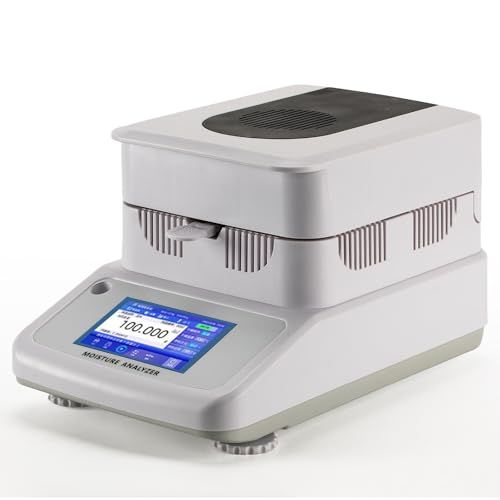
- 0.002 g weight readability
- Stores up to 100 test records
- 5-inch touchscreen with RS232 output
Best For: Lab and industrial moisture testing with data tracking
Higher-Capacity Compact Pick
120g moisture analyzer with USB and preset drying modes
- 120 g capacity for bigger samples
- 0.01% readability with backlit LCD
- USB data capture plus 20 memory slots
Best For: Powder and lab samples that need more capacity
Premium Touchscreen
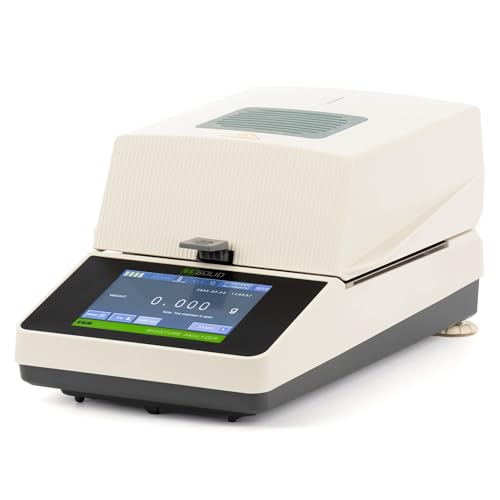
- 0.001 g readability and 0.01% moisture measurement
- 5-inch color touchscreen stores up to 20 methods
- 250 W halogen heating with RS-232 data output
Best For: Labs needing precise moisture testing with touchscreen control
Rapid Heating Analyzer

- Fast halogen heating with precision sensors
- 40°C to 160°C temperature control in 1°C steps
- Stores 20 data sets and supports printing
Best For: Fast moisture testing across many material types
Value Touchscreen

- 0.005 g readability and 0.05% moisture measurement
- 5-inch touchscreen with 20 saved test methods
- RS-232 export plus 50 sample pans included
Best For: Routine lab testing with a balanced feature set
Rapid Halogen Tester
Halogen Moisture Analyzer with 40–160°C Range
- Rapid halogen heating for quick moisture checks
- Adjustable 40–160°C temperature and 1–99 minute timing
- Stores 20 results and supports printer output
Best For: Routine moisture testing across food, plants, grains, and other materials
Touchscreen Lab Analyzer
120g Halogen Moisture Balance with Database
- 5-inch touchscreen with easy drying-mode control
- Internal database stores up to 100 records
- RS232 output for lab data transfer
Best For: Lab and industrial moisture testing with built-in record management
Fast-Mode Lab Balance
120g Halogen Moisture Analyzer with 3 Drying Modes
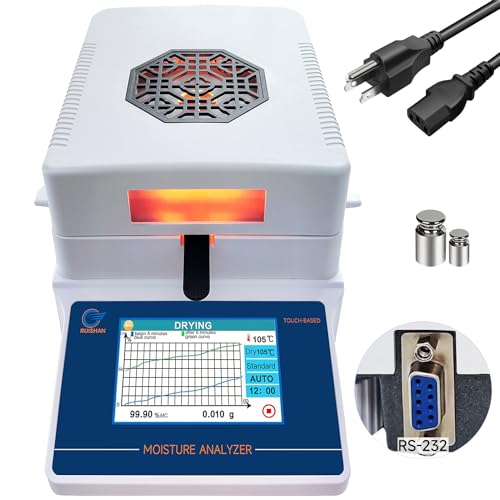
- 3 drying modes with automatic or timed ending
- Stores up to 32 research methods
- RS232 output for printer or computer connection
Best For: Users who want preset moisture-testing workflows for many sample types
Compact Precision Pick – 60g moisture analyzer with USB and 4 drying modes
If you want a digital moisture balance for small-batch testing, the ATS60 is built around 0.01% moisture readability, a 60 g capacity, and a compact footprint. It supports 4 drying modes and a 160°C drying temperature, making it a practical fit for repeatable moisture checks in labs or quality-control workflows.
Best For: Users who need a compact, precise analyzer for smaller samples and routine moisture testing.
Pros:
- 0.01% moisture readability for fine measurements
- 4 drying profiles: Standard, Slow, Step, and Fast
- USB interface lets you collect and analyze data on a PC
- 20 memory locations help reduce setup time for repeat tests
Cons:
- 60 g maximum capacity limits larger samples
- Compact design may be less suited to high-throughput work
This model focuses on controlled drying and easy data handling rather than sheer sample size. For buyers comparing digital moisture balances for compact lab use, it offers a strong mix of precision, presets, and PC connectivity.
Straightforward Lab Choice – 51g moisture balance with VFD and selectable heating
The MX-50 is a straightforward digital moisture balance for controlled laboratory work, with 51 g capacity and 0.001 g readability. Its four selectable heating modes, five measurement programs, and clear VFD display make it a solid option when you want dependable moisture determination with simple visibility.
Best For: Laboratory users who value a clear display and multiple measurement programs in a compact-capacity balance.
Pros:
- 0.001 g readability supports fine weight measurement
- Four selectable heating modes add temperature control
- Five measurement programs provide flexibility
- VFD display is easy to view during operation
Cons:
- 51 g capacity is limited for larger samples
- 115 V power may not suit every setup
Compared with more feature-heavy models, the MX-50 keeps the workflow direct and readable. It is a practical pick for users who want a stable, no-frills moisture determination balance with useful program options.
Feature-Rich Touchscreen Pick – 120g halogen analyzer with touchscreen and database
This halogen moisture analyzer is designed for buyers who want a digital moisture balance with more modern controls and built-in data handling. It offers up to 120 g capacity, 0.002 g weight readability, a 5-inch touchscreen, and a built-in database for storing up to 100 test records.
Best For: Lab and industrial users who want a touchscreen analyzer with data storage and flexible drying methods.
Pros:
- 0.002 g readability and 0.01% moisture readability
- 5-inch full-color touchscreen simplifies setup
- Built-in database stores up to 100 test records
- Multiple drying modes include Standard, Mild, Fast, and Slow
Cons:
- 110V power requirement may limit placement options
- More advanced interface may be more than basic users need
With RS232 output, customizable heating programs, and included accessories, this model is aimed at workflows where both measurement control and recordkeeping matter. It stands out among digital moisture balances for users who want a more feature-rich instrument.
Higher-Capacity Compact Pick – 120g moisture analyzer with USB and preset drying modes
If you need a digital moisture balance with the same compact ATS layout but more sample capacity, the ATS120 offers 120 g maximum weight, 0.01% readability, and a backlit graphical LCD. It includes 4 drying modes, 20 memory locations, and USB connectivity for collecting and analyzing results on a PC.
Best For: Users who want a compact moisture analyzer with a larger capacity for powder and similar samples.
Pros:
- 120 g capacity handles larger samples than smaller bench units
- 0.01% moisture readability supports precise analysis
- USB interface allows PC data collection and plotting
- 4 drying profiles and 20 memory locations simplify repeat use
Cons:
- Still limited to 120 g, so it is not for very large loads
- Compact form factor may not suit every lab layout
This is a practical step up if the 60 g version is too small but you still want the same style of operation. For shoppers comparing digital moisture balances, the ATS120 offers a balanced mix of capacity, precision, and repeatable presets.
Premium Touchscreen – 0.001 g Lab Precision
This digital moisture balance is a strong fit when you need fine resolution and a straightforward workflow in the lab. With 110 g capacity, 0.001 g readability, and halogen heating up to 160°C, it is built for fast moisture checks on food, grain, plastics, textiles, and chemicals.
Best For: Labs that want high-resolution moisture testing with touchscreen convenience and data output.
Pros:
- 0.001 g readability and 0.01% moisture measurement for detailed results
- 5-inch color touchscreen with up to 20 stored test methods
- 250 W halogen heating with 3 drying modes and 3 ending modes
- RS-232 output and 50 sample pans included
Cons:
- Requires 110V 60Hz AC power
- Manual calibration uses a 100 g weight
Overall, this model is aimed at users who want a feature-rich moisture analyzer with strong precision and flexible test settings. It offers a practical balance of speed, usability, and reporting for routine lab work.
Rapid Heating Analyzer – 1 mg Moisture Balance
This digital moisture balance focuses on speed and practical lab efficiency, especially where oven drying would be too slow. It uses a halogen lamp, precision sensors, and fast weighing to measure moisture in minutes for food, plants, grains, minerals, chemicals, soil, wood, paper, and textiles.
Best For: Users who need fast moisture results across a wide mix of sample types.
Pros:
- Rapid halogen heating designed to replace slower oven drying methods
- Adjustable temperature from 40°C to 160°C in 1°C steps
- Stores up to 20 sets of historical data for recordkeeping
- Printer interface with adjustable baud rates for output
Cons:
- Lower readability than the 0.001 g model in this roundup
- Operating range and data workflow may be more than needed for simple spot checks
In short, this is a solid pick if your priority is rapid turnaround and broad sample compatibility. It keeps the process simple while still offering data storage and printing support for lab or production use.
Value Touchscreen – 0.005 g Lab Analyzer
This digital moisture balance offers a good middle ground if you want touchscreen convenience without stepping up to the highest-resolution model. It delivers 110 g capacity, 0.005 g readability, and 0.05% moisture measurement with the same 250 W halogen heating and 160°C maximum temperature.
Best For: Laboratories that want a practical, easier-to-spec moisture analyzer for routine testing.
Pros:
- 0.005 g readability with 0.05% moisture measurement
- 5-inch color touchscreen and up to 20 stored test methods
- 250 W halogen heater with 3 drying modes and 3 ending modes
- RS-232 output and 50 sample pans included
Cons:
- Less precise than the 0.001 g version in this lineup
- Manual calibration still requires a 100 g weight
For routine lab analysis, this model gives you many of the same usability features as the higher-end version while keeping the spec sheet simpler. It makes sense when you want touchscreen operation, data export, and dependable moisture testing without chasing maximum precision.
Rapid Halogen Tester – Halogen Moisture Analyzer with 40–160°C Range
If you need digital moisture balances for fast lab or production checks, this halogen moisture analyzer is built to shorten drying time without giving up precision. It uses a halogen lamp, real-time sensors, and a fast weighing processor to replace slower oven-drying workflows, with adjustable temperature and timing for many sample types.
Best For: Food, plants, grains, minerals, chemicals, soil, wood, paper, and textiles when you want quick moisture results and simple operation.
Pros:
- Rapid heating with a 40–160°C adjustable range in 1°C steps
- Supports many sample types and completes measurements in minutes
- Stores up to 20 historical records for basic data tracking
- Includes printer interface for saving or printing results
Cons:
- 110V~120V version limits where it can be used
- Data storage is modest compared with models that hold larger databases
- Uses a simpler LCD interface rather than a full touchscreen
Overall, this is a practical pick for buyers who want a straightforward moisture analyzer that focuses on speed, repeatability, and easy record handling. The included accessories and compact form also make it a good fit for routine testing setups.
Touchscreen Lab Analyzer – 120g Halogen Moisture Balance with Database
For buyers comparing digital moisture balances for lab or industrial work, this model stands out for its 5-inch touchscreen and built-in data handling. It combines halogen heating, a PT-100 temperature sensor, and selectable drying methods to support fast, controlled moisture analysis.
Best For: Laboratory and industrial users who want a touch-operated moisture analyzer with stored records and RS232 connectivity.
Pros:
- 0.001g weight readability and 0.01% moisture readability
- Stores up to 100 test records in the internal database
- Five-inch full-color touchscreen makes setup and control easier
- Offers Standard, Mild, Fast, and Slow drying programs
Cons:
- 110V power requirement may not suit all locations
- Best suited to lab-style workflows rather than simple portable use
- External printer support is optional, not built in
This is a strong choice if you want more control over drying modes and better digital record keeping than basic units provide. The touchscreen workflow and RS232 output make it especially useful where documentation matters.
Fast-Mode Lab Balance – 120g Halogen Moisture Analyzer with 3 Drying Modes
If you want digital moisture balances for quick sample testing with flexible presets, this halogen analyzer is designed for speed and straightforward operation. It combines a 5-inch touchscreen, three drying modes, and preset methods so users can move from setup to measurement in minutes.
Best For: Lab users testing wood, grain, food, soil, paper, textile, and similar samples who want preset workflows and RS232 output.
Pros:
- High-definition 5-inch touchscreen with automatic and timed ending modes
- Preset and store up to 32 research methods for quick repeat tests
- Supports RS232 connection to a printer or computer
- Built with an aluminum enclosure and multi-story heating chamber
Cons:
- Readout accuracy is listed as +/- 0.01g rather than finer 0.001g balance readability
- Power is limited to 110V use
- Less database capacity than some competing analyzers
As a moisture analyzer, it leans into convenient presets and fast workflows rather than maximum database size. That makes it a sensible pick for users who want efficient testing across a broad range of materials and need easy data export.
How We Picked These Digital Moisture Balances
We focused on practical buyer priorities: measurement readability, sample capacity, drying temperature range, heating method, display clarity, data connectivity, and whether the unit looks suited to frequent lab use. We also considered how well each model fits common moisture testing workflows, from quick spot checks to more structured quality-control routines.
Quick Comparison
Some Digital Moisture Balances are built for maximum precision with 0.001 g readability, while others trade a little sensitivity for higher sample capacity or simpler operation. If you test small, valuable samples, precision matters most. If you routinely test larger or less uniform materials, a higher-capacity model may be the better fit. Touch screens, built-in databases, and USB or RS232 outputs can also make a meaningful difference when you need faster recordkeeping.
Key Buying Factors for Digital Moisture Balances
Readability and Result Resolution
For moisture testing, readability affects how confidently you can compare samples. A 0.001 g balance is typically better for detailed lab work, while 0.002 g or 0.005 g may be sufficient for broader screening applications.
Capacity and Sample Size
Check both total capacity and the size of the sample pan. Higher-capacity units are useful for bulkier materials, but smaller-capacity instruments often deliver finer resolution for delicate samples.
Heating Range and Drying Modes
The heating system determines how quickly moisture is driven off and how flexible the instrument is across different materials. A wider temperature range and multiple drying modes can help you tailor the test method to powders, granules, food ingredients, chemicals, or other lab samples.
Workflow Features
Backlit displays, touchscreen controls, built-in methods, and data interfaces reduce setup time and make results easier to manage. If you need traceability, look for models with USB or RS232 connectivity.
Who Should Buy Which Digital Moisture Balances?
If you need the highest practical precision for lab analysis, choose a model with 0.001 g readability and strong temperature control. If your priority is routine moisture screening, a mid-range balance with solid capacity and fast heating may be enough. Teams that handle frequent testing or documentation will benefit most from Digital Moisture Balances with touch controls and data export options. Matching the instrument to your sample type and reporting needs is the best way to avoid overpaying for features you won’t use.