If you want more than a simple air-quality alert, data logging is the feature that turns readings into useful trends. It helps you spot patterns, identify problem rooms, and understand how ventilation, occupancy, and appliances affect indoor air.
Below, we’ve rounded up the best air quality monitors with data logging for 2026, with options for home users, office buyers, and anyone who wants clearer historical insight from CO2, particulate, and VOC measurements.
Best 10 Air Quality Monitors with Data Logging Picks for 2026
Gen 2 Portable IAQ Monitor

- 8-in-1 monitoring for CO2, PM, TVOC, HCHO, temp, and humidity.
- Stores up to 90 days of app history with data export.
- Portable rechargeable design with smart alerts and USB-C power.
Best For: Portable, app-connected indoor monitoring with historical trends and export
Large-Display Datalogger

- Simultaneous PM2.5, CO2, temp, humidity, and health index readings.
- Stores up to 12,000 records with CSV export.
- Large LED display plus Hi/Lo alarms and adjustable sampling.
Best For: Room-visible monitoring with straightforward local data logging
Cloud-Logging Pro Monitor

- Broad sensor suite tracks PM, CO2, VOCs, HCHO, pollen, and more.
- Cloud history plus USB export supports long-term review.
- Custom alerts and on-device charts help spot spikes fast.
Best For: Long-term indoor tracking with cloud storage and reporting
Portable Analysis Meter

- Tracks CO2, PM2.5, PM10, temp, and humidity.
- Exports readings in CSV format via USB.
- Rechargeable handheld design with audio alarm and TFT display.
Best For: Portable monitoring with CSV export for analysis
Fast-Refreshing Smart Monitor
GoveeLife Smart Air Quality Monitor with PM2.5

- 2-second refresh for PM2.5, temperature, and humidity
- 13-day graphs and up to 2 years of exportable data
- Works with compatible GoveeHome devices for automation
Best For: plug-in monitoring with fast PM2.5 updates and long-term logging
Portable CO2 Logger
Aranet4 Indoor Air Quality Monitor

- Measures CO2, temperature, humidity, and atmospheric pressure
- Wireless design with up to 4 years of battery life
- App stores up to 90 days of historical graphs
Best For: wireless CO2 tracking with long battery life and simple app logging
Alexa-Connected Air Monitor
Amazon Smart Air Quality Monitor

- Tracks PM2.5, VOCs, CO, humidity, and temperature
- Alexa app alerts plus Echo announcements
- Can automate compatible purifiers, dehumidifiers, and fans
Best For: Alexa homes needing easy monitoring, alerts, and routines
Premium Radon + Whole-Home Tracking

- Measures radon, PM2.5, CO2, VOCs, humidity, temperature, and pressure
- Cloud data logging with live readings and app alerts
- Battery-powered and cable-free for flexible placement
Best For: Homeowners who want continuous radon and indoor air tracking
Portable Handheld Data Logger
Smart Air Quality Monitor 128S

- Built-in TF card stores up to 10W+ records
- Tracks CO2, PM1.0, PM2.5, PM10, TVOC, and HCHO
- Portable handheld design for home, office, or travel
Best For: Buyers who want local air-quality data logging in a portable unit
WiFi Touchscreen Analyzer with Logging
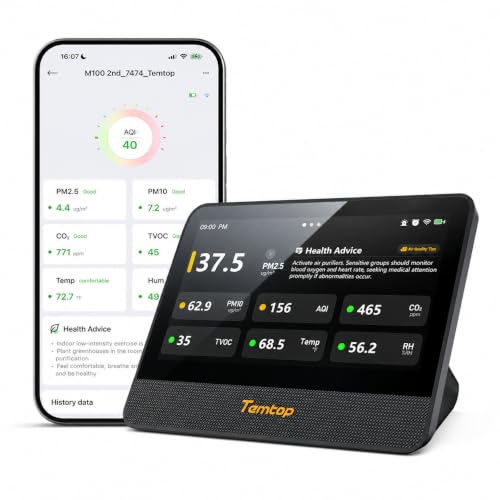
- Logs trends and supports remote app management
- 7-inch touchscreen shows graphs, max/min values, and forecasts
- LoRa extension support for larger coverage
Best For: Connected monitoring in homes, offices, and schools
Gen 2 Portable IAQ Monitor – BREATHE Airmonitor Plus
If you want air quality monitors with data logging that do more than just show a number, the BREATHE Airmonitor Plus Gen 2 is built for deeper indoor tracking. It measures CO2, PM1, PM2.5, PM10, TVOC, formaldehyde, temperature, and humidity, while the app stores up to 90 days of history and supports data export for longer-term review.
Best For: Homeowners, office users, and classroom setups that need portable monitoring with app-based history and export.
Pros:
- Tracks 8 indoor air quality metrics in real time, including CO2, PM, TVOC, and formaldehyde.
- Offers 90-day app history plus CSV-style data export for trend analysis.
- Supports smart alerts for CO2 and PM2.5 through the Breathe Tech app.
- Rechargeable design provides up to 6 hours of portable use, or continuous USB-C operation.
Cons:
- Portable battery life is limited to about 6 hours.
- Requires 2.4 GHz Wi-Fi for app connectivity.
This is a strong fit if you want a compact monitor that combines broad sensor coverage with useful logging tools. The mix of real-time readings, stored history, and exportable data makes it easier to spot patterns from cooking, cleaning, or ventilation changes.
Large-Display Datalogger – Extech IAQ320
For buyers comparing air quality monitors with data logging, the Extech IAQ320 focuses on readable on-device measurements and dependable recordkeeping. It simultaneously shows PM2.5, CO2, air temperature, relative humidity, and a health index, then stores up to 12,000 records with CSV export for later review.
Best For: Users who want a room-visible display and straightforward logging for indoor air checks.
Pros:
- Measures PM2.5, CO2, temperature, humidity, and health index at the same time.
- Large LED display is designed to be easy to see across the room.
- Stores up to 12,000 records and exports data in CSV format.
- Includes programmable sampling rate plus Hi/Lo limits with visual and audible alarms.
Cons:
- Logs fewer pollutant types than more feature-heavy smart monitors.
- Details emphasize local display and logging rather than app-based cloud history.
The IAQ320 is a practical choice when visibility and simple logging matter more than a long list of sensors. It gives you clear, room-side feedback and enough stored data for basic trend analysis or reporting.
Cloud-Logging Pro Monitor – CF-60PP Smart
The CF-60PP SMART is aimed at buyers who want air quality monitors with data logging plus cloud access and broader environmental tracking. It combines Wi-Fi app syncing, stored history, USB export, and a large sensor suite that covers PM1.0/PM2.5/PM10, CO2, TVOC, HCHO, pollen, AQI, temperature, humidity, date, and time.
Best For: Homes, schools, and facilities that need long-term logging with cloud history and alerting.
Pros:
- Tracks a wide range of indoor factors, including dust, gases, pollen, AQI, temperature, and humidity.
- App syncs live readings and stores historical data in the cloud.
- Supports USB data export and up to one year of historical sensor data.
- Custom alarm thresholds and push notifications help catch spikes quickly.
Cons:
- Feature set is broad, which may be more than casual users need.
- Some history features depend on the app and cloud workflow.
This model stands out if you need richer tracking and reporting tools for ongoing indoor air management. The combination of cloud history, on-device charting, and export options makes it well suited to long-term observation and documentation.
Portable Analysis Meter – Temtop M2000C 2nd
If you need air quality monitors with data logging for portable, data-driven review, the Temtop M2000C 2nd is built around the core indoor readings most buyers check first. It monitors CO2, PM2.5, and PM10, and adds temperature and humidity insights plus USB data export for in-depth analysis.
Best For: Users who want a rechargeable handheld monitor for CO2 and particulate tracking with exportable records.
Pros:
- Measures CO2, PM2.5, PM10, temperature, and humidity.
- USB export lets users download readings in CSV format for analysis.
- Audio alarm and colorful TFT display make the readings easy to act on.
- Rechargeable and portable design suits classrooms, homes, and small businesses.
Cons:
- Does not list app-based cloud history or remote monitoring.
- Focuses on core metrics rather than broad chemical sensing.
The M2000C 2nd is a straightforward pick if your priority is practical monitoring with useful data export. It keeps the interface simple while still giving you the records needed for deeper review.
Fast-Refreshing Smart Monitor – GoveeLife Smart Air Quality Monitor with PM2.5
If you want an air quality monitor with data logging that focuses on fast PM2.5 tracking, the GoveeLife H5106 is built for quick, connected monitoring at home or in the office. It measures PM2.5, temperature, and humidity, with a two-second refresh and remote viewing through Bluetooth or Wi-Fi.
Best For: Users who want a plug-in monitor with fast PM2.5 updates, app-based data logging, and Govee smart-device automation.
Pros:
- Two-second refresh helps show recent changes in PM2.5, temperature, and humidity.
- Offers 13-day online data graphs and up to 2 years of data export.
- Works with GoveeHome devices for automatic control of compatible purifiers, humidifiers, heaters, and fans.
- LED display includes a clock/PM2.5 view and four ambient air quality levels.
Cons:
- Requires constant power and has no built-in battery.
- 2.4G Wi-Fi is required to display the time.
- Only supports compatible GoveeLife devices for automation.
This is a strong pick if your priority is practical indoor tracking with logging and easy smart-home integration. It is less suited to portable use, but it handles everyday monitoring well for a fixed location.
Portable CO2 Logger – Aranet4 Indoor Air Quality Monitor
The Aranet4 is a strong choice if you want air quality monitors with data logging focused on CO2, temperature, humidity, and pressure. Its e-ink display is made for low-power, cable-free use, while the companion app gives you up to 90 days of historical data in easy-to-read graphs.
Best For: People who want a wireless CO2 monitor with long battery life and simple historical tracking.
Pros:
- Measures CO2, temperature, relative humidity, and atmospheric pressure in real time.
- Up to 4 years of battery life helps keep it truly wireless.
- App provides up to 90 days of historical data with graphs.
- NDIR sensor technology is designed for precise and reliable CO2 measurements.
Cons:
- Historical data retention is limited to 90 days in the app.
- Focuses on CO2 rather than broader pollutant detection like PM2.5 or VOCs.
- Requires AA batteries instead of rechargeable power.
For users who mainly care about ventilation and CO2 levels, this is one of the cleanest and easiest monitors to live with. It is especially appealing if you prefer a cable-free setup and don’t need a wide sensor suite.
Alexa-Connected Air Monitor – Amazon Smart Air Quality Monitor
If you want air quality monitors with data logging that slot neatly into an Alexa-powered home, this Amazon Smart Air Quality Monitor covers the basics well. It tracks PM2.5, VOCs, carbon monoxide, humidity, and temperature, then surfaces the information through a color-coded LED and the Alexa app.
Best For: Alexa users who want an easy plug-in monitor with multi-sensor tracking and app-based alerts.
Pros:
- Tracks five key factors: PM2.5, VOCs, carbon monoxide, humidity, and temperature.
- Sends phone notifications and Echo announcements when air quality drops.
- Can trigger Alexa routines for compatible purifiers, dehumidifiers, fans, and more.
- Simple setup: plug it in and follow the Alexa app instructions.
Cons:
- Data logging is centered on the Alexa app rather than a dedicated export-focused platform.
- Requires Alexa-compatible devices for the strongest automation features.
- Needs to be plugged in for use.
This is a practical pick if your home already runs on Alexa and you want clear, app-based air monitoring without extra setup complexity. Its strength is convenience and automation rather than advanced standalone logging.
Premium Radon + Whole-Home Tracking – Airthings View Plus
If you want air quality monitors with data logging that cover the basics and then some, the Airthings View Plus is built for continuous, app-based tracking of multiple indoor factors. It measures radon, PM2.5, CO2, VOCs, humidity, temperature, and air pressure, with data saved securely in the cloud for trend analysis.
Best For: Homeowners who want a battery-powered, always-on monitor for radon plus broad indoor air quality tracking.
Pros:
- Tracks radon, PM2.5, CO2, VOCs, humidity, temperature, and air pressure
- Cloud-based data logging and live readings through the Airthings app
- Battery-powered design supports flexible, cable-free placement
- Customizable eInk screen and timely notifications
Cons:
- Requires the Airthings app, an account, and internet access
- Needs WiFi connectivity for full monitoring and saved data features
For buyers focused on long-term indoor air tracking, this model stands out because it combines radon monitoring with several common comfort and pollution metrics in one device. The 5-year extended warranty option is also a useful extra for a monitor intended to run continuously.
Portable Handheld Data Logger – Smart Air Quality Monitor 128S
For shoppers comparing air quality monitors with data logging, this portable handheld unit is a practical pick when you want local storage and a broad sensor set. It continuously displays CO2, PM1.0, PM2.5, PM10, TVOC, HCHO, and tiny particle counts, while the built-in TF card can store a large number of records for later analysis.
Best For: People who want a compact, battery-powered monitor with onboard data storage for home, office, or travel use.
Pros:
- Built-in TF memory card stores up to 10W+ data records
- Measures CO2, PM1.0, PM2.5, PM10, TVOC, HCHO, and particle counts
- Portable handheld design is easy to carry and use
- TXT export via card reader supports later review and analysis
Cons:
- Smaller handheld format may be less convenient for permanent placement
- No WiFi app features are listed in the supplied notes
This model makes sense if your priority is logging air data locally instead of relying on a cloud platform. Its portability and broad set of measurements give it a useful role for spot checks and basic trend review across different spaces.
WiFi Touchscreen Analyzer with Logging – Temtop M100 2nd Gen
If you need air quality monitors with data logging for a larger space, the Temtop M100 2nd Gen is designed around real-time tracking and trend analysis. It monitors PM2.5, PM10, CO2, TVOC, temperature, humidity, and AQI, and adds WiFi connectivity, app-based notifications, and professional-style logging features.
Best For: Homes, offices, and schools that want a connected monitor with a large display and long-term trend tools.
Pros:
- Measures seven key parameters including PM2.5, PM10, CO2, TVOC, temperature, humidity, and AQI
- Data logging, trend analysis, and remote device management through the app
- 7-inch touchscreen shows graphs, max/min values, and weather forecasts
- LoRa extension support can expand coverage across multiple rooms or buildings
Cons:
- LoRa sub-units are sold separately
- Requires 2.4 GHz WiFi for live data and notifications
The M100 2nd Gen is the most feature-rich option here for buyers who want a visible dashboard and more advanced monitoring workflows. Manual calibration and customizable alerts add flexibility if you plan to rely on the readings over time.
How We Picked the Best Air Quality Monitors with Data Logging
We focused on Air Quality Monitors with Data Logging that offer a practical mix of measurement depth, usability, and export options. Priority went to models that track key indoor pollutants such as CO2, PM2.5, PM10, VOCs, humidity, and temperature, while also making it easy to review trends over time. We also favored monitors with readable displays, app support, alarm features, and flexible storage or CSV export when available.
Quick Comparison
For simple home tracking, look for a compact monitor with app-based history and alerts. For office or professional use, choose a model that supports more robust logging, data export, and longer-term trend analysis. If you need broader environmental coverage, step up to monitors that include humidity, temperature, pressure, or even radon alongside air-quality metrics.
Key Buying Factors for Air Quality Monitors with Data Logging
What They Measure
Start with the pollutant you care about most. CO2 is useful for ventilation and occupancy planning, while PM2.5 and PM10 help track dust, smoke, and fine particle exposure. VOC monitoring can flag off-gassing from cleaning products, furnishings, and cooking. If you want a fuller picture, consider models that also log humidity and temperature.
Logging and Export Options
Not all logging is equal. Some monitors store rolling history in an app, while others allow CSV export for spreadsheets and deeper analysis. If you want to compare rooms, track seasonal changes, or share records with a facility manager, exportable data is a major advantage.
Accuracy and Update Speed
Fast, stable readings matter when levels change quickly after cooking, cleaning, or opening windows. Look for monitors that refresh often enough to show real-world changes without excessive noise or delay. For repeated use, consistency is often more valuable than flashy features.
Display, Alerts, and Connectivity
A clear screen and straightforward notifications make the monitor easier to use day to day. Wi-Fi or app connectivity is helpful if you want remote visibility or long-term trend charts. Audible alarms can be especially useful in bedrooms, classrooms, workshops, and other high-occupancy spaces.
Who Should Buy Which Air Quality Monitors with Data Logging?
Homeowners and renters should prioritize ease of use, app history, and compact design. Office managers and power users should lean toward monitors with stronger data logging, export tools, and broader sensor coverage. If you’re mainly focused on ventilation and occupancy, choose a CO2-centered monitor; if your concern is dust, smoke, or indoor pollutants, prioritize PM and VOC tracking.
In short, the best choice depends on whether you want basic awareness or a more complete record of indoor air conditions. The right monitor should make trends easy to see, easy to share, and easy to act on.