Moisture can turn otherwise good filament into a source of popping, stringing, rough surfaces, and inconsistent extrusion. A suitable dryer helps hobbyist makers prepare damp spools and keep them usable between print jobs.
We compare 10 filament dryers across single- and multi-spool designs, focusing on capacity, heating performance, temperature control, storage, and everyday ease of use.
Best 10 Filament Dryers for Hobbyists Picks for 2026
High-Capacity Choice

- Dries up to four 1 kg spools
- Three fans with surround heating
- 35–70°C control and eight outlets
Best For: Multi-printer hobby setups and batch drying
Fast Four-Spool Storage

- Holds four 1 kg or two 2 kg spools
- Dual 200W chambers reach 85°C
- Sealed storage helps prevent re-absorption
Best For: High-volume drying and ongoing filament storage
Compact Everyday Dryer

- Compact design for one-spool workflows
- 35–70°C temperature and 0–99-hour timer
- Rotating spindle and translucent lid
Best For: Single-printer hobbyists and routine filament drying
Automatic Dual-Chamber Control

- Independent chambers hold four 1 kg spools
- 45–85°C range with PLA preset
- Automatic humidity-based drying mode
Best For: Advanced multi-material hobby workflows
Maximum Capacity

- Dries four spools at once
- Independent dual heating chambers
- Up to 75°C with humidity monitoring
Best For: Multi-spool and multi-material hobby printing
Balanced Two-Spool Pick
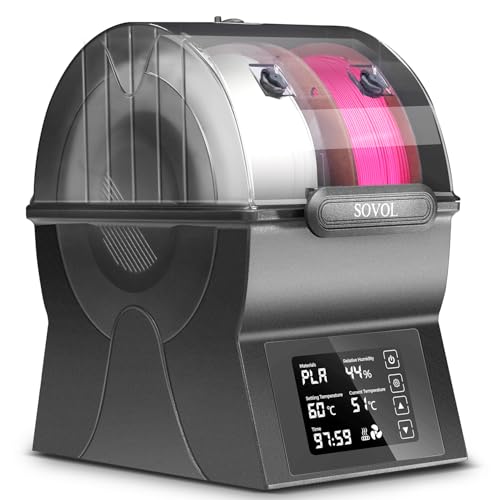
- Dries two 1 kg spools
- Heats up to 70°C
- Preset settings for nine filament types
Best For: Two-spool hobby printing and compact workspaces
Simple Single-Spool Choice

- Fan-assisted moisture removal
- LCD shows temperature, time, and humidity
- Adjustable 35°C–55°C range
Best For: Single-spool drying and routine hobby printing
Best Budget Capacity
Comgrow SH01 Filament Dryer Box

- Holds two 1 kg spools
- 40–50°C adjustable drying
- LCD temperature and humidity monitoring
Best For: Hobbyists drying and feeding standard PLA, PETG, and ABS filament
Best Premium Two-Spool Pick
Creality Space Pi Filament Dryer Plus

- 160W double PTC 360° heating
- 45–70°C adjustable temperature
- Presets for up to 12 filament types
Best For: Multi-material hobbyists needing two-spool drying and broad compatibility
Best Fast-Drying Safety Features

- 150W PTC heating to 70°C
- Two-spool capacity with dual outlets
- Up to 98-hour timer and safety cutoff
Best For: Hobbyists prioritizing quick heating, long cycles, and safety monitoring
High-Capacity Choice – SUNLU S4
For hobbyists looking for filament dryers for hobbyists that can handle several spools at once, the SUNLU S4 is built around high capacity and even airflow. It holds up to four 1 kg spools, supports drying while printing, and offers adjustable temperature and timer controls.
Best For: Multi-printer setups and hobbyists who regularly dry several filament spools at once.
Pros:
- Holds up to four 1 kg spools and supports multiple filament diameters.
- Three circulation fans and 360-degree surround heating promote even drying.
- 350W PTC heating, eight filament exit holes, and a 35–70°C temperature range.
Cons:
- Its large 4 kg body requires more workspace than compact dryers.
- May be more capacity than a single-printer hobbyist needs.
The S4 stands out when throughput matters. Its generous capacity, multiple outlets, and customization options make it a practical choice for larger hobby printing workflows, though its footprint is best suited to a dedicated work area.
Fast Four-Spool Storage – Creality Space Pi X4
The Creality Space Pi X4 is a strong option among filament dryers for hobbyists who want both active drying and moisture-controlled storage. Its dual heating chambers hold four standard 1 kg spools or two 2 kg spools, with temperatures reaching 85°C.
Best For: High-volume hobbyists who want to dry filament and limit moisture re-absorption between prints.
Pros:
- Stores four standard 1 kg spools or two large 2 kg spools.
- Dual independent 200W heating chambers reach up to 85°C.
- Silicone-sealed storage and an illuminated viewing window help maintain humidity control.
Cons:
- Its larger multi-spool design may be unnecessary for occasional users.
- The supplied notes do not specify a timer range or exact external dimensions.
With separate heating chambers and a sealed storage function, the Space Pi X4 is designed for users who want a more continuous filament-management setup rather than a dryer used only occasionally.
Compact Everyday Dryer – SUNLU S2
The SUNLU S2 is a straightforward pick for hobbyists seeking filament dryers for hobbyists without the size of a multi-spool unit. It can dry filament while printing, uses a rotating spindle for even drying, and provides simple touchscreen control from 35–70°C.
Best For: Single-printer users who need an accessible dryer and spool holder for common materials such as PLA, PETG, TPU, and ABS.
Pros:
- Compact 265 × 274 × 118 mm capacity accommodates several common filament diameters.
- Adjustable temperature and drying time from 0–99 hours.
- Translucent lid allows inspection without opening the enclosure.
Cons:
- Designed for a smaller capacity than four-spool dryers.
- Its maximum temperature is 70°C, limiting suitability for higher-temperature drying needs.
The S2 focuses on ease of use and everyday convenience. Its compact format, large touchscreen, and printing-through capability make it a sensible starting point for hobbyists managing one spool at a time.
Automatic Dual-Chamber Control – Comgrow SH03
The Comgrow SH03 gives hobbyists a feature-rich approach to filament dryers for hobbyists, combining four-spool capacity with independently controlled chambers. Its automatic drying mode responds to humidity, while dual 200W PTC heaters reach up to 85°C.
Best For: Hobbyists who want independent control, automatic humidity-based drying, and space for multiple filament types.
Pros:
- Supports up to four 1 kg spools in two independently controlled chambers.
- Adjustable 45–85°C range with dedicated PLA preset and up to 98 hours of operation.
- Includes automatic drying, 360-degree hot-air circulation, and multiple monitoring protections.
Cons:
- Its extensive controls may be more than casual users need.
- The four-spool design requires more room than a compact single-spool dryer.
The SH03 is aimed at users who value automation and control. Independent chamber settings and humidity-responsive operation make it particularly flexible for drying different materials or managing a larger print queue.
Maximum Capacity – Creality Space Pi X4L
For hobbyists who need filament dryers for hobbyists with higher-volume workflows, the Creality Space Pi X4L stands out with four-spool capacity and two independently controlled drying chambers. Its 75°C maximum temperature and print-through design suit multi-material and multi-color setups.
Best For: Hobbyists drying several spools or different filament types at the same time.
Pros:
- Dries up to four spools while allowing printing.
- Dual chambers have separate PTC heaters and temperature controls.
- Reaches temperatures up to 75°C for materials including PLA, PETG, and ABS.
- LCD touchscreen provides drying modes and real-time humidity monitoring.
Cons:
- Uses US-standard 110V power; connecting it to 220V can damage the unit.
- The four-spool design may be more capacity than a casual hobbyist needs.
- The exterior can reach up to 60°C despite the insulation.
The X4L is the most capable option here for users managing multiple active filaments, but its capacity and voltage requirement make it important to plan your workspace and electrical setup carefully.
Balanced Two-Spool Pick – Sovol SH02
The Sovol SH02 is a practical choice among filament dryers for hobbyists who want two-spool capacity without moving to a larger four-spool machine. It combines a 150W PTC heater, circulating fan, improved sealing, and preset programs for common filament types.
Best For: Hobbyists who regularly dry two 1 kg spools or feed two printers from one dryer.
Pros:
- Dries two 1 kg rolls simultaneously and includes two filament-feed holes.
- Heats to 50°C in about seven minutes and up to 70°C in about 25 minutes, according to the supplied notes.
- Offers one-key settings for nine filament types.
- Improved sealing helps protect filament even when the dryer is powered off.
Cons:
- Desiccant bags are not included.
- It has less capacity than the four-spool Creality model.
- The safety alarm may require fan replacement if the fan stops rotating.
The SH02 offers a strong middle ground for home workspaces: it has useful capacity and automation while remaining focused on the needs of two-printer or two-spool setups.
Simple Single-Spool Choice – SUNLU S1 Plus
For hobbyists seeking filament dryers for hobbyists in a straightforward single-spool format, the SUNLU S1 Plus offers adjustable drying, a fan-assisted design, and a visible LCD readout. Its 35°C–55°C range covers a broad selection of commonly used filament materials.
Best For: Hobbyists who want a compact, easy-to-monitor dryer for one spool at a time.
Pros:
- Fan design helps discharge excess moisture during drying.
- LCD shows temperature, time, and humidity.
- Temperature and drying time can be adjusted for different materials and conditions.
- Supports 1.75 mm, 2.85 mm, and 3.00 mm filament sizes.
Cons:
- Its 35°C–55°C temperature range is lower than the other options here.
- It is designed for one spool rather than simultaneous multi-spool drying.
- The supplied notes do not specify a higher-temperature mode for demanding materials.
The S1 Plus is an approachable option for routine hobby printing and basic moisture control, especially when you value simple controls and a clear display over high capacity or high-temperature drying.
Best Budget Capacity – Comgrow SH01 Filament Dryer Box
For hobbyists seeking filament dryers for hobbyists, the Comgrow SH01 provides a straightforward way to dry and store two 1 kg spools while printing. Its 40–50°C temperature range, LCD display, and sealed design suit common PLA, PETG, ABS, and similar materials.
Best For: Hobbyists who want a two-spool dryer and storage box for standard filament types.
Pros:
- Stores two 1 kg spools and supports 1.75 mm and 2.85 mm filament.
- Offers adjustable 40–50°C temperatures and 6–12-hour drying times.
- Includes temperature and humidity monitoring on a 2-inch LCD screen.
- Sealed outlet design helps maintain a dry storage environment during printing.
Cons:
- Its maximum temperature is 50°C, limiting suitability for higher-temperature materials.
- Operation requires the work state to be displayed or the unit may shut down after three minutes.
- The moisture outlet must be opened while drying and closed during storage.
The SH01 is a practical entry-level choice for routine drying and protected feeding, especially if your projects mainly use PLA, PETG, or ABS. Choose a higher-temperature model if you regularly work with nylon or other demanding materials.
Best Premium Two-Spool Pick – Creality Space Pi Filament Dryer Plus
The Creality Space Pi Plus is one of the more capable filament dryers for hobbyists who use several material types. It combines 160W double PTC 360° hot-air heating, two-spool capacity, a 4-inch touchscreen, and preset settings for up to 12 filament categories.
Best For: Hobbyists who want fast, even heating and broader material support in a two-spool dryer.
Pros:
- Dries two 1 kg rolls at once with double 360° hot-air heating.
- Supports temperatures from 45–70°C for materials including PLA, PETG, TPU, ABS, PA, PC, and composites.
- One-key presets cover up to 12 filament types.
- Four filament holes and two PTFE pipes can support two printers simultaneously.
Cons:
- The supplied notes do not specify a maximum drying duration.
- Its 1.9 kg weight may be less convenient for frequent repositioning.
- The broader feature set may be more than needed for single-material users.
With its higher temperature ceiling and uniform PTC airflow, the Space Pi Plus is a strong fit for hobbyists who switch between everyday and engineering-oriented filaments. Its touchscreen presets also reduce setup effort when changing materials.
Best Fast-Drying Safety Features – Comgrow SH02 Filament Dryer
The Comgrow SH02 is a useful option for hobbyists comparing filament dryers for hobbyists with faster heating and longer drying cycles in mind. Its 150W PTC heater reaches 50°C within seven minutes, supports temperatures up to 70°C, and includes presets for nine filament types.
Best For: Hobbyists who want quick warm-up, extended drying times, and built-in safety protections.
Pros:
- Holds two 1 kg spools and can feed two printers through two filament holes.
- 360° PTC airflow reaches 50°C within seven minutes and 70°C within 25 minutes.
- One-key presets cover nine materials, including PLA, TPU, PETG, ABS, PA, and PC.
- Offers up to 98 hours of drying plus overheat and fan-failure protection.
Cons:
- The notes do not specify the touchscreen size or detailed display information.
- At 4.4 pounds, it is heavier than the SH01.
- Its preset approach may provide less direct control than fully manual operation.
The SH02 stands out when speed and unattended operation matter. Its 70°C maximum, long timer, sealed construction, and safety monitoring make it a versatile choice for hobbyists using a wider range of filament materials.
How We Picked the Best Filament Dryers for Hobbyists
We evaluated these models around the needs of home makers rather than industrial production. The main considerations were spool capacity, stated heating power and temperature range, drying and storage functions, controls, visibility, footprint, and how easily the unit can support printing while the filament remains inside. We also considered whether a dryer suits occasional troubleshooting, regular multi-material printing, or longer-term moisture protection.
Specifications can vary by material and manufacturer, so use recommended drying temperatures and times for the specific filament you own. A dryer is not a substitute for sealed storage with fresh desiccant after drying.
Quick Comparison
| Type | Best suited to | What to prioritize |
|---|---|---|
| Single-spool dryer | Casual users and focused maintenance | Compact size, simple controls, reliable heat |
| Two-spool dryer | Most hobby workspaces | Independent or flexible heating, spool fit, feed-through ports |
| Four-spool dryer | Multi-material printing and batch preparation | Capacity, even heating, ventilation, and workspace clearance |
Key Buying Factors for Filament Dryers for Hobbyists
Capacity and Spool Compatibility
Choose capacity based on how many materials you actually use at once. A four-spool unit is useful for color or material changes, but it takes more desk space. Check maximum spool width and diameter, especially if you buy large or specialty reels.
Temperature Control and Material Support
PLA may need gentler treatment than moisture-sensitive materials such as nylon or PVA. Look for adjustable temperature and timer settings rather than relying only on a single preset. Higher maximum temperatures can expand material compatibility, but accurate, stable control matters more than a headline number.
Drying Versus Active Storage
Some boxes are designed to dry filament while feeding it to a printer; others mainly protect prepared spools. Feed-through openings, a tight seal, a humidity display, and space for desiccant can make a major difference during long prints.
Usability and Safety
Clear controls, readable displays, quiet operation, removable spool supports, and automatic shutoff improve everyday use. Keep the dryer on a stable, heat-resistant surface and follow the manufacturer’s guidance for loading, ventilation, and compatible materials.
Who Should Buy Which Filament Dryers for Hobbyists?
Choose a compact single-spool model if you print occasionally, have limited workspace, or mainly need to revive one damp reel. A two-spool dryer is the most practical middle ground for many hobbyists: it can handle common material changes without the bulk of a larger cabinet.
Choose a four-spool model if you regularly print with several materials, run multiple printers, or want to prepare reels in batches. Prioritize a sealed design and storage features if your main problem is humidity between prints. If you mostly print PLA in a dry environment, simpler controls may be sufficient; frequent nylon, TPU, PETG, or support-material users should favor adjustable heat, dependable monitoring, and consistent airflow.