The best USB-C KVM switches make it easier to share monitors, keyboards, mice, storage, and other accessories between two or more computers. They can also reduce cable clutter by combining display switching, USB connectivity, and laptop charging in one workstation hub.
This roundup compares 10 USB-C KVM switches across important factors such as display support, refresh rate, power delivery, computer capacity, and port selection. Use the guide below to narrow the options to the setup that fits your desk.
Best 10 USB C Kvm Switches Picks for 2026
Top Dual-Display Pick
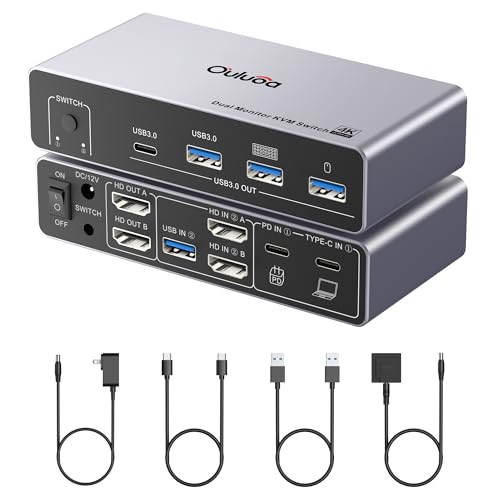
- Dual HDMI monitor support
- 100W laptop charging
- Four shared USB ports
Best For: Desktop-and-laptop dual-monitor workstations
Best for Three Computers

- Switches three computer systems
- 8K@60Hz single-display output
- 60W PD on USB-C inputs
Best For: Three-computer, single-monitor desks
Best Full-Featured Dock

- 12-in-1 docking connectivity
- Dual HDMI monitor outputs
- 60W charging per laptop
Best For: Two-laptop dual-monitor workstations
Best USB4 Dock Switch

- Shares one dock among three computers
- Up to 140W PD
- 20Gbps USB4 data transfer
Best For: USB-C or Thunderbolt 4 dock-based desks
Dual-Screen USB-C Workstation

- Runs two HDMI monitors at up to 4K@60Hz
- Shares four USB 3.0 peripheral ports
- Switches between laptops by button or wired remote
Best For: Dual-monitor laptop workstations and demanding peripheral setups
Versatile Desk Sharing
USB-C and HDMI Single-Monitor KVM

- Shares one HDMI monitor between a laptop and desktop
- Supports 4K@60Hz output and 5Gbps USB 3.0
- Includes wired controller and up to 100W PD input
Best For: Mixed laptop-and-desktop single-monitor workstations
Best Overall
Hearvo USB 3.0 HDMI + USB-C KVM Switch
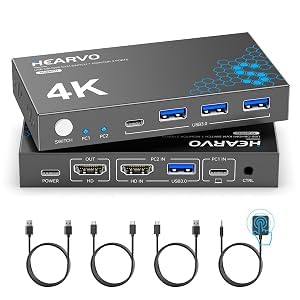
- Mixed HDMI and USB-C inputs for two computers
- Four shared USB ports with up to 5Gbps transfer
- 4K@60Hz output with wired remote and adaptive EDID
Best For: Mixed PC, laptop, or Mac mini workstations
Best Budget Setup
MLEEDA USB-C KVM Switch for Two Laptops

- Switches two Windows or Mac laptops to one HDMI monitor
- Supports 4K@60Hz and 1440p@120Hz
- Includes wired remote and USB power cord
Best For: Basic two-laptop desks using an HDMI monitor
Best for USB-C Charging

- Supports two USB-C computers and one HDMI monitor
- Delivers up to 100W USB-C Power Delivery
- Shares keyboard, mouse, and compatible USB devices
Best For: USB-C laptop desks that need charging while switching
Top Dual-Display Pick – 8K USB-C KVM Dock
If you need to share two monitors and USB peripherals between a desktop and laptop, this USB C KVM switch is built for that arrangement. It supports dual HDMI displays, includes three USB 3.0 ports plus USB-C, and provides up to 100W laptop charging. Windows supports extended or mirrored displays through MST, while macOS is limited to SST mode.
Best For: Desktop-and-laptop users who need dual-monitor control, peripheral sharing, and laptop charging.
Pros:
- Supports two HDMI monitors with up to 8K@60Hz output from the desktop input.
- Provides three USB 3.0 ports and one USB-C port for shared accessories.
- Includes 100W PD, an external power adapter, a wired remote, and a 12-month warranty.
Cons:
- macOS supports SST mode only rather than Windows-style extended MST displays.
- HDMI cables within 6.56 feet are recommended for stable signal transmission.
This is a strong choice when dual displays and broad USB expansion matter more than a compact setup. Its included power supply and high PD rating also suit desks using power-hungry USB accessories.
Best for Three Computers – SABRENT 8K USB-C KVM
This USB C KVM switch is designed for a three-computer desk with one shared monitor, keyboard, and mouse. Two systems connect over USB-C and a third uses DisplayPort, while the DisplayPort 1.4 output supports up to 8K at 60Hz or 4K at 144Hz. It is a single-display switch, not a dual-monitor solution.
Best For: Users switching among two USB-C laptops and one DisplayPort computer on one high-resolution monitor.
Pros:
- Controls three computers from one monitor and shared keyboard and mouse.
- Supports up to 8K@60Hz or 4K@144Hz through DisplayPort 1.4.
- Offers up to 60W PD on both USB-C inputs and includes remote switching.
Cons:
- Supports one external display only.
- USB-C laptops must support DisplayPort Alternate Mode for video.
- Shared USB ports operate at USB 2.0 speeds and are not intended for fast storage.
Choose this model if three-system switching and high-refresh single-monitor output are the priorities. Verify USB-C video compatibility before buying, especially for laptops with data-only or charge-only ports.
Best Full-Featured Dock – AV Access Dual-Laptop KVM
For a two-laptop workspace, this USB C KVM switch combines switching with a 12-in-1 docking station. It connects two laptops to two HDMI monitors while sharing USB devices, Ethernet, audio, and an SD card slot. The USB-C inputs require DP Alt Mode and DP MST for extended dual displays; Mac models support mirrored displays only.
Best For: Hybrid workers and professionals managing two compatible laptops with dual monitors and extensive desk peripherals.
Pros:
- Combines dual-laptop KVM switching with 12-in-1 docking connectivity.
- Includes two HDMI outputs, Ethernet, USB ports, audio, and an SD card slot.
- Supports up to 60W charging for each laptop and switching in about 2–3 seconds.
Cons:
- Dual-display extension requires compatible USB-C DP Alt Mode and DP MST support.
- Mac models support mirrored displays only.
- It is not compatible with 5K monitors, FreeSync/G-Sync, or Dell Display Manager.
This is the most workstation-oriented option in the group, especially if you also need networking and removable-storage access. Its compatibility limitations make checking laptop and monitor specifications essential before purchase.
Best USB4 Dock Switch – Cable Matters 140W KVM
This USB C KVM switch shares a USB-C or Thunderbolt 4 monitor or docking station among three computers rather than directly switching multiple HDMI outputs. It provides up to 20Gbps data transfer, supports up to 8K@30Hz on Windows, and delivers up to 140W PD to the selected active computer. Use the included USB4 20Gbps cables for compatibility.
Best For: Users who already own a compatible USB-C or Thunderbolt 4 display or dock and want to share it among three computers.
Pros:
- Switches one USB-C or Thunderbolt 4 monitor or dock between three computers.
- Supports up to 20Gbps data transfer and up to 140W PD for the active device.
- Includes RF remote control and can convert a compatible dock into a KVM setup.
Cons:
- macOS supports one external display.
- Windows video support is up to 8K@30Hz, not 8K@60Hz.
- Only the selected computer receives charging, and the included USB4 cables are required.
This switch is a practical fit for a dock-centered desk where replacing the monitor or dock is undesirable. Confirm that your dock has a detachable host cable and account for its 20Gbps bandwidth before expecting maximum display performance.
Dual-Screen USB-C Workstation – Dual-Monitor Laptop KVM
This USB C KVM switch is designed for two laptops sharing two HDMI monitors and a full set of peripherals. It combines docking, dual-screen output, and one-click switching in a practical setup for users who want to reduce cable swapping at a busy desk.
Best For: Dual-monitor laptop workstations, video editing, graphics work, and users who need USB 3.0 peripheral sharing.
Pros:
- Supports two external monitors at up to 4K@60Hz simultaneously.
- Includes four USB 3.0 ports with speeds up to 5Gbps.
- Offers physical-button and wired-remote switching, with LED channel indicators.
- Provides two 100W PD inputs, with usable laptop power noted at approximately 73–80W.
Cons:
- Requires laptops with USB-C DP Alt Mode for video, data, and PD functionality.
- Dual-monitor extend mode is not supported on Mac OS according to the supplied notes.
- A 100W power adapter is not included.
This is the most capable option here for a dual-monitor USB-C setup, but compatibility checks are important—especially for Mac users and laptops that lack the required USB-C video support.
Versatile Desk Sharing – USB-C and HDMI Single-Monitor KVM
This USB C KVM switch lets one laptop and one desktop share a single HDMI monitor, keyboard, mouse, and other USB accessories. It is a straightforward choice for mixed-computer desks, provided the laptop has a compatible Thunderbolt 3-or-newer USB-C port.
Best For: Home offices or workstations combining a USB-C laptop with a desktop around one 4K monitor.
Pros:
- Supports HDMI output up to 4K@60Hz, with compatibility for lower resolutions and 1440p@120Hz.
- Provides three USB-A 3.0 ports and one USB-C 3.0 data port at up to 5Gbps.
- Offers switching from the unit or included wired controller, plus an active-channel LED.
- Supports USB-C Power Delivery input up to 100W for compatible laptop charging.
Cons:
- The laptop USB-C port must support Thunderbolt 3, 4, or 5.
- The KVM requires external power to operate.
- Keyboard hotkey switching is not supported.
- The USB-C 3.0 port is data-only and does not provide video or laptop charging.
Choose this model when a single shared HDMI display is enough and you want broad USB peripheral connectivity. Its main buying consideration is the laptop’s Thunderbolt compatibility, so verify the specific model before ordering.
Compact Single-Display Switcher – Two-Laptop USB-C KVM
This USB C KVM switch allows two compatible laptops to share one HDMI monitor, keyboard, mouse, and other USB devices. It is aimed at users who want a simpler single-screen setup with 4K output and laptop power support.
Best For: Two-laptop home offices using one HDMI monitor and standard USB peripherals.
Pros:
- Supports one shared HDMI monitor at up to 4K@60Hz.
- Includes two USB-A 2.0 ports and one USB-C 2.0 data port for peripherals.
- Provides up to 100W charging support for the active laptop.
- Works with lower resolutions and supports 1440p@120Hz.
Cons:
- Both laptops require Thunderbolt 3, 4, or 5 ports with suitable video and charging support.
- USB connections are limited to USB 2.0 speeds of up to 480Mbps.
- It supports HDMI monitors only; the USB-C data port cannot transmit video.
- Power must remain connected, and the charging function powers only the computer in use.
This model makes sense for a basic two-laptop, one-monitor arrangement where peripheral bandwidth is not a priority. Compared with faster USB 3.0 alternatives, its USB 2.0 ports are better suited to keyboards, mice, printers, and routine accessories than high-speed storage.
Best Overall – Hearvo USB 3.0 HDMI + USB-C KVM Switch
For shoppers comparing usb c kvm switches, the Hearvo stands out as a flexible option for a mixed PC-and-laptop or PC-and-Mac mini setup. It combines USB-C and HDMI computer inputs, supports one shared 4K monitor, and lets two computers use the same keyboard, mouse, and other USB accessories.
Best For: Home offices and workstations that need broad peripheral sharing between a USB-C computer and an HDMI-equipped PC.
Pros:
- Supports one monitor and two computers with mixed HDMI and full-function USB-C inputs.
- Offers three USB-A ports and one USB-C port with USB 3.0 data transfer up to 5Gbps.
- Supports 4K at 60Hz, HDCP 2.2, adaptive EDID, and plug-and-play setup.
- Includes both a physical button and wired remote for switching.
Cons:
- The connected USB-C computer must support video and data transmission through its USB-C port.
- Only one monitor is supported.
The Hearvo is a well-rounded choice when USB-C compatibility and extensive USB sharing matter equally. Its included cables and remote add convenience, while adaptive EDID is designed to help maintain a stable display when switching.
Best Budget Setup – MLEEDA USB-C KVM Switch for Two Laptops
The MLEEDA is a straightforward USB-C KVM switch for two Windows or Mac laptops sharing one HDMI monitor. It supports 4K at 60Hz and provides both a button and wired remote, but its simpler design relies on a USB hub for expanding peripheral connections.
Best For: Laptop users who want an affordable two-computer switch with HDMI display output and basic USB sharing.
Pros:
- Connects two compatible laptops to one HDMI monitor.
- Supports up to 4K at 60Hz and lower resolutions including 1440p at 120Hz.
- Provides physical-button and 1.5-meter wired-remote switching.
- Includes a USB power cord and 12 months of after-sales service.
Cons:
- USB-C and HDMI cables are not included.
- Requires the included USB power cord and supports USB hubs, but not USB-C docking stations.
- Does not support EDID emulation or hotkey switching.
This model makes sense for a laptop-focused desk where HDMI is the monitor connection and a USB hub can handle additional accessories. Check your cable inventory and laptop compatibility before buying, since the package does not include video or USB-C cables.
Best for USB-C Charging – USB-C KVM Switch with 100W PD
This USB-C KVM switch is designed for two USB-C computers that share one HDMI monitor, keyboard, mouse, and compatible USB devices. Its main advantage over many usb c kvm switches is support for up to 100W USB-C Power Delivery, allowing a compatible laptop to remain powered while you switch between systems.
Best For: USB-C laptop users who prioritize charging alongside shared display and peripherals.
Pros:
- Connects two USB-C computers to one HDMI monitor.
- Supports HDMI output up to 4K at 60Hz.
- Provides up to 100W USB-C PD input for compatible laptop charging.
- Shares keyboards, mice, flash drives, hard drives, printers, and other compatible USB devices.
Cons:
- Both computers need compatible USB-C ports with video output, such as Thunderbolt video support.
- The monitor connection is HDMI, and the setup requires a compatible power adapter for stable PD operation.
- Switching is handled by a physical button rather than a wired remote or hotkey.
The defining feature here is charging: it is a practical fit for a two-laptop setup where keeping a USB-C computer powered is important. Verify USB-C video compatibility and use an appropriate power adapter before relying on the 100W PD capability.
How We Picked the Best USB C Kvm Switches
We focused on the features that have the greatest effect on everyday usability: the number of computers and displays supported, maximum resolution and refresh rate, USB data speeds, power delivery, compatibility, and switching convenience. We also considered whether each model is designed for a simple single-monitor setup or a more demanding dual-display workstation.
Because USB-C ports do not all support the same video, data, or charging standards, we treated advertised specifications as a starting point rather than a guarantee for every computer. Your laptop, monitor, cables, and operating system must also support the required modes.
Quick Comparison
Single-monitor USB-C KVM switches are generally the simplest and most affordable choice for switching between two laptops or computers. Dual-monitor models are better suited to productivity workstations, but they require compatible video outputs and additional cables. If you use high-resolution displays, prioritize models rated for 4K at 60Hz or 8K at 60Hz, depending on your hardware.
Power delivery varies considerably. Some switches provide enough power to maintain a laptop charge during normal use, while higher-output models are better for demanding notebooks. A KVM’s PD rating is not the same as the charger included with it, so check whether you must supply your own USB-C power adapter.
Key Buying Factors for USB-C KVM Switches
Display Support
Confirm the number of monitors, video connectors, resolution, and refresh rate you need. A dual-monitor switch may require two HDMI or DisplayPort connections from each computer, while some laptops need a dock or adapter to provide enough outputs.
Computer and Peripheral Capacity
Check how many computers the switch can share and which accessories are supported. USB 3.0 or faster ports are preferable for external drives, webcams, and other high-bandwidth devices; basic USB 2.0 ports may be sufficient for keyboards and mice.
Power Delivery and Cables
Higher-wattage PD can be useful for charging compatible laptops, but performance depends on the power supply, cable rating, and the computer’s own charging limits. Use certified cables that support the required video bandwidth and wattage.
Switching Method and Compatibility
Look for a physical button, wired remote, or keyboard shortcut that suits your desk. Verify compatibility with Windows, macOS, and any specialized peripherals before buying, particularly if you use mixed operating systems.
Who Should Buy Which USB C Kvm Switches?
Choose a compact single-monitor model if you alternate between two laptops and mainly need one display, keyboard, and mouse. A dual-monitor KVM is the better fit for office multitasking, development, trading, or creative work that benefits from more screen space. For users connecting three computers, a higher-capacity model can avoid repeatedly unplugging cables.
Prioritize high refresh-rate support for gaming or smooth motion, strong PD output for a laptop-centered desk, and faster USB ports if you regularly move files to external storage. If your setup is unusually complex, confirm the complete signal path—computer ports, cables, KVM, and monitors—before ordering.