The best solar system models make astronomy easier to understand by turning planetary scale, motion, and order into something children and adults can see and explore.
This roundup compares 10 solar system models, from build-your-own foam kits and glowing planetariums to orbital displays and detailed miniature sets, so you can choose the right fit for learning, play, or décor.
Best 10 Solar System Models Picks for 2026
Best Glow-in-the-Dark Pick
National Geographic Solar System Model

- Builds and paints all eight planets and the Sun
- Movable arms support adjustable display positions
- Glow-in-the-dark accents and facts poster included
Best For: Ages 8+, creative astronomy projects, and space decor
Best Interactive Building Set
LEGO Planet Earth and Moon in Orbit
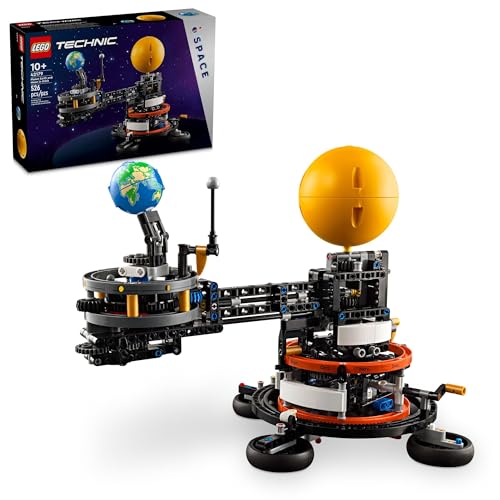
- 526-piece LEGO Technic construction set
- Crank shows Earth and Moon orbiting the Sun
- Includes month and moon-phase details
Best For: Ages 10+ and hands-on orbital science learning
Best Classroom Project Kit

- Foam planets and 64 project components included
- Comes with 12 paints, two brushes, and a palette
- Designed for school projects and family activities
Best For: Ages 6–12, classroom learning, and creative craft projects
Best Projector Combination
GeoSafari Orbiting Solar System

- Eight planets move on orbiting arms
- Projects 32 space images onto the ceiling
- Includes NASA imagery, discs, and a facts guide
Best For: Ages 5+ and visual, hands-on astronomy exploration
Best DIY STEM Pick
4M Glow-in-the-Dark Planetarium
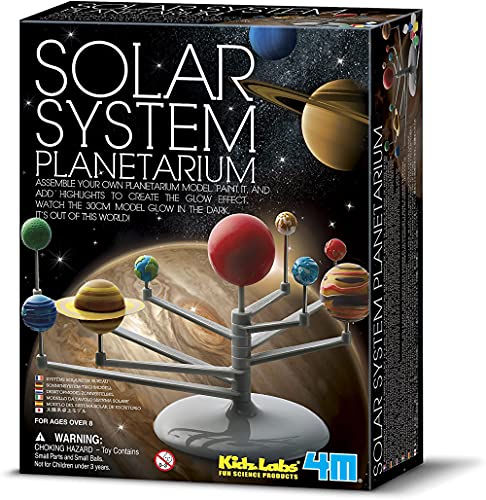
- Hands-on assembly and painting activity
- Includes glow paint, chart, and quiz questions
- Recommended for ages 8 and up
Best For: Creative children learning through STEM projects
Best Craft Project Kit
48-Piece Foam Ball Solar System
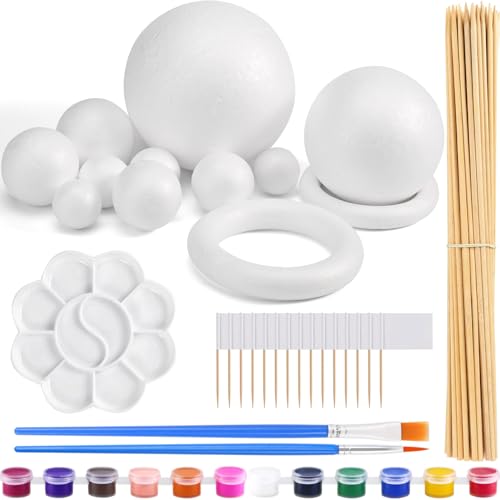
- Ten ball sizes show relative scale
- Includes 12 paints and project accessories
- Glue-free assembly for school projects
Best For: Young learners and classroom craft activities
Best Display Model
True-Scale Solar System Collection

- Sun and eight planets at 1:2 billion scale
- Realistic colors and surface details
- Includes Moon, manual, and tweezers
Best For: Astronomy enthusiasts and polished educational displays
Best DIY Display Kit
35-Piece Solar System Foam Ball Model
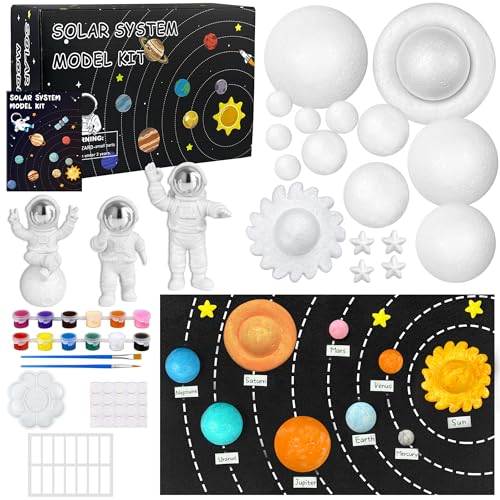
- Paint-and-assemble format with 35 listed pieces
- Includes wall-hanging display materials and instructions
- Designed for educational projects and creative learning
Best For: DIY projects, classrooms, and learners ages 8+
Best Interactive Projector

- Projects eight planets and 24 space images
- Offers bilingual English and Spanish astronomy facts
- Doubles as a night light or flashlight
Best For: Interactive STEM learning and bedtime use for young children
Best Sun-Earth-Moon Demonstrator
Orbital Model and Planetarium Kit

- Shows seasons, rotations, eclipses, and moon phases
- Uses moving components for Earth science lessons
- Includes a seasonal plate and assembly instructions
Best For: Classroom demonstrations and school science projects
Best Glow-in-the-Dark Pick – National Geographic Solar System Model
For shoppers comparing solar system models, this National Geographic kit combines hands-on construction, painting, and display appeal. Kids build and customize all eight planets and the Sun, then use the movable arms to adjust the arrangement and enjoy glow-in-the-dark accents.
Best For: Ages 8 and up, space-themed bedroom decor, and creative astronomy STEM projects.
Pros:
- Includes planets, paints, brush, palette, decals, and a solar system facts poster.
- Movable arms allow kids to rearrange the display.
- Glow-in-the-dark accents add visual appeal after assembly.
- Supports construction, creativity, coordination, and problem-solving skills.
Cons:
- Recommended for children ages 8 and up, so it may not suit younger children.
- The kit requires painting and assembly before it can be displayed.
This is a strong choice when you want solar system models that function as both an educational activity and a decorative display. Its included supplies make it convenient, while the movable structure adds more interaction than a static model.
Best Interactive Building Set – LEGO Planet Earth and Moon in Orbit
Among solar system models, this LEGO Technic set stands out for its working orbital mechanism. After building the 526-piece model, children can turn the crank to watch representations of Earth and the Moon move around the Sun, with printed details covering months and moon phases.
Best For: Kids ages 10 and up who enjoy construction toys and interactive space science displays.
Pros:
- Crank-operated design demonstrates Earth and Moon movement around the Sun.
- Printed month and moon-phase details connect the model to seasons and lunar cycles.
- LEGO Builder app offers 3D viewing, progress tracking, and model rotation tools.
- 526 pieces provide an involved building experience.
Cons:
- Its recommended age of 10 and up may be advanced for younger children.
- The set represents Earth, the Moon, and the Sun rather than a complete eight-planet model.
This model is best suited to families seeking a build-focused learning activity rather than a traditional full solar system display. The hand-powered movement makes orbital concepts easier to observe and gives the finished piece ongoing play value.
Best Classroom Project Kit – 64-Piece Solar System Model
This 64-piece option is one of the more craft-oriented solar system models for school or home projects. Children paint foam planets and assemble the components using the included sticks, flags, brushes, palette, and instruction sheet, creating a project that combines art with introductory astronomy.
Best For: Ages 6–12, classroom activities, family projects, and children who enjoy painting and crafting.
Pros:
- Includes foam discs, balls, stars, bamboo sticks, flags, paints, brushes, and a palette.
- Foam surfaces are described as smooth and easy to color.
- Supports hand-eye coordination, focus, artistic skills, and basic planet learning.
- Suitable for classroom themes and family activities.
Cons:
- The manufacturer information gives both a 6–12 recommendation and a listing highlight for ages 3–5, so age guidance is inconsistent.
- Foam construction may be less substantial than a rigid plastic or brick-built model.
- Painting and assembly are required before the project is complete.
Choose this kit when the activity itself matters as much as the finished model. Its broad supply list is convenient for a guided project, though adults may want to review the components and age suitability before use.
Best Projector Combination – GeoSafari Orbiting Solar System
This GeoSafari set adds projection to the usual solar system models, giving children both a rotating display and 32 space images to explore. Eight planets sit on moving arms around a Sun-shaped projector, while the included discs show planets, constellations, asteroids, and NASA imagery.
Best For: Children ages 5 and up who benefit from visual, hands-on astronomy exploration.
Pros:
- Combines an orbiting eight-planet model with a ceiling projector.
- Includes 32 images across four discs, including NASA photos.
- Guide provides space facts and supports exploration of planets and constellations.
- Works well as indoor classroom decor or a space-themed gift.
Cons:
- Requires three AA batteries, which are not included.
- The projector and moving display add more features than a simple static model, but require indoor use.
- The product is designed for manual operation rather than automated orbiting.
This is a practical pick for younger children who are motivated by images and interactive demonstrations. It offers more variety than paint-your-own solar system models, although buyers should plan to supply the required batteries.
Best DIY STEM Pick – 4M Glow-in-the-Dark Planetarium
For children who learn best by making, this 4M kit is one of the more engaging solar system models. Kids assemble and paint the planets, then use the included glow paint, rods, and string to create a display while learning basic astronomy facts.
Best For: Children ages 8 and up who enjoy hands-on STEM projects and creative model building.
Pros:
- Combines assembly, painting, and astronomy learning.
- Includes planets, stencils, glow paint, rods, string, and a fact-filled wall chart.
- Includes 10 sets of Kidz Quiz questions and complete instructions.
- Requires no batteries.
Cons:
- Pluto is not included.
- Assembly and painting require time and adult guidance may be useful for some children.
This is a strong choice when the activity matters as much as the finished display. It is less suited to shoppers seeking a preassembled or highly detailed decorative model.
Best Craft Project Kit – 48-Piece Foam Ball Solar System
This foam-ball set is a flexible option for school assignments, crafts, and introductory solar system models. Its ten ball sizes help illustrate relative planetary scale, while the paints, brushes, bamboo sticks, and flags give children the materials to build and label their own display.
Best For: Young children, classroom activities, and hands-on science or craft projects.
Pros:
- Includes 10 differently sized foam balls for visual scale comparisons.
- Provides 12 paint colors, brushes, a palette, bamboo sticks, and toothpick flags.
- Can be assembled without glue.
- Useful for school science projects, handmade crafts, and decoration.
Cons:
- Foam construction is more craft-oriented than display-grade.
- Painting and assembly are required before the model is complete.
- The supplied age details are broad, so supervision may be appropriate for younger children.
Choose this kit when you want plentiful project supplies and an easy way to demonstrate size relationships. It is best viewed as a creative learning activity rather than a precision astronomical replica.
Best Display Model – True-Scale Solar System Collection
Among solar system models designed for display, this collection emphasizes accurate relative sizing and realistic planetary details. The 1:2,000,000,000 scale keeps the set compact enough for a desk or shelf, while the included manual and tweezers support closer observation and handling.
Best For: Astronomy enthusiasts, students, classrooms, and gift buyers seeking a polished educational display.
Pros:
- Represents the Sun and eight planets at a stated true scale.
- Features planet colors and details inspired by real space photography.
- Includes the Moon, illustrated manual, and precision tweezers.
- Comes in a premium gift box with a greeting card.
Cons:
- Recommended for ages 10 and up.
- The compact display model is intended for visual reference and display, not a room-sized orbital demonstration.
- Its premium presentation may be more than needed for a simple school craft.
This is the strongest fit for buyers who prioritize realism, scale, and presentation over building activity. It works well as a conversation piece while still offering useful educational context through the manual.
Best DIY Display Kit – 35-Piece Solar System Foam Ball Model
This hands-on option stands out among solar system models for older children, classrooms, and adults who want to paint and assemble their own display. It includes foam spheres, pigments, brushes, a felt background, hanging supplies, and instructions, with a wall-mounted format that saves space.
Best For: DIY science projects, classroom displays, and creative learners ages 8 and up.
Pros:
- Includes 14 foam balls, 12 pigments, brushes, palette, stars, astronauts, and display supplies.
- Instructions support learning planetary order and orbital positions.
- Wall-hanging design creates a compact educational display.
- Encourages hands-on coordination and color-recognition skills.
Cons:
- Requires painting and assembly before it can be displayed.
- Foam construction may be less durable than a rigid plastic model.
Choose this kit if the making process matters as much as the finished solar system. Its broad component selection supports a creative project, though it is less suitable for shoppers seeking a ready-to-use model.
Best Interactive Projector – Talking Solar System for Kids
For younger children, this interactive choice combines a solar system model with projection, audio facts, and a night-light function. It displays the eight planets, offers English and Spanish language options, and includes 24 space images across three slides.
Best For: Children ages 3 and up who enjoy interactive STEM toys, bedtime lighting, and bilingual astronomy activities.
Pros:
- Projects the eight planets and space images onto a wall or ceiling.
- Provides astronomy facts in both English and Spanish.
- Includes 24 HD images on three exploration slides.
- Works as a night light or flashlight as well as a learning toy.
Cons:
- Requires three AA batteries, which are not included.
- Projection clarity depends on adjusting the top knob and room conditions.
- Focuses on interactive projection rather than a detailed physical planetary display.
This is a strong pick when engagement and bedtime versatility are priorities. It offers more interactive features than traditional solar system models, but buyers wanting a purely mechanical or craft-based model may prefer another format.
Best Sun-Earth-Moon Demonstrator – Orbital Model and Planetarium Kit
This mechanical teaching model takes a focused approach to solar system models by demonstrating the relationships among the Sun, Earth, and Moon. Its moving components are designed to illustrate seasons, planetary rotation and orbit, solar and lunar eclipses, and moon phases.
Best For: School science lessons, Earth science demonstrations, and children over age 6 learning through movement.
Pros:
- Demonstrates Earth’s orbit, rotation, seasons, and eclipse positions.
- Helps explain both solar and lunar eclipses with movable components.
- Includes a seasonal plate showing seasons and traditional Chinese calendar terms.
- Suitable for classroom teaching or a school project.
Cons:
- Assembly requires multiple screws, gears, alignment steps, and a wrench.
- Represents the Sun-Earth-Moon system rather than all eight planets.
- The supplied instructions require careful setup for correct alignment.
Consider this model when demonstrating orbital relationships is more important than showing the complete solar system. Its moving design can make abstract astronomy concepts easier to discuss, but assembly and its narrower three-body scope should be expected.
How We Picked the Best Solar System Models
We focused on models that offer a clear educational purpose, age-appropriate engagement, and useful hands-on features. The selection includes construction kits, illuminated displays, talking and projection-based designs, orbital demonstrations, and scale-focused models. We also considered project completeness, assembly requirements, durability, display value, and how well each option supports independent learning or guided teaching.
Because “best” depends on the intended use, this list does not treat a detailed display model and a creative STEM craft kit as interchangeable. Instead, it highlights the strengths and limitations shoppers should weigh before buying.
Quick Comparison
- Best for guided learning: A projector, talking model, or orbital demonstration can explain concepts beyond planet names and colors.
- Best for hands-on STEM: DIY kits encourage painting, assembling, labeling, and researching planetary features.
- Best for younger learners: Choose sturdy, visually clear designs with simple controls and age-appropriate parts.
- Best for display: True-scale or miniature planet sets prioritize realistic coloring, proportions, and presentation.
- Best for a gift: Look for a complete kit with instructions, engaging lighting, or a building experience that matches the recipient’s interests.
Key Buying Factors for Solar System Models
Age and Supervision
Check the recommended age range and account for small balls, sticks, paints, batteries, and other components. Younger children may need adult help with assembly, painting, or explaining scale. A model with fewer loose parts can be a better everyday learning tool.
Learning Features
Decide whether you want static planet identification or a deeper demonstration of orbit, rotation, relative position, and planetary order. Moving mechanisms, projections, audio, and glow effects can add context, while a simple kit may better support creativity and recall.
What Is Included
Compare the contents carefully. Some kits include paints, brushes, stands, labels, backgrounds, or batteries; others may require household supplies or separate power sources. A complete package usually offers better value and less setup frustration.
Scale, Accuracy, and Space
Most home models cannot represent true distances and planet sizes at the same time. If accuracy matters, check the stated scale and whether the product is designed for demonstration or visual appeal. Also measure available shelf, desk, or classroom space before ordering.
Who Should Buy Which Solar System Models?
Choose a build-and-paint kit for children who enjoy crafts, experiments, and personalized projects. An orbital or projection model is better for families and teachers who want to explain movement and astronomy concepts interactively. Talking models suit learners who benefit from audio prompts, while glow-in-the-dark planetariums add an entertaining bedroom or gift-room experience. For older students, collectors, or décor-focused buyers, a detailed miniature or scale model can provide a more polished display. When in doubt, prioritize the recipient’s age, available space, and preferred learning style over the largest feature list.