The best optical spectroscopes with wavelength scale make it easier to observe emission lines, compare light sources, and connect visible color with measurable wavelengths. The products in this roundup range from simple classroom tubes to portable digital instruments.
Use the buying guide below to match the instrument’s wavelength range, accuracy, optical design, portability, and intended application to your needs.
Best 10 Optical Spectroscopes with Wavelength Scale Picks for 2026
Best Overall Quantitative Option
EISCO Premium Quantitative Spectroscope

- 400–700 nm measurement range
- ±5 nm stated accuracy
- 500 lines/mm diffraction grating
Best For: Visible-spectrum experiments and basic astronomy
Best Portable Digital Pick
Compact Digital Display Spectrometer

- Digital display for measurements
- Compact 10 × 5.5 × 2.6 cm design
- Single-beam spectrometer format
Best For: Portable general-purpose educational use
Best Classic Scale Design
Eisco PH100QA Quantitative Spectroscope
- Numeric 400–700 nm scale
- ±5 nm stated accuracy
- Metal body with held diffraction grating
Best For: Classroom and hobbyist visible-spectrum work
Best Extended-Range Smart Meter
Handheld 340–1000 nm Spectrometer

- 340–1000 nm coverage
- Android and PC connectivity
- PDF measurement report export
Best For: LED, grow-light, and lighting analysis
Best Two-Piece Set
EISCO Spectroscope Set with 400–700nm Scale

- Two spectroscopes in one set
- 400–700nm scale with ±5nm accuracy
- 500 lines/mm diffraction gratings
Best For: Teaching labs, flame tests, astronomy, and hobby use
Best Benchtop Demonstration Model
Physics Spectroscope with Stable Base

- Metal body for classroom use
- Stable round base and support post
- Includes cup-shaped experimental attachment
Best For: Benchtop demonstrations and supported experimental setups
Best Classroom Bulk Pack
Eisco Premium Quantitative Spectroscope 10pk

- Pack includes 10 spectroscopes
- 400–700nm measurement range
- Built for STEM classroom activities
Best For: Classroom lab groups and multiple student stations
Pocket Gemstone Analyzer
Handheld Diffraction Spectroscope
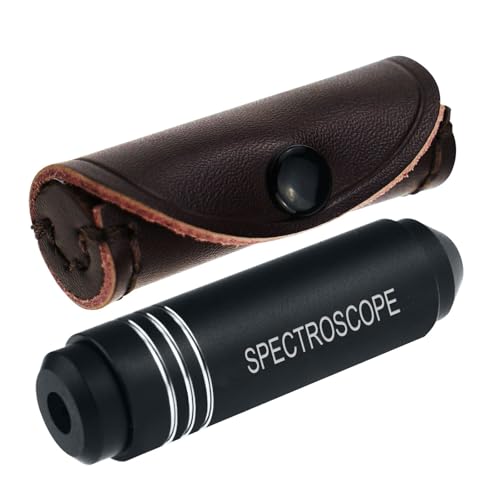
- Pocket-sized and travel-friendly
- Aircraft-aluminum construction
- Designed for gemstone absorption analysis
Best For: Portable gem identification and jewelry inspection
Graduated Direct-View Analyzer
Eisco Direct Vision Spectroscope

- 400–700 nm graduated scale
- Spectrum and scale are viewed together
- Includes three cuvettes
Best For: STEM lessons and visible-light spectral measurement
Classroom Spectrum Set
Eisco Economy Spectroscope Tube 6-Pack

- Six matching spectroscope tubes
- Adjustable rotating slit cap
- No batteries required
Best For: Group optics lessons and classroom demonstrations
Best Overall Quantitative Option – EISCO Premium Quantitative Spectroscope
If you want optical spectroscopes with wavelength scale readings for classroom experiments, light-source comparisons, or basic astronomy, the EISCO Premium Quantitative Spectroscope offers a useful 400–700 nm range and stated ±5 nm accuracy. Its secured diffraction grating and scale are designed to keep readings legible.
Best For: Students, educators, and hobbyists measuring visible spectra from gas tubes, flame tests, and basic astronomy applications.
Pros:
- Measures wavelengths from 400–700 nm.
- Provides stated accuracy of ±5 nm.
- Uses a 500 lines/mm diffraction grating.
- Metal enclosure with a secured grating and scale.
Cons:
- Limited to the visible 400–700 nm range.
- Requires a corded electric power source according to the supplied details.
This is a practical choice when a traditional, readable wavelength scale matters more than digital reporting or extended spectral coverage.
Best Portable Digital Pick – Compact Digital Display Spectrometer
Spectrometer, Precise Spectrometer Portable Multifunctional Digital Display Optical Instruments
Check Price On AmazonFor buyers seeking optical spectroscopes with wavelength scale functionality in a compact format, this portable single-beam spectrometer uses a digital display rather than a traditional printed scale. Its lightweight design is intended for convenient use in laboratories, classrooms, or outdoor experiments.
Best For: Users who prioritize a small, handheld form factor and digital readout for general educational or scientific use.
Pros:
- Compact dimensions of 10 × 5.5 × 2.6 cm.
- Advertised lightweight design at 70 g.
- Clear digital display for reading measurements.
- Designed as a multifunctional, single-beam instrument.
Cons:
- The supplied notes do not specify a wavelength range or measurement accuracy.
- The package dimensions and listed item weight are inconsistent with the stated 70 g product description.
This model may suit portability-focused buyers, but the missing range and accuracy specifications make it harder to compare with calibrated optical spectroscopes.
Best Classic Scale Design – Eisco PH100QA Quantitative Spectroscope
The Eisco PH100QA is a straightforward option among optical spectroscopes with wavelength scale readings. Its black numeric scale covers 400–700 nm, while the held diffraction grating is intended to support clear visual comparisons and readings during classroom or hobbyist experiments.
Best For: Labs, classrooms, and science enthusiasts who want a traditional numeric scale for visible-light measurements.
Pros:
- Numeric wavelength scale spans 400–700 nm.
- Provides stated ±5 nm measurement accuracy.
- Suitable for charged gas tubes, flame tests, and basic astronomy.
- Durable metal construction for frequent use.
Cons:
- Its measurement range is limited to 400–700 nm.
- It provides optical readings rather than digital reports.
Choose this model when you want an uncomplicated, scale-based instrument for learning and routine visible-spectrum observations.
Best Extended-Range Smart Meter – Handheld 340–1000 nm Spectrometer
For applications that need more than the visible range offered by traditional optical spectroscopes with wavelength scale designs, this handheld spectrometer covers 340–1000 nm. It connects with Android devices and includes PC software for measurements and PDF report exports.
Best For: Grow-light and LED testing, CCT/CRI/LUX measurements, and users who want app- or PC-assisted spectral analysis.
Pros:
- Wide 340–1000 nm wavelength coverage.
- Measures CCT, CRI, LUX, PPFD, PAR, and blue light according to the supplied notes.
- Very small 47 × 28 × 25 mm body weighing 23 g.
- Supports Android connectivity and PDF report export through the PC client.
Cons:
- Does not support secondary development.
- PC software does not export spectral data as a table format.
- Uses app or PC connectivity rather than a stated built-in wavelength scale.
This is the strongest fit for modern lighting analysis and extended-range measurements, especially when digital reporting is more useful than reading a printed scale.
Best Two-Piece Set – EISCO Spectroscope Set with 400–700nm Scale
For shoppers comparing optical spectroscopes with wavelength scale, this EISCO set stands out by combining a quantitative instrument with a separate economy viewing tube. The quantitative spectroscope covers 400.0–700.0nm with stated accuracy of ±5.0nm, while both units use 500 lines/mm diffraction gratings.
Best For: Teaching labs, flame tests, gas discharge tubes, basic astronomy, and hobbyists who want both measured readings and quick visual comparisons.
Pros:
- Includes both a Premium Quantitative Spectroscope and an Economy Spectroscope Tube.
- Provides a numbered 400.0–700.0nm wavelength scale.
- Uses 500 lines/mm gratings to help separate nearby spectral lines.
- Designed for repeatable readings without adding a separate taped-on scale.
Cons:
- The quantitative unit’s stated accuracy is ±5.0nm, so it is intended for educational rather than precision laboratory work.
- The set includes two different instruments, which may be more than needed for simple viewing.
This is the most versatile option of the three for hands-on instruction or shared hobby use. Its combination of a readable scale and a second quick-view tube gives buyers more flexibility than a single basic spectroscope.
Best Benchtop Demonstration Model – Physics Spectroscope with Stable Base
Among optical spectroscopes with wavelength scale, this physics spectroscope is positioned as a sturdy classroom and laboratory demonstration instrument. Its metal body, round base, vertical support, and cup-shaped attachment keep the setup supported on a benchtop during experiments.
Best For: Classroom demonstrations and experimental setups where a stable, mounted spectroscope is more useful than a handheld design.
Pros:
- Metal construction with a matte black painted finish.
- Stable round base and vertical support post for benchtop use.
- Three projecting tube sections arranged around a central cylindrical body.
- Includes a cup-shaped attachment for various light-emitter setups.
Cons:
- The supplied notes do not specify a wavelength scale or measurement range.
- At 2.43 pounds and over 10 inches long, it is less portable than a handheld model.
This model makes the most sense when stability and visibility during demonstrations matter more than a documented numerical wavelength range. Buyers specifically seeking a wavelength scale should verify the included features before ordering.
Best Classroom Bulk Pack – Eisco Premium Quantitative Spectroscope 10pk
For classrooms needing multiple optical spectroscopes with wavelength scale, this 10-pack provides a consistent set of Eisco Premium Quantitative Spectroscopes. Each instrument measures wavelengths from 400.0 to 700.0nm and is designed to keep its diffraction grating and scale securely positioned for legible readings.
Best For: STEM instruction, classroom lab groups, flame-test activities, gas-tube experiments, and basic astronomy exercises requiring several student stations.
Pros:
- Includes 10 Premium Quantitative Spectroscopes.
- Offers a 400.0–700.0nm measurement range.
- Suitable for charged gas tubes, flame tests, and basic astronomy applications.
- Securely holds the diffraction grating and scale for readable measurements.
Cons:
- A 10-pack may be excessive for individual hobbyists or small demonstrations.
- The supplied notes do not state the measurement accuracy.
This is the practical choice for educators who want matching equipment across multiple workstations. It offers the clearest quantity advantage here, while the documented wavelength range supports structured STEM exercises.
Pocket Gemstone Analyzer – Handheld Diffraction Spectroscope
For buyers seeking optical spectroscopes with wavelength scale capabilities in a compact format, this handheld diffraction spectroscope is designed for gemstone examination. Its grating reveals absorbed wavelengths as vertical black lines, supporting quick comparisons during gemological work.
Best For: Gemstone identification, jewelry inspection, and portable gemological analysis.
Pros:
- Pocket-sized design is convenient for travel, markets, and trade shows.
- Aircraft-aluminum construction is built for durability.
- Diffraction grating helps display gemstone absorption lines.
- Can assist with identifying stones such as YAG and cubic zirconia.
Cons:
- The supplied details do not specify a numeric wavelength scale range.
- Its compact format is specialized for gemstones rather than broad classroom demonstrations.
This is a practical choice when portability matters more than a large graduated scale. The aluminum body and gemstone-focused design make it particularly suited to jewelers and gem enthusiasts who need a quick inspection tool.
Graduated Direct-View Analyzer – Eisco Direct Vision Spectroscope
This Eisco direct vision spectroscope is a strong fit for shoppers comparing optical spectroscopes with wavelength scale markings. Its graduated 400–700 nm scale is superimposed on the observed spectrum, allowing users to estimate the displacement of visible spectral lines.
Best For: STEM instruction, visible-light demonstrations, and introductory spectral-line measurement.
Pros:
- Includes a visible-spectrum scale marked from 400 to 700 nm.
- Direct-view design lets users observe the spectrum and scale together.
- Metal case provides a more substantial housing for classroom or lab handling.
- Includes three cuvettes.
Cons:
- At 7 × 4.75 × 1.125 inches, it is less pocketable than handheld models.
- The supplied instructions involve manually tilting the slit end to locate lines.
Among these options, this is the clearest match for buyers who specifically want a built-in wavelength scale. Its visible-range markings and direct viewing method make it well suited to guided physics or optics activities.
Classroom Spectrum Set – Eisco Economy Spectroscope Tube 6-Pack
For group activities involving optical spectroscopes with wavelength scale concepts, this six-pack provides matching tubes for classroom demonstrations. Each unit uses a diffraction grating and adjustable rotating slit cap to help students explore visible-light diffraction and constituent wavelengths.
Best For: Classroom optics lessons, student group work, and hands-on science demonstrations.
Pros:
- Six matching spectroscope tubes support simultaneous student use.
- Adjustable rotating slit cap allows control of the diffraction opening.
- Designed for exploring visible-light wavelengths and optical principles.
- Requires no batteries.
Cons:
- The supplied notes do not specify a printed numeric wavelength scale.
- Cardboard and plastic construction may be less protective than a metal-cased instrument.
- Its economy classroom format is less suited to precision gemological analysis.
This set is the practical pick when several learners need their own instrument. It emphasizes quantity, adjustable slit control, and accessible demonstrations rather than a calibrated wavelength-reading experience.
How We Picked the Best Optical Spectroscopes with Wavelength Scale
We compared the listed instruments by wavelength coverage, scale readability, stated accuracy, optical format, portability, construction, and intended use. We also considered whether each model is best suited to demonstrations, student laboratory work, flame and gas-discharge observations, gem inspection, or quantitative light testing.
A clear wavelength scale is especially useful for teaching and basic analysis because it lets users relate spectral lines to approximate nanometer values. Digital models can add measurements such as color temperature, illuminance, or color-rendering data, but they may require more setup and offer a different learning experience than a direct-view optical instrument.
Quick Comparison
- Best for general classroom wavelength measurements: Choose a quantitative model covering approximately 400–700 nm with a numeric scale and stated accuracy.
- Best for group instruction: A multipack gives several students access at once and works well for demonstrations and lab stations.
- Best for flame tests and discharge tubes: Look for a handheld spectroscope with a diffraction grating and a clearly marked visible-spectrum scale.
- Best for broader light testing: A digital spectrometer with a range such as 340–1000 nm may provide more diagnostic data than a basic visible-light viewer.
- Best for field or jewelry work: Pocket-sized or direct-vision designs are easier to carry and use quickly, though they may prioritize convenience over laboratory precision.
Key Buying Factors for Optical Spectroscopes with Wavelength Scale
Wavelength Range and Scale Resolution
Most teaching spectroscopes focus on the visible range, commonly about 400–700 nm. Confirm that the scale includes the part of the spectrum you need and check whether graduations are spaced every 5 nm, marked more broadly, or intended only for visual comparison. A wider range is valuable for specialized light sources, but it does not automatically mean better visible-spectrum accuracy.
Accuracy and Optical Layout
For experiments requiring approximate measurements, a stated accuracy—such as 5 nm—is more useful than an unqualified “high precision” claim. Adjustable slits, stable mounts, diffraction-grating quality, and a well-aligned optical path can improve line visibility. Direct-vision designs are convenient, while more structured optical layouts may be preferable for repeatable demonstrations.
Portability and Durability
Handheld tubes and pocket spectroscopes are practical for field observations, gem inspection, and quick comparisons. Metal cases or sturdier housings can better withstand frequent classroom handling. For shared laboratories, consider whether the instrument includes protective storage and whether replacement or additional units are readily available.
Digital Features
Digital spectrometers may display readings and additional metrics such as CCT, CRI, or LUX. These features suit LED, plant-lighting, and professional testing applications, but they can cost more and may need batteries, calibration, or software. Choose digital functionality only when those measurements support your work.
Who Should Buy Which Optical Spectroscopes with Wavelength Scale?
Teachers and students should prioritize a readable numeric scale, simple operation, and enough units for hands-on work. Science hobbyists can choose a compact diffraction or direct-vision model for observing flames, discharge tubes, and household light sources. Laboratories and lighting testers should consider a digital instrument with a broader range and relevant measurement modes. Jewelers and gem enthusiasts will generally benefit most from a pocket-sized spectroscope that is quick to position and easy to carry.